Questions

5 Marks Questions

Take a timed test

9 questions · 4 auto-graded MCQ + 5 self-marked written.

Question 15 Marks
What is meant by stability of a coordination compound in solution? State the factors which govern stability of complexes.
Answer
The stability of a complex in a solution refers to the degree of association between the two species involved in a state of equilibrium. Stability can be expressed quantitatively in terms of stability constant or formation constant. $\text{M}+3\text{L}\leftarrow\rightarrow\text{ML}_{3}$ Stability constant, $\beta=\frac{[\text{ML}_{3}]}{[\text{M}][\text{L}]^{3}}$ For this reaction, the greater the value of the stability constant, the greater is the proportion of $\ce{ML^3}$ in the solution. Stability can be of two types:
  1. Thermodynamic stability:
The extent to which the complex will be formed or will be transformed into another species at the point of equilibrium is determined by thermodynamic stability.
  1. Kinetic stability:
This helps in determining the speed with which the transformation will occur to attain the state of equilibrium.
Factors that affect the stability of a complex are:
  1. Charge on the central metal ion: Thegreater the charge on the central metal ion, the greater is the stability of the complex.
  2. Basic nature of the ligand: A more basic ligand will form a more stable complex.
  3. Presence of chelate rings: Chelation increases the stability of complexes.
View full question & answer
MCQ 25 Marks
Match the complex ions given in Column $I$ with the hybridisation and number of unpaired electrons given in Column $II$ and assign the correct code:
 
Column $I ($Complex ion$)$
 
Column $II ($Hybridisation, number of unpaired electrons$)$
$a.$ $\ce{[Cr(H_2O)_6]^{3+}}$ $1.$ $dsp^2, 1$
$b.$ $\ce{[Co(CN)_4]^{2-}}$ $2.$ $sp^3d^2, 5$
$c.$ $\ce{[Ni(NH_3)_6]^{2+}}$ $3.$ $d^2sp^3, 3$
$d.$ $\ce{[MnF_6]^{4-}}$ $4.$ $sp^3, 4$
 
 
$5.$
$sp^3d^2, 2$
  • A
    $\ce{A (3), B (1), C (5), D (2)}.$
  • $\ce{A (4), B (3), C (2), D (1)}.$
  • C
    $\ce{A (3), B (2), C (4), D (1)}.$
  • D
    $\ce{A (4), B (1), C (2), D (3)}.$
Answer
Correct option: B.
$\ce{A (4), B (3), C (2), D (1)}.$
View full question & answer
Question 35 Marks
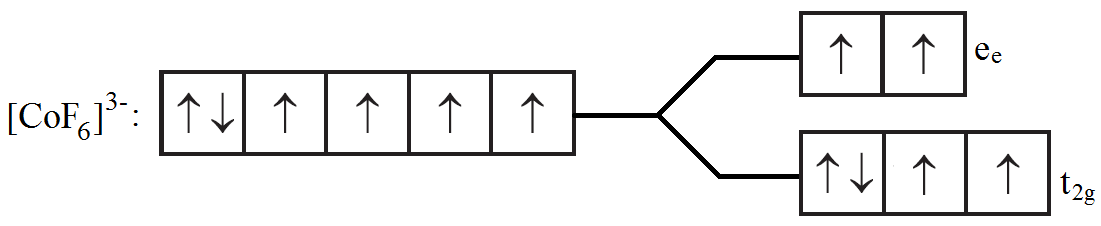
Give the electronic configuration of the following complexes on the basis of Crystal Field Splitting theory. $\ce{[CoF_6]^{3-}, [Fe(CN)_6]^{4-}}$ and $\ce{[Cu(NH_3)_6]^{2+}}$
Answer
According to spectrochemical series related ligands the given complexes can be arranged in a series in the order of increasing field strength as$\ce{- CN^- > NH_{3 }> F^-}$
Thus $CN^-$ and $NH_3$ are strong field ligand pair up the $t_{2g}$ electrons before filling $e_g$ set.
$[\text{CoF}_6]^{3-},\text{Co}^{3+}(\text{d}^6)\text{t}^4_{2\text{g}}\text{e}^2_\text{g},$

$[\text{Fe}(\text{CN})_6]^{4-},\text{Fe}^{2+}(\text{d}^6)\text{t}^6_{2\text{g}}\text{e}^3_\text{g},$

$[\text{Cu}(\text{NH}_3)_6]^{2+},\ \text{Cu}^{2+}(\text{d}^9)\text{t}^6_{2\text{g}}\text{e}^3_\text{g},$
View full question & answer
MCQ 45 Marks
Match the complex ions given in Column $I$ with the colours given in Column $II$ and assign the correct code:
 
Column $I ($Complex ion$)$
 
Column $II ($Colour$)$
$a.$ $[Co(NH_3)_6]^{3+}$ $1.$
Violet
$b.$ $[Ti(H_2O)_6]^{3+}$ $2.$
Green
$c.$ $[Ni(H_2O)_6]^{2+}$ $3.$
Pale blue
$d.$ $[Ni(H_2O)_4(en)]^{2+} (aq)$ $4.$
Yellowish orange
 
 
$5.$
Blue
Code:
  • A
    $\text{A (1), B (2), C (4), D (5).}$
  • B
    $\text{A (4), B (3), C (2), D (1).}$
  • C
    $\text{A (3), B (2), C (4), D (1).}$
  • $\text{A (4), B (1), C (2), D (3).}$
Answer
Correct option: D.
$\text{A (4), B (1), C (2), D (3).}$
 
Column $I ($Complex ion$)$
 
Column $II ($Colour$)$
$a.$ $[Co(NH_3)_6]^{3+}$ $4.$
Yellowish orange
$b.$ $[Ti(H_2O)_6]^{3+}$ $1.$
Violet
$c.$ $[Ni(H_2O)_6]^{2+}$ $2.$
Green
$d.$ $[Ni(H_2O)_4(en)]^{2+} (aq)$ $3.$
Pale blue
View full question & answer
MCQ 55 Marks
Match the coordination compounds given in Column $I$ with the central metal atoms given in Column $II$ and assign the correct code:
 
Column $I ($Coordination Compound$)$
 
Column $II ($Central metal atom$)$
$a.$
Chlorophyll
$1.$
Rhodium
$b.$
Blood pigment
$2.$
Cobalt
$c.$
Wilkinson catalyst
$3.$
Calcium
$d.$
Vitamin $B_{12}$
$4.$
Iron
 
 
$5.$
Magnesium
Code:
  • $\text{A (5), B (4), C (1), D (2).}$
  • B
    $\text{A (3), B (4), C (5), D (1).}$
  • C
    $\text{A (4), B (3), C (2), D (1).}$
  • D
    $\text{A (3), B (4), C (1), D (2).}$
Answer
Correct option: A.
$\text{A (5), B (4), C (1), D (2).}$
 
Column $I ($Coordination Compound$)$
 
Column $II ($Central metal atom$)$
$a.$
Chlorophyll
$5.$
Magnesium
$b.$
Blood pigment
$4.$
Iron
$c.$
Wilkinson catalyst
$1.$
Rhodium
$d.$
Vitamin $B_{12}$
$2.$
Cobalt
View full question & answer
Question 65 Marks
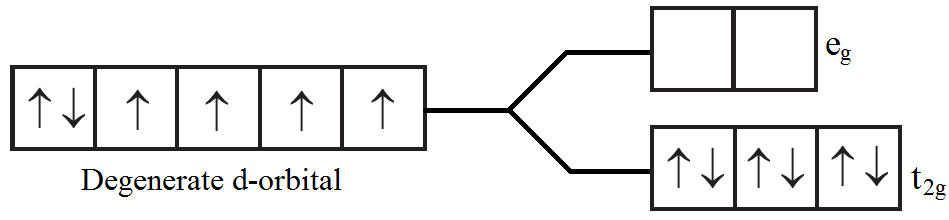
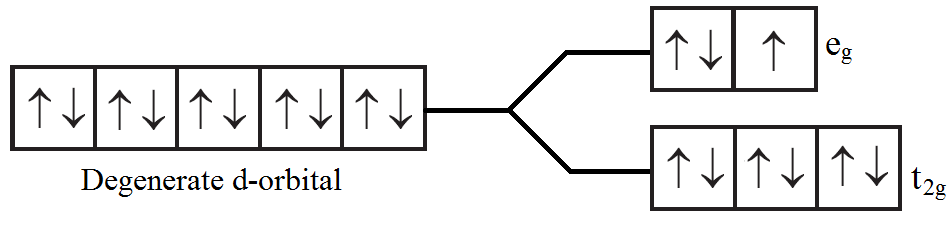
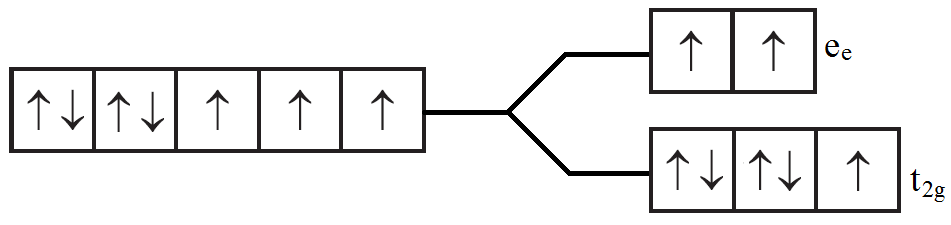
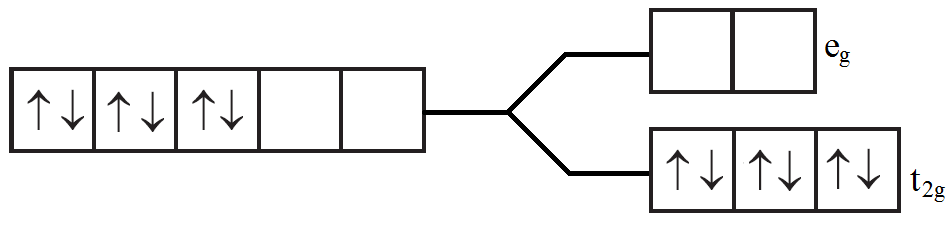
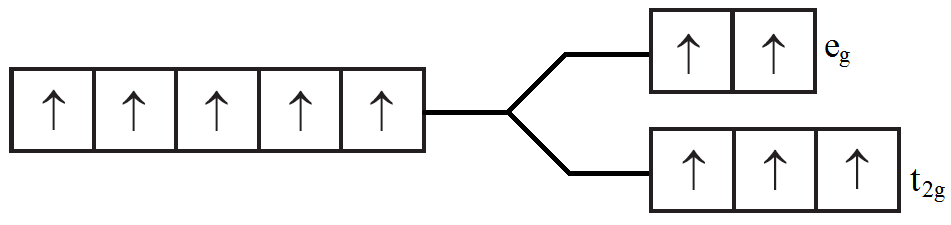
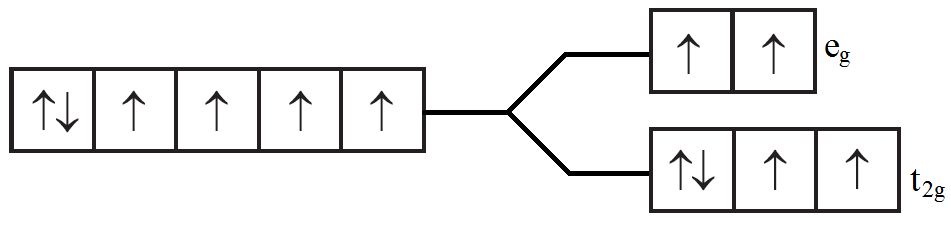
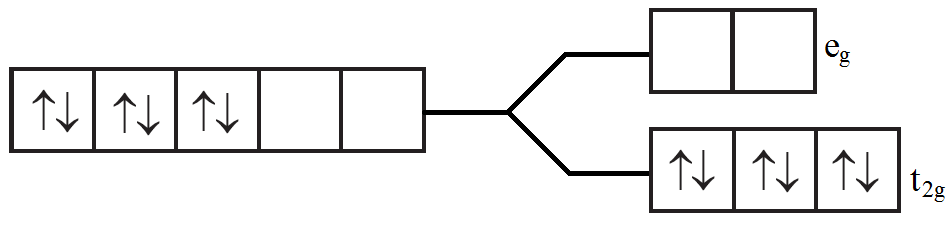
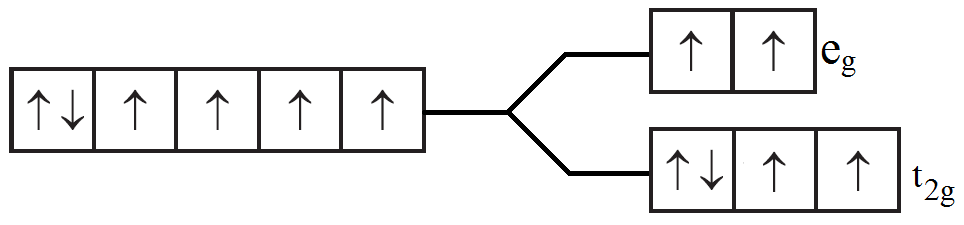
Using crystal field theory, draw energy level diagram, write electronic configuration of the central metal atom/ion and determine the magnetic moment value in the following:
  1. $[\text{CoF}_6]^{3-}, [\text{Co(H}_2\text{O})_6]^{2+}, [\text{Co(CN)}_6]^{3-}$
  2. $[\text{FeF}_6]^{3-}, [\text{Fe(H}_2\text{O})_6]^{2+}, [\text{Fe(CN})_6]^{4-}$
Answer
  1.  

$\text{Co}^{2+}=3\text{d}^7$
Number of unpaired electrons = 4
Magnetic moment
$=\sqrt{\text{n}(\text{n}+2)}=\sqrt{4(4+2)}=4.9\text{B.M.}$
$[\text{Co(H}_2\text{O})_6]^{2+}:$

$\text{Co}^{2+}=3\text{d}^7$
Number of unpaired electrons = 3
Magnetic moment = $\sqrt{3(3+2)}=3.87\text{B.M.}$
$[\text{Co(CN)}_6]^{3-}:$

$\text{Co}^{3+}=3\text{d}^6$
Number of unpaired electrons = 0
Diamagnetic.
  1. $\text{FeF}^{3-}_6:$

$\text{Fe}^{3+}=3\text{d}^5$
Number of unpaired electrons = 5
Magnetic moment = $\sqrt{5(5+2})=5.92\text{B.M.}$
$[\text{Fe(H}_2\text{O})_6]^{2+}:$

$\text{Fe}^{2+}=3\text{d}^6$
Number of unpaired electrons = 4
Magnetic moment = $\sqrt{4(4+2})=4.9\text{B.M.}$
$[\text{Fe(CN)}_6]^{4-}:$

$\text{Fe}^{2+}=3\text{d}^6$
Diamagnetic.
View full question & answer
MCQ 75 Marks
 Match the compounds given in Column $I$ with the oxidation state of cobalt present in it $($given in Column $II)$ and assign the correct code.
 
Column $I ($Compound$)$
 
Column $II ($Oxidation state of $Co)$
$a.$ $\ce{[Co(NCS)(NH_3)_5](SO_3)}$ $1.$ $+4$
$b.$ $\ce{[Co(NH_3)_4Cl_2]SO_4}$ $2.$ $0$
$c.$ $\ce{Na_4[Co(S_2O_3)_3]}$ $3.$ $+1$
$d.$ $\ce{[Co_2(CO)_8]}$ $4.$ $+2$
    $5.$ $+3$
Code:
  • A
    $\ce{A (1), B (2), C (4), D (5).}$
  • B
    $\ce{A (4), B (3), C (2), D (1).}$
  • $\ce{A (5), B (1), C (4), D (2).}$
  • D
    $\ce{A (4), B (1), C (2), D (3).}$
Answer
Correct option: C.
$\ce{A (5), B (1), C (4), D (2).}$
  $Column $I ($Compound$)$   Column $II ($Oxidation state of $Co)$
$a.$ $[Co(NCS)(NH_3)_5](SO_3)$ $5.$ $+3$
$b.$ $[Co(NH_3)_4Cl_2]SO_4$ $1.$ $+4$
$c.$ $Na_4[Co(S_2O_3)_3]$ $4.$ $+2$
$d.$ $[Co_2(CO)_8]$ $2.$ $0$
Explanation:
Oxdiation state of $CMI ($central metal ion$)$ can be calculated by considering the oxidation state of whole molecule is equal to charge present on coordination sphere.
  1. $[Co(NCS)(NH_3)_5]SO_3$
Let oxidation state of $Co$ be $ x.$
$x - 1 + × 0 = +2$
$x = +2 + 1 = +3$
  1. $[Co(NH_3)_4Cl_2]SO_4$
Let oxidation state of $Co = x$
$\Rightarrow x + 4 \times 0 + 2 \times (-1) = +2$
$\Rightarrow x - 2 = +2$
$x = 4$
  1. $Na_4[Co(S_2O_3)_3]$
Let oxidation state of $Co = x$
$x + 3 × (-2) = -4$
$x - 6 = -4$
$x = -4 + 6 = +2$
  1. $[Co(CO)_8]$
Let oxidation state of $Co = x$
$x - 8 × 0 = 0$
$x = 0$
Hence, correct choice is $(c).$
View full question & answer
MCQ 85 Marks
 Match the complex species given in Column $I$ with the possible isomerism given in Column $II$ and assign the correct code:
 
Column $I ($Complex species$)$
 
Column $II ($Isomerism$)$
$a.$ $[Co(NH_3)_4C_{l2}]^+$ $1.$
Optical
$b.$ $cis-[Co(en)_2Cl_2]^+$ $2.$
Ionisation
$c.$ $[Co(NH_3)_5 (NO_2)]Cl_2$ $3.$
Coordination
$d.$ $[Co(NH_3)_6][Cr(CN)_6]$ $4.$
Geometrical
    $5.$
Linkage
Code:
  • A
    $\text{A (1), B (2), C (4), D (5).}$
  • B
    $\text{A (4), B (3), C (2), D (1).}$
  • C
    $\text{A (4), B (1), C (5), D (3).}$
  • D
    $\text{A (4), B (1), C (2), D (3).}$
Answer
 
Column $I ($Complex species$)$
 
Column $II ($Isomerism$)$
$a.$ $[Co(NH_3)_4C_{l2}]^+$ $4.$ Geometrical
$b.$ $cis-[Co(en)_2Cl_2]^+$ $1.$
Optical
$c.$ $[Co(NH_3)_5 (NO_2)]Cl_2$ $2.$
Ionisation
$d.$ $[Co(NH_3)_6][Cr(CN)_6]$ $3.$
Coordination
Explanation:
Isomerism in coordination compound is decided by type of ligands and geometry of coordination and arrangement of ligands.
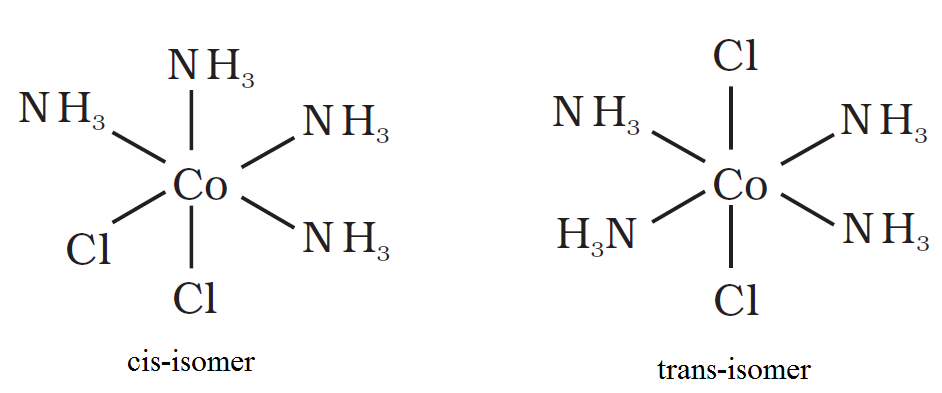
  1. $[Co(NH_3)_4Cl_2]+$ shows geometrical isomerism due to presence of two types of ligand whose $[Co(NH_3)_4Cl_2]+$ arrangement around central metal ion.
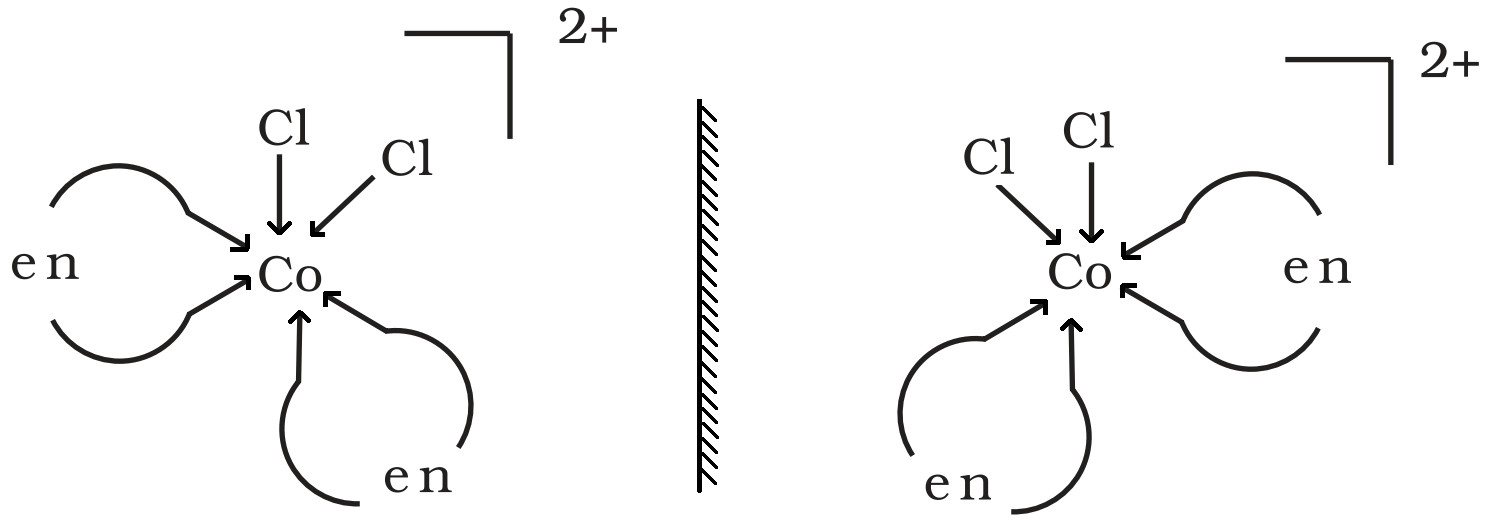
  1. cis$-[Co(en)_2Cl_2]+$ shows optical isomer due to its non$-$superimposable mirror image relationship.
  1. $[Co(NH_3)_5(NO_2)]Cl_2$ shows ionization isomer due to its interchanging ligand from outside the ionization sphere.
  2. $[Co(NH_3)_6][Cr(CN)_6]$ shows coordination isomer due to interchanging of ligand in between two metal ions from one coordination sphere to another coordination sphere.
View full question & answer
Question 95 Marks
$\ce{COSO_4Cl.5NH_3}$ exists in two isomeric forms $‘A’$ and $‘B’$. Isomer $‘A’$ reacts with $\ce{AgNO_3}$ to give white precipitate, but does not react with $\ce{BaCl_2.}$ Isomer $‘B’$ gives white precipitate with $\ce{BaCl_2} $ but does not react with $\ce{AgNO_3}$. Answer the following questions.
  1. Identify $‘A’$ and $‘B’$ and write their structural formulas.
  2. Name the type of isomerism involved.
  3. Give the $\text{IUPAC}$ name of $‘A’$ and $‘B’.$
Answer
$\ce{CoSO_4Cl.5NH_3:}$
  1. Isomer A reacts with $\ce{AgN0_3}$ but not with $\ce{BaCl_2},$ it shows it has $CP$ ion outside the coordination sphere.
Hence, $\ce{A = [Co(NH_3)_5SO_4]Cl}$
Isomer B reacts with $BaCl_2$ but not with $\ce{AgNO_3 }$, it shows it has $\ce{SO_4^-}$ outside the coordination sphere.
Hence, $\ce{B = [CO(NH_3)5Cl]S0_4}$​​​​​​​
  1. Ionisation isomerism.
  2. $A =$ Pentaamminesulphatocobalt $(III)$ chloride and.
$B =$ Pentaamminesulphatocobalt $(III)$ sulphate.
View full question & answer