MCQ
Materials which allow only larger currents to flow through them are:
  • A
    Insulators
  • Semi$-$conductors
  • C
    Conductors
  • D
    Alloys

Answer

Correct option: B.
Semi$-$conductors

Semiconductors in their natural state are poor conductors because a current requires the flow of electrons, and semiconductors have their valence band filled, preventing the entry flow of new electrons.
Thus semi$-$conductors allows a large current to pass through them.

Need a full question paper?

Generate a complete, print-ready paper with questions like this in minutes — across 16+ boards, with answer keys.
Start Generating Free

Similar questions

Complete the equation for the following fission process $92^{\mathrm{U}^{235}}+0^{\mathrm{n}^1} \rightarrow 38^{ \mathrm{Sr}^{90}}+\ldots$
A milliammeter of range $10\, mA$ has a coil of resistance $1 \,\Omega$. To use it as voltmeter of range $10\, volt$, the resistance that must be connected in series with it, will be ............. $\Omega $
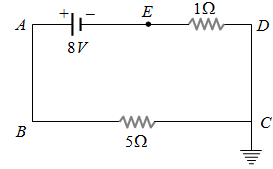
In the given circuit, the potential of the point E is
The number of turns in primary and secondary coils of a transformer are 100 and 20 respectively. If an alternating potential of 200 volt is applied to the primary, the induced potential in secondary will be
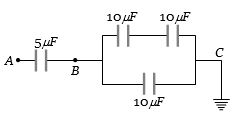
In the given circuit if point $C$ is connected to the earth and a potential of $ + \,2000\,V$ is given to the point $A$, the potential at $B$ is.....$V$
Binding energy of a nucleus is
A coil of wire having finite inductance and resistance has a conducting ring placed coaxially within it. The coil is connected to a battery at time t = 0, so that a time-dependent current $I_1(t)$ starts flowing through the coil. If $I_2(t)$ is the current induced in the ring. and B(t) is the magnetic field at the axis of the coil due to $I_1(t)$, then as a function of time (t > 0), the product $I_2$ (t) B(t)
A monochromatic beam of light of wavelength $400\,nm$ incident normally upon a photosensitive surface ($25\%$ reflects and rest absorbs), produces a pressure of $5 \times 10^{-7}\,Nm^{-2}$ on it. If $0.1\%$ of the incident photons produce electrons then corresponding saturation current will be..............$\mu A$ (consider area of photosensitive surface $= 5\,cm^2$)
In terms of Bohr radius $r_0$, the radius of the second Bohr orbit of a hydrogen atom is given by:
A nucleus of uranium decays at rest into nuclei of thorium and helium. Then :