MCQ
$\mathop {\lim }\limits_{x \to 0} \frac{{{e^{\tan x}} - {e^x}}}{{\tan x - x}} = $
  • $1$
  • B
    $e$
  • C
    ${e^{ - 1}}$
  • D
    $0$

Answer

Correct option: A.
$1$
a
(a) $\mathop {\lim }\limits_{x \to 0} \,\,\frac{{{e^{\tan x}} - {e^x}}}{{\tan x - x}} = \mathop {\lim }\limits_{x \to 0} \,\,\frac{{{e^x}[{e^{\tan x - x}} - 1]}}{{\tan x - x}}$

$ = \mathop {\lim }\limits_{x \to 0} \,{e^x}\,.\mathop {\lim }\limits_{x \to 0} \,\frac{{{e^{\tan x - x}} - 1}}{{\tan x - x}} = {e^0} \times 1 = 1$.

Need a full question paper?

Generate a complete, print-ready paper with questions like this in minutes — across 16+ boards, with answer keys.
Start Generating Free

Similar questions

If $f(x)$ $=\int\limits_{9{x^2}}^{{x^4}} {{5^{\sqrt t }}} dt$ , then $\mathop {\lim }\limits_{h \to 0} $ $\frac{{f(3 + h) - f(3 - h)}}{h}$ is equal to
The expression $\frac{2^2+1}{2^2-1}+\frac{3^2+1}{3^2-1}+\frac{4^2+1}{4^2-1}+\ldots+\frac{(2011)^2+1}{(2011)^2-1}$ lies in the interval
If three dice are throw simultaneously, then the probability of getting a score of 5 is:
If $x = {\log _5}(1000)$ and $y = {\log _7}(2058)$ then
Number of values of $ x \in \left[ {0,2\pi } \right]$ satisfying the equation $cotx - cosx = 1 - cotx. cosx$
A bag contains $6$ white and $4$ black balls. A die is rolled once and the number of balls equal to the number obtained on the die are drawn from the bag at random. The probability that all the balls drawn are white is:
Consider the experiment of rolling a die. Let $A$ be the event 'getting a prime number ', $B$ be the event 'getting an odd number '. Write the sets representing the events $A$ or $B$.
The number of integral points (integral point means both the coordinates should be integer) exactly in the interior of the triangle with vertices $(0, 0), (0, 21)$ and $(21, 0)$, is
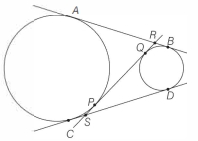
Suppose $S_1$ and $S_2$ are two unequal circles, $A B$ and $C D$ are the direct common tangents to these circles. A transverse common tangent $P Q$ cuts $A B$ in $R$ and $C D$ in $S$. If $A B=10$, then $R S$ is
If $a, b, c$ are in harmonic progression, then straight line $\frac{x}{a} + \frac{y}{b} + \frac{1}{c} = 0$ always passes through a fixed point, that point is