Maximum force of friction is called
Easy
Download our app for free and get started
(a)
Limiting friction is maximum force of friction.

Download our appand get started for free
Experience the future of education. Simply download our apps or reach out to us for more information. Let's shape the future of learning together!No signup needed.*
Similar Questions
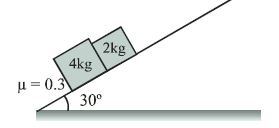
- 1Two blocks, $4\, kg$ and $2\, kg$ are sliding down an inclined plane as shown in figure. The acceleration of $2\, kg$ block is ........ $m/s^2$View Solution
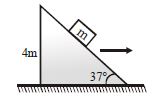
- 2If the coefficient of friction between block & wedge is $\mu $, then the maximum horizontal acceleration of the wedge for which block will remain at rest w.r.t. the wedge isView Solution
- 3A cyclist goes round a circular path of circumference $34.3\, m$ in $\sqrt {22} $ sec. the angle made by him, with the vertical, will be ....... $^o$View Solution
- 4$Assertion$ : Mountain roads rarely go straight up the slope.View Solution
$Reason$ : Slope of mountains are large, therefore more chances of vehicle to slip from roads - 5A car is moving with a constant speed of $20\,m / s$ in a circular horizontal track of radius $40\,m$. A bob is suspended from the roof of the car by a massless string. The angle made by the string with the vertical will be : (Take $g =10$ $\left.m / s ^2\right)$View Solution
- 6A body of mass $'m '$ is tied to one end of a spring and whirled round in a horizontal plane with a constant angular velocity. The elongation in the spring is $1\, cm$. If the angular velocity is doubled, the elongation in the spring is $5\, cm$. The original length of the spring is ......... $cm$View Solution
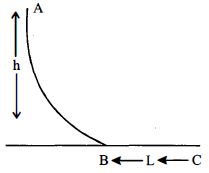
- 7A small ball of mass $m$ starts at a point $A$ with speed $v_0$ and moves along a frictionless track $AB$ as shown. The track $BC$ has coefficient of friction $\mu $. The ball comes to stop at $C$ after travelling a distance $L$ which isView Solution
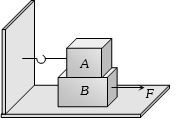
- 8A block A with mass $100\, kg $ is resting on another block $B$ of mass $200\, kg$. As shown in figure a horizontal rope tied to a wall holds it. The coefficient of friction between $A$ and $B$ is $ 0.2 $ while coefficient of friction between $B$ and the ground is $0.3$. The minimum required force $F$ to start moving $B$ will be ........ $N$View Solution
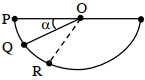
- 9A ball is released from rest from point $P$ of a smooth semi-spherical vessel as shown in figure. The ratio of the centripetal force and normal reaction on the ball at point $Q$ is $A$ while angular position of point $Q$ is $\alpha$ with respect to point $P$. Which of the following graphs represent the correct relation between $A$ and $\alpha$ when ball goes from $Q$ to $R$ ?View Solution
- 10A block of mass $M$ is being pulled along rough horizontal surface. The coefficient of friction between the block and the surface is $\mu $. If another block of mass $M/2$ is placed on the block and it is again pulled on the surface, the coefficient of friction between the block and the surface will beView Solution