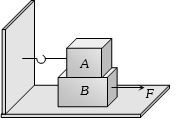
A block A with mass $100\, kg $ is resting on another block $B$ of mass $200\, kg$. As shown in figure a horizontal rope tied to a wall holds it. The coefficient of friction between $A$ and $B$ is $ 0.2 $ while coefficient of friction between $B$ and the ground is $0.3$. The minimum required force $F$ to start moving $B$ will be ........ $N$
Medium
Download our app for free and get started
(c) $F = {f_{AB}} + {f_{BG}}$
$ = {\mu _{AB}}{m_a}g + {\mu _{BG}}({m_A} + {m_B})g$
$ = 0.2 \times 100 \times 10 + 0.3(300) \times 10$ $ = 200 + 900 = 1100\;N$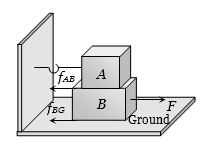

Download our appand get started for free
Experience the future of education. Simply download our apps or reach out to us for more information. Let's shape the future of learning together!No signup needed.*
Similar Questions
- 1$A$ block of mass $M$ is placed on $a$ horizontal surface and it is tied with an inextensible string to $a$ block of mass, as shown in figure. A block of mass $m_0$ is also placed on $M$ If friction force exists between the block $M$ and the block $m_0$ and not between the block $M$ and the horizontal surface, then the minimum value of $\mu$ for which the block m remains stationary isView Solution

- 2A block slides down on incline of angle $30^o$ with an acceleration $\frac{g}{4}$. Find the coefficient of kinetic frictionView Solution
- 3A train is moving with a speed of $12 \mathrm{~m} / \mathrm{s}$ on rails which are $1.5 \mathrm{~m}$ apart. To negotiate a curve radius $400 \mathrm{~m}$, the height by which the outer rail should be raised with respect to the inner rail is (Given, $g=$ $10 \mathrm{~m} / \mathrm{s}^2$ ) :View Solution
- 4Starting from rest a body slides down a $45^o$ inclined plane in twice the time it takes to slide down the same distance in the absence of friction. The co-efficient of friction between the body and the inclined plane isView Solution
- 5Starting from rest, a body slides down a $45^°$ inclined plane in twice the time it takes to slide down the same distance in the absence of friction. The coefficient of friction between the body and the inclined plane isView Solution
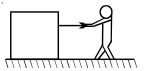
- 6View SolutionA man pulls a block heavier than himself with a light horizontal rope. The coefficient of friction is the same between the man and the ground, and between the block and the ground
- 7A body of mass $5\, kg$ is moving in a circle of radius $1\,m$ with an angular velocity of $2$ radian/sec. The centripetal force is ......... $N$View Solution
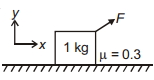
- 8A force $\vec{F}=\hat{i}+4 \hat{j}$ acts on the block shown. The force of friction acting on the block isView Solution
- 9A block rests on a rough inclined plane making an angle of ${30^o}$ with the horizontal. The coefficient of static friction between the block and the plane is $0.8$. If the frictional force on the block is $10 \,N$, the mass of the block (in kg) is (take $g = 10\,\,m/{s^2})$View Solution
- 10View SolutionA metal block is resting on a rough wooden surface. A horizontal force applied to the block is increased uniformly. Which of the following curves correctly represents velocity of the block ?