Maximum kinetic energy of the positive ion in the cyclotron is
Medium


Download our appand get started for free
Experience the future of education. Simply download our apps or reach out to us for more information. Let's shape the future of learning together!No signup needed.*
Similar Questions
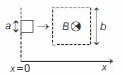
- 1A square-shaped conducting wire loop of dimension moving parallel to the $X$-axis approaches a square region of size $b(a < b)$, where a uniform magnetic field $B$ exists pointing into the plane of the paper (see figure). As the loop passes through this region, the plot correctly depicting its speed $v$ as a function of $x$ isView Solution
- 2Two parallel beams of protons and electrons, carrying equal currents are fixed at a separation $d$. The protons and electrons move in opposite directions. $P$ is a point on a line joining the beams, at a distance $x$ from any one beam. The magnetic field at $P$ is $B$. If $B$ is plotted against $x$, which of the following best represents the resulting curveView Solution
- 3A particle carrying a charge equal to $100$ times the charge on an electron is rotating per second in a circular path of radius $0.8$ $metre$. The value of the magnetic field produced at the centre will be $({\mu _0} = $ permeability for vacuum)View Solution
- 4To Verify Ohm's law, a student is provided with a test resistor $\mathrm{R}_{\mathrm{T}}$, a high resistance $\mathrm{R}_1$, a small resistance $\mathrm{R}_2$, two identical galvanometers $\mathrm{G}_1$ and $\mathrm{G}_2$, and a variable voltage source $\mathrm{V}$. The correct circuit to carry out the experiment isView Solution
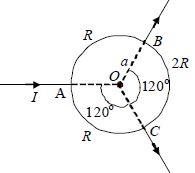
- 5The resistances of three parts of a circular loop are as shown in the figure. The magnetic field at the centre $O$ is :-View Solution
- 6A rectangular coil (Dimension $5\,cm\times 2\,cm$ ) with $100\,turns,$ carrying a current of $3\,A$ in the clock-wise direction, is kept centered at the origin and in the $X-Z$ plane. A magnetic field of $1\,T$ is applied along $X-$ axis. If the coil is tilted through $45^o$ about $Z-$ axis, then the torque on the coil is.....$Nm$View Solution
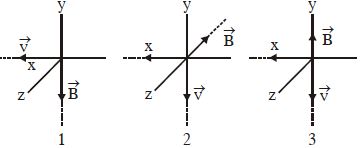
- 7The figure shows three situations when an electron moves with velocity $\vec v$ travels through a uniform magnetic field $\vec B$. In each case, what is the direction of magnetic force on the electronView Solution
- 8A square current carrying loop is suspended in a uniform magnetic field acting in the plane of the loop. If the force on one arm of the loop is $\overrightarrow F$ the net force on the remaining three arms of the loop isView Solution
- 9View SolutionThe direction of magnetic lines of forces close to a straight conductor carrying current will be
- 10The region between $y = 0$ and $y = d$ contains a magnetic field $\vec B = B\hat z$ A particle of mass $m$ and charge $q$ enters the region with a velocity $\vec v = v\hat i$. If $d = \frac{{mv}}{{2qB}}$ , the acceleration of the charged particle at the point of its emergence at the other side isView Solution