MCQ
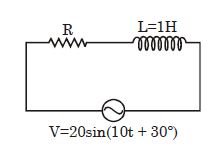
Maximum power loss across the circuit can be.......$W$
  • A
    $400$
  • B
    $100$
  • C
    $20$
  • $10$

Answer

Correct option: D.
$10$
d
Powerless across circuit is maximum when

$\mathrm{R}=\mathrm{X}_{\mathrm{L}}=10\, \Omega$

${P_{\max }} = \frac{{V_{rms}^2}}{{2R}} = \frac{{V_0^2}}{{4R}} = \frac{{{{(20)}^2}}}{{4 \times 10}} = 10{\mkern 1mu} {\rm{W}}$

Need a full question paper?

Generate a complete, print-ready paper with questions like this in minutes — across 16+ boards, with answer keys.
Start Generating Free

Similar questions

A lens of power $+ 2$ diopters is placed in contact with a lens of power $-1$ diopter. The combination will behave like
Antimony and bismuth are usually used in a thermocouple, because
An $\alpha$ particle and a proton are accelerated from rest through the same potential difference. The ratio of linear momenta acquired by above two particals will be.
Three concentric metallic spherical shell $A, B$ and $C$ or radii $a, b$ and $c$ $(a < b < c)$ have surface charge densities $- \sigma , + \sigma ,$ and $- \sigma $ respectively. The potential of shell $A$ is :
Energy of the electron in $n^{\text {th }}$ orbit of hydrogen atom is given by $E_n=-\frac{13.6}{n^2} e V$. The amount of energy needed to transfer electron from first orbit to third orbit is
A $20 \,cm$ length of a certain solution causes right-handed rotation of $38^o $. A $30\,cm $ length of another solution causes left-handed rotation of $24^o $. The optical rotation caused by $30\,cm$ length of a mixture of the above solutions in the volume ratio $1 : 2$ is
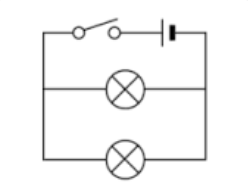
Which of the following component is connected in parallel in the circuit?
An electron $($mass $=9 \times 10^{-31} \mathrm{~kg}$. Charge $=1.6 \times 10^{-19} \mathrm{C}$ ) whose kinetic energy is $7.2 \times 10^{-18}$ joule is moving in a circular orbit in a magnetic field of $9 \times 10^{-5} \mathrm{weber} / \mathrm{m}^2$. The radius of the orbit is
The current flowing through a conductor connected across a source is $2\,A$ and $1.2\,A$ at $0^{\circ}\,C$ and $100^{\circ}\,C$ respectively. The current flowing through the conductor at $50^{\circ}\,C$ will be $......\times 10^2\,mA$.
Intensity of light depends upon