MCQ
$(Me)_2\, SiCl_2$ on condensation after hydrolysis will produce
- A$Si(OH)_4$
- B$(Me)_2 \,Si = O$
- ✓$[—O—(Me)_2\, Si—O—]_n$
- D$Me_2 \,SiCl(OH)$
Generate a complete, print-ready paper with questions like this in minutes — across 16+ boards, with answer keys.
Assertion $A$ : The first ionization enthalpy for oxygen is lower than that of nitrogen.
Reason $R$ : The four electrons in $2 p$ orbitals of oxygen experience more electron-electron repulsion.
In the light of the above statements, choose the correct answer from the options given below.
| Experiment |
$[A]$ (in $mol\, L^{-1})$ |
$[B]$ (in $mol\, L^{-1})$ |
Initial rate of reaction (in $mol\, L^{-1}\,min^{-1})$ |
| $I$ | $0.10$ | $0.20$ | $6.93 \times {10^{ - 3}}$ |
| $II$ | $0.10$ | $0.25$ | $6.93 \times {10^{ - 3}}$ |
| $III$ | $0.20$ | $0.30$ | $1.386 \times {10^{ - 2}}$ |
The time(in minutes) required to consume half of $A$ is

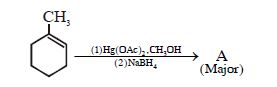
$(A)$ the reaction of $Al _2 O _3$ with coke ($C$) at a temperature $>2500^{\circ} C$.
$(B)$ the neutralization of aluminate solution by passing $CO _2$ gas to precipitate hydrated alumina $\left( Al _2 O _3 .3 H _2 O \right)$
$(C)$ the dissolution of $Al _2 O _3$ in hot aqueous $NaOH$.
$(D)$ the electrolysis of $Al _2 O _3$ mixed with $Na _3 AlF _6$ to give $Al$ and $CO _2$.