Meena applies the front brakes, while riding on her bicycle along a flat road. The force that slows her bicycle is provided by the
KVPY 2020, Medium


Download our appand get started for free
Experience the future of education. Simply download our apps or reach out to us for more information. Let's shape the future of learning together!No signup needed.*
Similar Questions
- 1The maximum speed that can be achieved without skidding by a car on a circular unbanked road of radius $R$ and coefficient of static friction $\mu $, isView Solution
- 2A block of mass $10\, kg$ moving at $10\,m/s$ is released to slide on rough surface having coefficient of friction $0.2.$ It will stop by travelling distance ........ $m$View Solution
- 3A plank is resting on a horizontal ground in the northern hemisphere of the earth at a $45^{\circ}$ latitude. Let the angular speed of the earth be $\omega$ and its radius $r_e$. The magnitude of the frictional force on the plank will beView Solution
- 4A small block starts slipping down from a point $B$ on an inclined plane $A B,$ which is making an angle $\theta$ with the horizontal section $BC$ is smooth and the remaining section $CA$ is rough with a coefficient of friction $\mu .$ It is found that the block comes to rest as it reaches the bottom (point $A)$ of the inclined plane. If $B C=2A C$, the coefficient of friction is given by $\mu=k \tan \theta$ .The value of $k$ isView Solution
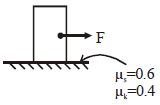
- 5$10\, kg$ block is placed as shown, if $F = 50$ newton find friction force ............ $N$View Solution
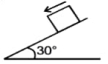
- 6A block of mass $10 \,kg$ is released on rough incline plane. Block start descending with acceleration $2 \,m / s ^2$. Kinetic friction force acting on block is ..... $N$ (take $g=10 \,m / s ^2$ )View Solution
- 7Radius of the curved road on national highway is $R$. Width of the road is $b$. The outer edge of the road is raised by $h$ with respect to inner edge so that a car with velocity $v$ can pass safe over it. The value of $h$ isView Solution
- 8Consider a car moving on a straight road with a speed of $100\, m/s$. The distance at which car can be stopped, is ........ $m$. $[\mu_k = 0.5]$View Solution
- 9A railway line is taken round a circular arc of radius $1000\ m$ , and is banked by raising the outer rail $h$ $m$ above the inner rail. If the lateral force on the inner rail when a train travels round the curve at $10\ ms^{-1}$ is equal to the lateral force on the outer rail when the train's speed is $20\ ms^{-1}$ . The value of $4g\ tan\theta $ is equal to : (The distance between the rails is $1.5\ m$ )View Solution
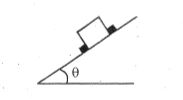
- 10View SolutionA block is stationary on a rough inclined plane. How many forces are acting on the block?