Question
A part of the early classification of elements has been given below:$\text{H}\ \ \ \ \ \ \ \text{Li} \ \ \ \ \ \ \ \text{Be} \ \ \ \ \ \ \ \ \ \text{B}\ \ \ \ \ \ \ \text{C}\ \ \ \ \ \ \ \text{N}\ \ \ \ \ \ \ \text{O}\\\text{F}\ \ \ \ \ \ \ \text{Na}\ \ \ \ \ \ \text{Mg}\ \ \ \ \ \ \ \text{Al}\ \ \ \ \ \ \text{Si}\ \ \ \ \ \ \ \text{P}\ \ \ \ \ \ \ \ \text{S}$
  1. Which law of classification of element is illustrated by the above arrangement of elements?
  2. Name the scientist who proposed such a classification of elements.
  3. Why is such a classification of elements compared with a characteristics of musical scale?
  4. State one limitation of this classification of elements.
Answer

  1. Newlands' law of octaves is illustrated by the above arrangement of elements.
  2. John Newlands is the scientist who proposed this classification of elements.
  3. This classification is compared with a characteristic of the musical scale because the repetition of the properties of elements is just like the repetition of the eighth note in an octave of music.
  1. Limitation:
Newlands' law of octaves could only be applied up to the element calcium.

Need a full question paper?

Generate a complete, print-ready paper with questions like this in minutes — across 16+ boards, with answer keys.

Start Generating Free

Similar questions

Draw the diagram of a flower and label the four whorls. Write the names of gamete producing organs in the flower.
  1. Give one example each of a unisexual and a bisexual flower.
  2. Mention the changes a flower undergoes after fertilisation.
  3. How does the amount of DNA remain constant though each new generation is a combination of DNA copies of two individuals?
  1. Suggest an explanation for the fact that the chemicals produced by endocrine glands arc usually in the form of small molecules.
  2. Write any three endocrine glands and chemically produced by them.
Draw a labelled diagram of the human digestive system. With the help of this diagram, describe the process of digestion of food in man (humans).
i. Explain by giving one example each:
a. Unisexual flowers
b. Bisexual flowers
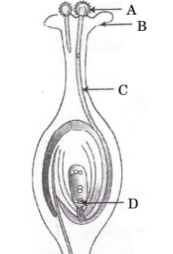
ii. Name the labelled parts A, B, C and D in the diagram given below.
Image
iii. Pollination may occur without fertilisation but fertilisation will not take place without pollination. Give reason to justify this statement.
State the basic requirements for sexual reproduction? Write the importance of such reproduction in nature?
  1. Explain the role of placenta in the development of human embryo.
  2. Give example of two bacterial and two viral sexually transmitted diseases. Name the most effective contraceptive which prevents spread of such diseases.
Draw a neat and labeled diagram showing longitudinal section of a bisexual flower.
When ethanoic acid reacts with sodium hydrogencarbonate, then a salt X is formed and a gas Y is evolved.
Name the salt X and gas Y. Describe an activity with the help of a labelled diagram of the apparatus used to prove that the evolved gas is the one which you have named. Also write the chemical equation of the reaction involved.
How does food prepared by leaves is utilized by roots? Explain.