Question
Mention any two autosomal genetic disorders with their symptoms.

Answer

Sickle Cell Anaemia and Phenyl ketonuria are the two autosomal genetic disorders as described below:
(i) Sickle Cell Anaemia: The red colour of Red blood cells (RBCs) is due to presence of a specific pigment named Haemoglobin which acts as carrier of oxygen and transports oxygen from respiratory surface to various cells of body. As blood becomes deficit of Haemoglobin. It loses it's ability to transport oxygen and this state is known as Annemia. Under low oxygen availability, molecular structure of haemoglobin is deformed so that RBCs become sickle shaped and unable to transport oxygen due to its deformed shaped this is why it is called sickle cell anaemia.
(ii) Phenylketonuria: This inborn error of metabolism is also inherited as the autosomal recessive trait caused due to lack of an enzyme phenylalanine hydroxylase that converts phenylalanine into tyrosine amino acid.
→ This phenylalanine, and its derivatives like phenylpyruvic acid therefore accumulate in blood and tissue, especially in cerebrospinal fluid (CSF) causing mental retardation and also get excreted in urine. This condition is known as Phenylketonuria.
→ The gene that controls the synthesis of enzymes is located on chromosome 12 (chromosome of C-group) in human being.
→ It has been seen that this disease occurs in about 1 in 18000 individuals.
Need a full question paper?

Generate a complete, print-ready paper with questions like this in minutes — across 16+ boards, with answer keys.

Start Generating Free

Similar questions

Explain evolution with the help of its embryological evidences.###Explain evidence from embryology in evolution.
  1. Write an equation for Verhaulst-Pearl Logistic Growth, where.

N - Population density at a timet E.

r - Intrinsic rate of natural increase.

K - Carrying Capacity.

  1. Draw a graph for a population whose population density has reached the carrying capacity.
  2. Why is this logistic growth model considered a more realistic one for most animal populations?
  3. Draw a growth curve where resources are not limiting to growth of a population.
Work out a monohybrid cross upto F, generation, between two pea plants and two Antirrhinum plants, both having contrasting traits with respect to colour of flower. Comment on the patterns of inheritance in the crosses carried above.
Differentiate between the genetic codes given below:
  1. Unambiguous and Universal.
  2. Degenerate and Initiator.
What are the various advantages of using genetically modified plants to increase the overall yield of the crop?
Describe the mechanism of pattern of inheritance of ABO blood groups in humans.
Unless the vector and source DNAs are cut, fragments separated and joined, the desired recombinant vector molecules cannot be created.
  1. How are the desired DNA sequences cut?
  2. Explain the technique used to separate the cut fragments.
  3. How are the resultant fragments joined to the vector molecule?
Bioreactors are the inclusion carriers in any biotechnology based production process. The ultimate success of any biotechnological technique depends on the efficiency of the bioreactor due to large scale production and economy.
In the context of the above passage, answer the following questions :
(i) For optimization of a bioreactor system, list possible operating instructions (rules). Make a list of any four.
(ii) "Optimal growth and metabolic activities of cells." Mention the stages of growth mentioned in.
(iii) Is the bioproduct formed in the bioreactor completely ready for immediate use as desired? Write the appropriate reasons also to support your answer.
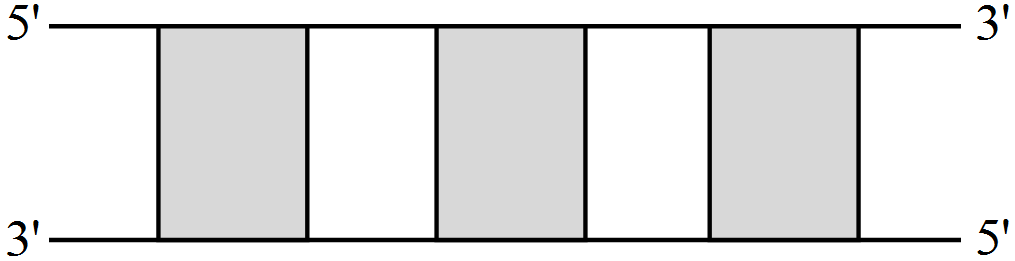
Illustration below is a DNA segment, which constitutes a gene:

  1. Name the shaded and unshaded regions of gene.
  2. Explain how these genes are expressed.
  3. How is this gene different from prokaryotic gene in its expression?
a. Draw the embryo sac of a flowering plant and label the following:
i. Central cell
ii. Chalazal end
iii. Synergids
b. Name the cell and explain the process it undergoes to develop into an embryo sac.
c. Explain the development of endosperm in coconut.