MCQ
Mention the correct relationship between $I$ and $II$
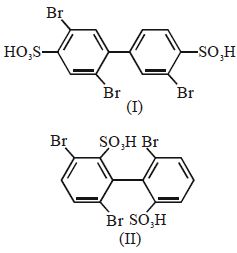
- AChain isomer
- ✓Position isomer
- CIdentical
- DStereoisomer
Generate a complete, print-ready paper with questions like this in minutes — across 16+ boards, with answer keys.
$A(g) + B(g) \to C(g)$ $\Delta U=\,-\,3\,Kcal$
$\Delta S=\,-\,10\,cal/K$
value of $\Delta G$ will be ......$cal$
$(A)$ The decreasing order of atomic radii of group $13$ elements is $\mathrm{Tl}>\mathrm{In}>\mathrm{Ga}>\mathrm{Al}>\mathrm{B}$.
$(B)$ Down the group $13$ electronegativity decreases from top to bottom.
$(C)$ $\mathrm{Al}$ dissolves in dil. $\mathrm{HCl}$ and liberate $\mathrm{H}_2$ but conc. $\mathrm{HNO}_3$ renders Al passive by forming a protective oxide layer on the surface.
$(D)$ All elements of group 13 exhibits highly stable +1 oxidation state.
$(E)$ Hybridisation of $\mathrm{Al}$ in $\left[\mathrm{Al}\left(\mathrm{H}_2 \mathrm{O}\right)_6\right]^{3+}$ ion is $\mathrm{sp}^3 \mathrm{~d}^2$.
Choose the correct answer from the options given below: