Question
Mention the defects of human vision and describe the method to remove them.

Answer

The eye, as any other organ can suffer from problems or defects. we will consider four kinds of defects of vision, viz., short-sightedness or myopia; long-sighedness or hypermetropia; presbyopia; and astigmatism.
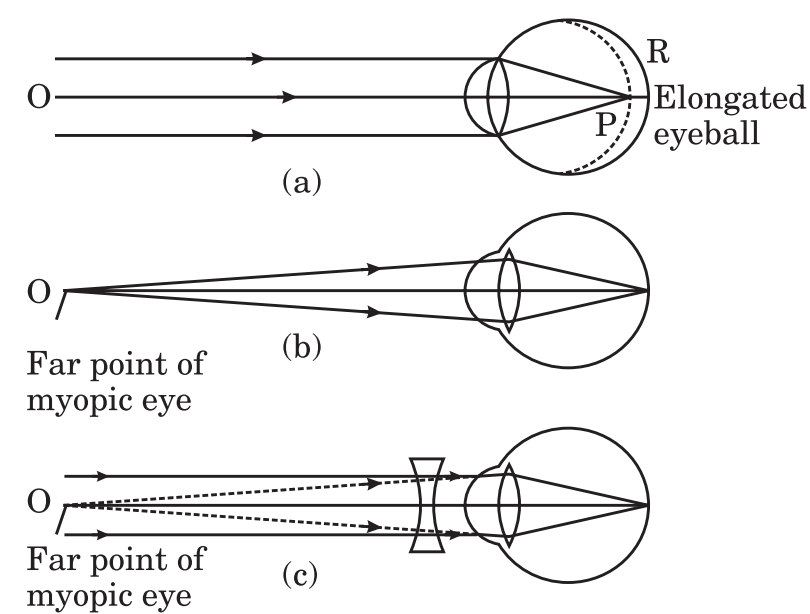
Short sightedness or Myopiya : This defect is also known as nearsightedness. A short-sighted person cannot see objects placed beyond a certain distance from the eye. This distance is the short-sighted eye's far point. Nearsightedness can occur because (a) the eyeball is elongated, i.e., the distance between the lens and then retina is greater than normal, or (b) the maximum focal length of the lens (when the eye is relaxed) is less than usual.
Image
The result is that a parallel beam of light froma distant object converges short of the retina [Figure (a)]. However, a divergent beam from any point closer than the far point converges on the retina [Figure (b)]. This defect can be corrected by using a concave lens of appropriate focal length. The lens should be such that parallel rays from a distant object appear to come from the far point of the eye after refraction from it [(c)]. Suppose the focal length of the lens to be used is $f$. Then $u$ $=-\infty$ and $v=-d$ (the distance of the far point O from the concave lens), and from the lens formula,
$\frac{1}{-d}-\frac{1}{\infty}=\frac{1}{f} \Rightarrow f=-d$ ...(i)
The negative sign of the focal length shows that the lens is concave. The focal length of the lens should be equal to the distance of the far point of the eye.
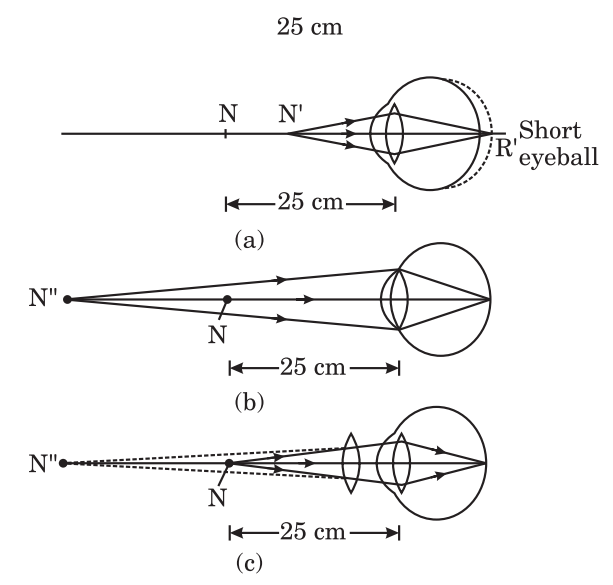
Long-sightedness or hypermetropia : The defect is also known as farsightedness or hypermetropia. The eye, in this case, cannot see objects within a certain distance from the eye. The minimum distance beyond which it can see clearly without straining is its near point. The possible causes of this defect are (a) the shortening of th eyeball, i.e., the distance between the lens and the retina is less than normal, or (2) the focal length of the lens is greater than usual.
Consequently, rays from any point, N', which is closer than the near point, N, converge behind the retina [Figure (a)], while rays from all points, N', beyond the near point converge on the retina [Figure (b)]. This defect can be corrected by using a convex lens of the appropriate focal length to make the divergent rays from an object placed at the normal near point, N, converge on the retina after refraction by the convex lens. Then rays from the object appear to come from the point N', the near point of the defective eye, and can be seen clearly [Figure (c)].
Image
Suppose the focal length of the convex lens used is $f$. Then $u =- D$ and $v=-d$ the distance of the near point N' from the convex lens.) Thus, from the lens formula,
$\frac{1}{f}=\frac{1}{-d}-\frac{1}{- D }=\frac{d- D }{ D d} \Rightarrow f=\frac{ D d}{d- D }$ ...(ii)
In equation (ii), as d > D the focal length is positive, which shows that the lens used is convex. Since the image of an object placed at the normal near point is formed at the near point N' of the defective eye, the image of any object situated between N and N' wil be formed beyond the near point of the defective eye and seen clearly due to the eye's accomodating power.
Presbyopia : In old age, the understanding capacity of the eye lens decreases. Therefore, neither objects that are very close nor that are very far away are clearly visible. This defect of the eye is called presbyopia. This defect can be removed by using bifocal lenses.
Astigmatism : An eye with astimatism cannot see horizontal and vertical lines located at equal distances with equal clearity. This defect arises due to unequal curvatures of the vertical or horizontal parts of the cornea or retina. This defect is rectified by the use of cylindrical lenses.

Need a full question paper?

Generate a complete, print-ready paper with questions like this in minutes — across 16+ boards, with answer keys.
Start Generating Free

Similar questions

An object is placed at a distance of 30cm from a converging lens of focal length 15cm. A normal eye (near point 25cm, far point infinity) is placed close to the lens on the other side.
  1.  Can the eye see the object clearly?
  2.  What should be the minimum separation between the lens and the eye so that the eye can clearly see the object?
  3.  Can a diverging lens, placed in contact with the converging lens, help in seeing the object clearly when the eye is close to the lens?
In an agricultural experiment, a solution containing 1 mole of a radioactive material $\Big(\text{t}_{\frac{1}{2}}=14.3\text{ days}\Big)$ was injected into the roots of a plant. The plant was allowed 70 hours to settle down and then activity was measured in its fruit. If the activity measured was $1\mu\text{Ci},$ what per cent of activity is transmitted from the root to the fruit in steady state?
A town has a population of $1$ million. The average electric power needed per person is $300W$. A reactor is to be designed to supply power to this town. The efficiency with which thermal power is converted into electric power is aimed at $25\%$.
  1. Assuming $200\ \text{MeV}$ to thermal energy to come from each fission event on an average, find the number of events that should take place every day.
  2. Assuming the fission to take place largely through ${235}U,$ at what rate will the amount of ${235}U$ decrease? Express your answer in $\ kg$ per day.
  3. Assuming that uranium enriched to $3\%$ in $^{235}U$ will be used, how much uranium is needed per month $(30$ days$)$?
An electrical technician requires a capacitance of $2\mu F$ in a circuitacross a potential difference of $1kV. A$ large number of $1\mu F$ capacitors are available to him each of which can withstand a potential difference of not more than $400V$. Suggest a possible arrangement that requires the minimum number of capacitors.
A spherical conductor of radius 12cm has a charg of $1.6 \times 10^{-7} C$ distributed uniformly on its surface. What is the electric field:
(a) inside the sphere
(b) just outside the sphere
(c) at a point 18 cm from the centre of the sphere?
Sometimes a radioactive nucleus decays into a nucleus which itself is radioactive. An example is:
$^{38}\text{Sulphur}\xrightarrow [=2.48\text{h}]{\text{half-life}}\ \ ^{38}\text{Cl}\ \xrightarrow[=0.62\text{h}]{\text{half-life}}\ ^{38}\text{Ar}(\text{stable})$
Assume that we start with $1000^{38}S$ nuclei at time $t = 0$. The number of ${38}Cl$ is of count zero at $t = 0$ and will again be zero at $t = \infty$ . At what value of $t,$ would the number of counts be a maximum?
Both the capacitors shown in figure are made of square plates of edge a. The separations between the plates of the capacitors are $d_1$ and $d_2$ as shown in the figure. $A$ potential difference $V$ is applied between the points $a$ and $b,$ An electron is projected between the plates of the upper capacitor along the central line. With what minimum speed should the electron be projected so that it does not collide with any plate? Consider only the electric forces.
A rectangular loop of sides $25\ cm$ and $10\ cm$ carrying a current of $15A$ is placed with its longer side parallel to a long straight conductor $2.0\ cm$ apart carrying a current of $25A ($fig$)$. What is the net force on the loop?
Suppose the $19\Omega$ resistor of the previous problem is disconnected. Find the current through $P_2Q_2$ in the two situations:
  1. Both the wires move towards right.
  2. If $P_1Q_1$ moves towards left but $P_2Q_2$ moves towards right.
Show that for a material with refractive index $\mu\geq\sqrt{2}$, light incident at any angle shall be guided along a length perpendicular to the incident face.