Question types

Ray Optics and Optical Instruments question types

65 questions across 6 question groups — pick any mix to generate a Physics paper with step-by-step answer keys.

65
Questions
6
Question groups
5
Question types
Sample Questions

Ray Optics and Optical Instruments questions

One sample from each question group in this chapter. Select any group above to see the full set with answer keys.

In a white light spectrum produced by dispersion of light through a prism the ray that is deviated least is :
  • A
    yellow
  • B
    blue
  • C
    green
  • red

Answer: D.

View full solution
The resolving power of a telescope can be increased by increasing :
  • A
    Wavelength of light
  • Diameter of objective
  • C
    Length of the tube
  • D
    Focal length of eyepiece

Answer: B.

View full solution
A biconvex lens of glass having refractive index 1.47 is immersed in a liquid. It becomes invisible and behaves as a plane glass plate. The refractive index of the liquid is :
  • 1.47
  • B
    1.62
  • C
    1.33
  • D
    1.51

Answer: A.

View full solution
Draw the ray diagram of an astronomical telescope showing image formation in the normal adjustment position. Write the expression for its magnifying power.
View full solution
Two thin lenses of powers 5D and 2D are placed coaxially at a distance 20 cm apart. Find the focal length and power of the combination of lenses.
View full solution
Q 133 Marks Question3 Marks
Draw a ray diagram for the image formation of an point object placed on the principal axis of the convex lens when the object is placed at a distance equal to three times of the focal length of the lens.
View full solution
Establish the formula : $\frac{n_{2}}{v}-\frac{n_{1}}{u}=\frac{n_{2}-n_{1}}{R}$ for refraction at single curved surface, where symbols have their usual meanings.
View full solution
(a) What do you mean by equivalent lens? In a system of two lenses these are placed at a some distance from each other. Establish the formula for the equivalent focal length of the system.
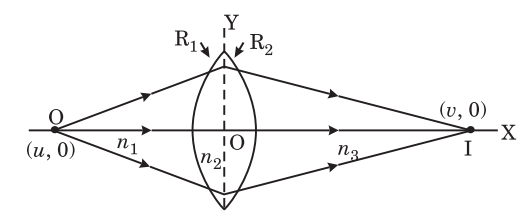
(b) A lens converted by two curved surfaces of radius of curvature R1 and R2 is placed according to the following figure :
Image
Prove that: $\frac{n_3}{v}-\frac{n_1}{u}=\frac{n_2-n_1}{R_1}+\frac{n_3-n_2}{R_2}$
View full solution
Draw a neat labelled diagram of human eye. Explain shortsightedness and longsightedness eye defects giving their cause and method of removal showing ray diagram.
View full solution
Write the formula for refraction of light at spherical surface (concave or convex). With the help of this formula derive the lens formula : $\frac{1}{f}=(n-1)(\frac{1}{R_{1}}-\frac{1}{R_{2}})$, where symbols used have their usual meanings.
View full solution
Draw a graph between angle of deviation '$\delta$' and angle of incidence i for a prism showing the variation of $\delta$ with i.
Show for a prism that the refractive index n is given by :
$n=\frac{\sin \left[\left(\frac{A+\delta_m}{2}\right)\right]}{\sin (A / 2)}$
where symbols have their usual meanings.
View full solution

Generate a Ray Optics and Optical Instruments paper free

Pick question groups from the list above, set marks and difficulty, and export a branded PDF with step-by-step answer keys. First 3 chapters free — no signup.

Download App