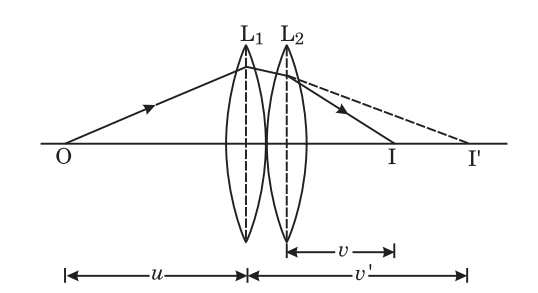
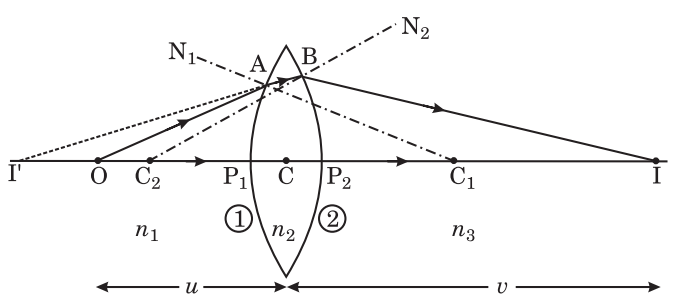
Write the formula for refraction of light at spherical surface (concave or convex). With the help of this formula derive the lens formula : $\frac{1}{f}=(n-1)(\frac{1}{R_{1}}-\frac{1}{R_{2}})$, where symbols used have their usual meanings.
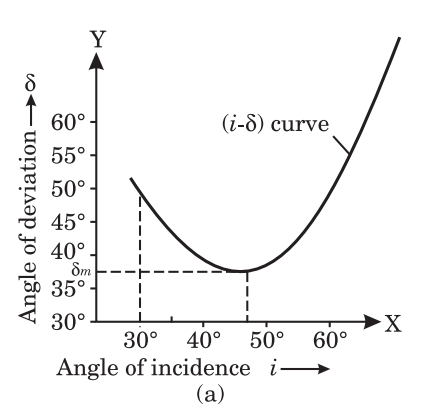
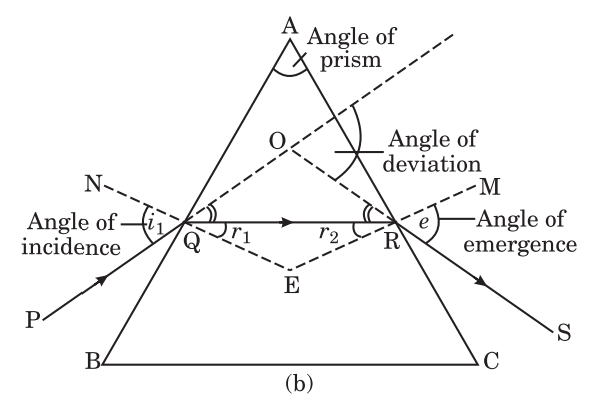
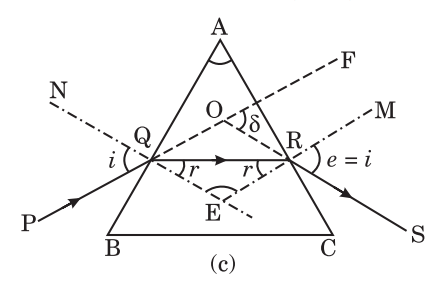
Draw a graph between angle of deviation '$\delta$' and angle of incidence i for a prism showing the variation of $\delta$ with i. Show for a prism that the refractive index n is given by : $n=\frac{\sin \left[\left(\frac{A+\delta_m}{2}\right)\right]}{\sin (A / 2)}$ where symbols have their usual meanings.
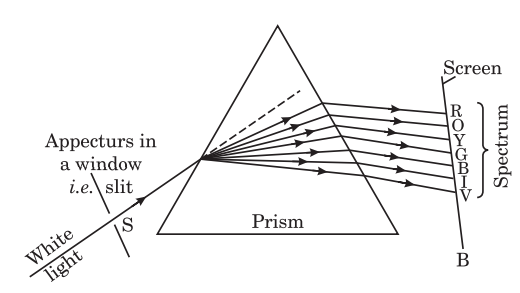
What is dispersion of light? Explain its cause. Deviation of red colour is minimum white that for violet colour is minimum due to dispersion by prism. Explain it. Draw a diagram for dispersion.
Answer
Dispersion of Light and its cause : In the year 1666 Sir Issac Newton allowed the white light from sun to enter a darkened room through a small aperture S in a window and placed a glass prism in the path of the light rays. The light coming out of the prism was received on a white screen. A series of coloured bands was seen on the screen. The order of the colours from the side of base of the prism was as follows: Violet, Indigo, Blue, Green, Yellow, Orange and Red. This order of colours in the spectrum can easily be remembered by the word VIBGYOR, the first letter of each colour. This series of coloured bands is termed as spectrum. In the spectrum each colour is overlapped by the other i.e., there is no separate boundary line of a particular colour. But in fig. showing dispersion of white light through prism, colours are shown separated just for clarity for a single incident white light ray coming from the sun. Dispersion of light may be defined as follows : "The phenomenon of splitting of white light into its constituent colours on passing through a transparent medium i.e., prism is called dispersion of light and the series of coloured bands received on the screen is called spectrum of white light." Cause of Dispersion : The wave theory of light has been able to explain satisfactorily the cause of phenomenon of dispersion. The different colours (i.e. constituents) of white light are in fact, the waves of different wavelengths. The wavelength of the visible region of light range between about 4000 Å for violet to 7800 Å for red. Even though the velocity of light is the same for all colours i.e., wavelengths in the vacuum but it is different for different colours in a transparent material medium. Now, on the basis of wave theory the refractive index n of a medium is defined as follows : $n=\frac{\text { Velocityof lightinvacuum }}{\text { Velocity of lightinmedium }}$ i.e. $n=\frac{c}{V}$ As the velocity of light for a larger wavelength is found to be greater than that for a smaller wavelength i.e., $\lambda_{ V }<\lambda_{ R }$ , the refractive index for the larger wavelength is smaller than for the smaller wavelength i.e., $n_{ V }>n_{ R }$ , where V and R refer to violet and red colours. Now, for thin prism, angle of deviation is given by : $\delta=(n-1) A$ Since refractive index n is different for different colours, hence angle of deviation $\delta$ will be different for different colours. Hence if white light passes through the prism the rays of different colours are deviated through different angles. This causes splitting of light into its constituent colours. This is dispersion of white light. Since refractive index of the material of the prism n is maximum for violet colour and minimum for red colour (i.e., $n_{ V }>n_{ R }$) hence deviation is maximum for red colour while it is minimum for red colour. (i.e., $\delta_{ V }>\delta_{ R }$).
An object is placed infront of a concave mirror of radius of curvature 15 cm at a distance of (i) 10 cm and (ii) 5 cm from the mirror. Calculate the position, nature and magnification of the image in each case.
Answer
Here $R =-15 cm \Rightarrow f= B / 2=-15 cm / 2$ $=-7.5 cm$ (i) When $u=-10 cm$ $\frac{1}{v}+\frac{1}{u}=\frac{1}{f}$ $\Rightarrow \quad \frac{1}{v}=\frac{1}{f}-\frac{1}{u}=\frac{1}{-7.5 cm}-\frac{1}{-10 cm}$ $=\left(\frac{-1}{30}\right) cm ^{-1} \Rightarrow v=-30 cm$ ∴ Magnification : $m=-\left(\frac{v}{u}\right)=-\left[\frac{-30 cm}{-10 cm}\right]=-3$ i.e. image will be formed at a distance of 30 cm for the mirror infront of it and will be real and inverted and three times in size in comparison to the size of the object. (ii) When u = - 5 cm : $\frac{1}{v}+\frac{1}{u}=\frac{1}{f}$ $\Rightarrow \frac{1}{v}=\frac{1}{f}-\frac{1}{u}=\left(\frac{1}{-7.5 cm}-\frac{1}{-5 cm}\right)=\left(\frac{1}{15}\right) cm ^{-1}$ $\Rightarrow \quad v=15 cm$ Magnification. $m=-\left(\frac{v}{u}\right)=\left[\frac{+15 cm}{-5 cm}\right]=+3$ i.e. image will be formed at a distance of 15 cm from the mirror behind it and it will be virtual, erect and three times in size in comparison to the size of the object.
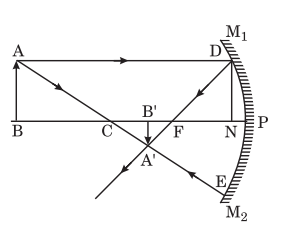
Draw a ray diagram of image formation by a concave mirror and establish the relation between object distance $(u)$, image distance ($v$) and focal length $(f)$.