Question
Metallic (nonferromagnetic) and nonmetallic particles in a solid waste may be separated as follows. The waste is allowed to slide down an incline over permanent magnets. The metallic particles slow down as compared to the norunetallic ones and hence are separated. Discuss the role of eddy currents in the process.
Answer

As the metallic particle slide over permanent magnet they are attracted towards magnet due to formation of eddy current on the metallic body and thus they slow down and are separated from rest of material.

Need a full question paper?

Generate a complete, print-ready paper with questions like this in minutes — across 16+ boards, with answer keys.

Start Generating Free

Similar questions

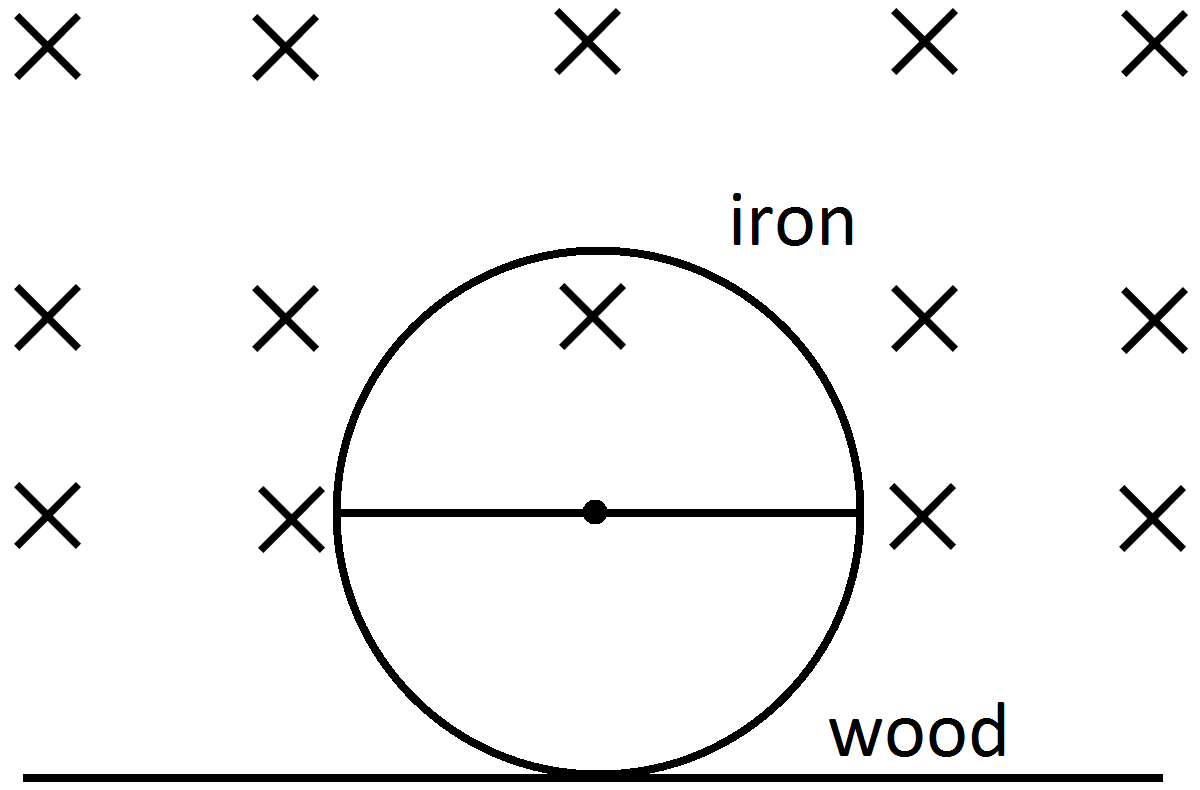
Figure shows a circular wheel of radius $10.0\ cm$ whose upper half, shown dark in the figure, is made of iron and the lower half of wood. The two junctions are joined by an iron rod. A uniform magnetic field $B$ of magnitude $2.00 \times 10^{-4} T$ exists in the space above the central line as suggested by the figure. The wheel is set into pure rolling on the horizontal surface. If it takes $2.00$ seconds for the iron part to come down and the wooden part to go up, find the average emf induced during this period.
An alpha particle is projected vertically upward with a speed of $3.0 \times 10^4\ km s^{-1}$ in a region where a magnetic field of magnitude $1.0T$ exists in the direction south to north. Find the magnetic force that acts on the $\alpha -$particle.
A compound microscope forms an inverted image of an object. In which of the following cases it is kely to create difficulties?
  1. Looking at small germs.
  2. Looking at circular spots.
  3. Looking at a vertical tube containing some water.
An electron enters with a velocity $v = v_0$ i into a cubical region $($faces parallel to coordinate planes$)$ in which there are uniform electric and magnetic fields. The orbit of the electron is found to spiral down inside the cube in plane parallel to the $x-y$ plane. Suggest a configuration of fields $E$ and $B$ that can lead to it.
What is electric current ? Explain about it.
A rectangular coil of $100$ turns has length $5\ cm$ and width $4\ cm.$ It is placed with its plane parallel to a uniform magnetic field and a current of $2A$ is sent through the coil. Find the magnitude of the magnetic field $B$ if the torque acting on the coil is $0.2N m^{-1}$.
State Bohr’s quantization condition of angular momentum. Calculate the shortest wavelength of the Bracket series and state to which part of the electromagnetic spectrum does it belong.
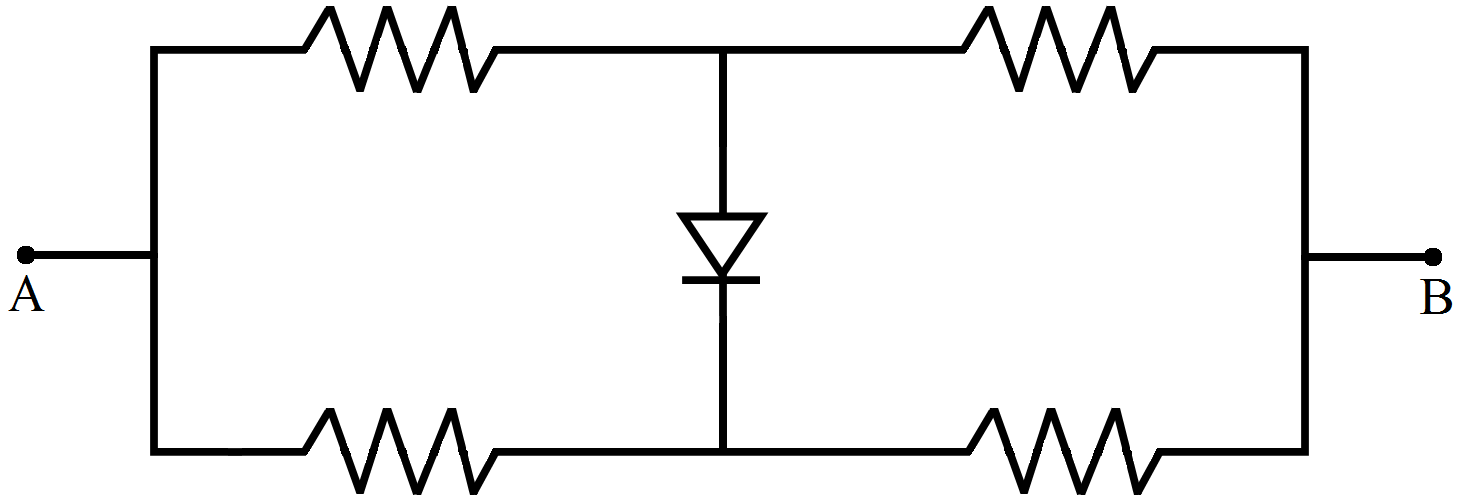
Each of the resistances shown in figure. has a value of $20\Omega.$ Find the equivalent resistance between A and B. Does it depend on whether the point A or B is at higher potential?
Explain J J. Thomson's plum pudding model of atom.
Answer the following questions:
  1. Optical and radio telescopes are built on the ground while X-ray astronomy is possible only from satellites orbiting the Earth. Why?
  2. The small ozone layer on top of the stratosphere is crucial for human survival. Why ?