Question
✓
Answer
i. Let the Priyanka visits four cities Delhi, Lucknow, Agra, Meerut are respectively A, B, C and D. Number of way's in which Priyanka can visit four cities A, B, C and D is 4 ! i.e. 24
$\therefore A=\{a, b\}$ and $B=\{1,2,3\}$
$\therefore n ( S )=24$
Clearly, sample space for this experiment is
$S =\left\{\begin{array}{l}A B C D, A B D C, A C B D, A C D B, A D B C, A D C B \\ B A C D, B A D C, B C A D, B C D A, B D A C, B D C A \\ C A B D, C A D B, C B A D, C B D A, C D A B, C D B A, \\ D A B C, D A C B, D C A B, D C B A, D B A C, D B C A\end{array}\right\}$
Let $E _1$ be the event that Priyanka visits A before B .
Then,
$E_1=\{A B C D, A B D C, A C B D, A C D B, A D B C, A D C B, C A B D, C A D B, C D A B, D A B C, D A C B, D C A B\}$
$\Rightarrow n \left( E _1\right)=12$
$\therefore P ($ she visits A before B $)= P \left( E _1\right)=\frac{n\left(E_1\right)}{n(S)}=\frac{12}{24}=\frac{1}{2}$
ii. Let the Priyanka visits four cities Delhi, Lucknow, Agra, Meerut are respectively A, B, C and D. Number of way's in which Priyanka can visit four cities A, B, C and D is 4! i.e. 24
$\therefore n ( S )=24$
Clearly, sample space for this experiment is
$S =\left\{\begin{array}{l}A B C D, A B D C, A C B D, A C D B, A D B C, A D C B \\ B A C D, B A D C, B C A D, B C D A, B D A C, B D C A \\ C A B D, C A D B, C B A D, C B D A, C D A B, C D B A, \\ D A B C, D A C B, D C A B, D C B A, D B A C, D B C A\end{array}\right\}$
$\begin{array}{l} E _1=\{ ABCD , ABDC , ACBD , ACDB , ADBC , ADCB , CABD , CADB , CDAB , DABC , DACB , DCAB \} \\ \Rightarrow n \left( E _1\right)=12 \\ \therefore P (\text { she visits A before } B )=P\left(E_1\right)=\frac{n\left(E_1\right)}{n(S)}=\frac{12}{24}=\frac{1}{2}\end{array}$
iii. Let the Priyanka visits four cities Delhi, Lucknow, Agra, Meerut are respectively A, B, C and D. Number of way's in which Priyanka can visit four cities A, B, C and D is 4! i.e. 24
$\therefore n ( S )=24$
Clearly, sample space for this experiment is
$S =\left\{\begin{array}{l}A B C D, A B D C, A C B D, A C D B, A D B C, A D C B \\ B A C D, B A D C, B C A D, B C D A, B D A C, B D C A \\ C A B D, C A D B, C B A D, C B D A, C D A B, C D B A, \\ D A B C, D A C B, D C A B, D C B A, D B A C, D B C A\end{array}\right\}$
Let $E _3$ be the event that she visits A first and B last.
Then,
$E_3=\{ ACDB , ADCB \}$
$n\left(E_3\right)=2$
$\because P($ she visits $A$ first and $B$ last $)=P\left(E_3\right)$
$=\frac{n\left(E_3\right)}{n(S)}=\frac{2}{24}=\frac{1}{12}$
OR
Let the Priyanka visits four cities Delhi, Lucknow, Agra, Meerut are respectively A, B, C and D. Number of way's in which Priyanka can visit four cities A, B, C and D is 4! i.e. 24
$\therefore n ( S )=24$
Clearly, sample space for this experiment is
$S =\left\{\begin{array}{l}A B C D, A B D C, A C B D, A C D B, A D B C, A D C B \\ B A C D, B A D C, B C A D, B C D A, B D A C, B D C A \\ C A B D, C A D B, C B A D, C B D A, C D A B, C D B A, \\ D A B C, D A C B, D C A B, D C B A, D B A C, D B C A\end{array}\right\}$
Let $E _4$ be the event that she visits A either first or second. Then, $E_4=\{A B C D, A B D C, A C B D, A C D B, A D B C, A D C B, B A C D, B A D C, C A B D, C A D B, D A B C, D A C B\}$
$\Rightarrow n\left(E_4\right)=12$
Hence, P (she visits A either first or second)
$=P\left(E_4\right)=\frac{n\left(E_4\right)}{n(S)}=\frac{12}{24}=\frac{1}{2}$
$\therefore A=\{a, b\}$ and $B=\{1,2,3\}$
$\therefore n ( S )=24$
Clearly, sample space for this experiment is
$S =\left\{\begin{array}{l}A B C D, A B D C, A C B D, A C D B, A D B C, A D C B \\ B A C D, B A D C, B C A D, B C D A, B D A C, B D C A \\ C A B D, C A D B, C B A D, C B D A, C D A B, C D B A, \\ D A B C, D A C B, D C A B, D C B A, D B A C, D B C A\end{array}\right\}$
Let $E _1$ be the event that Priyanka visits A before B .
Then,
$E_1=\{A B C D, A B D C, A C B D, A C D B, A D B C, A D C B, C A B D, C A D B, C D A B, D A B C, D A C B, D C A B\}$
$\Rightarrow n \left( E _1\right)=12$
$\therefore P ($ she visits A before B $)= P \left( E _1\right)=\frac{n\left(E_1\right)}{n(S)}=\frac{12}{24}=\frac{1}{2}$
ii. Let the Priyanka visits four cities Delhi, Lucknow, Agra, Meerut are respectively A, B, C and D. Number of way's in which Priyanka can visit four cities A, B, C and D is 4! i.e. 24
$\therefore n ( S )=24$
Clearly, sample space for this experiment is
$S =\left\{\begin{array}{l}A B C D, A B D C, A C B D, A C D B, A D B C, A D C B \\ B A C D, B A D C, B C A D, B C D A, B D A C, B D C A \\ C A B D, C A D B, C B A D, C B D A, C D A B, C D B A, \\ D A B C, D A C B, D C A B, D C B A, D B A C, D B C A\end{array}\right\}$
$\begin{array}{l} E _1=\{ ABCD , ABDC , ACBD , ACDB , ADBC , ADCB , CABD , CADB , CDAB , DABC , DACB , DCAB \} \\ \Rightarrow n \left( E _1\right)=12 \\ \therefore P (\text { she visits A before } B )=P\left(E_1\right)=\frac{n\left(E_1\right)}{n(S)}=\frac{12}{24}=\frac{1}{2}\end{array}$
iii. Let the Priyanka visits four cities Delhi, Lucknow, Agra, Meerut are respectively A, B, C and D. Number of way's in which Priyanka can visit four cities A, B, C and D is 4! i.e. 24
$\therefore n ( S )=24$
Clearly, sample space for this experiment is
$S =\left\{\begin{array}{l}A B C D, A B D C, A C B D, A C D B, A D B C, A D C B \\ B A C D, B A D C, B C A D, B C D A, B D A C, B D C A \\ C A B D, C A D B, C B A D, C B D A, C D A B, C D B A, \\ D A B C, D A C B, D C A B, D C B A, D B A C, D B C A\end{array}\right\}$
Let $E _3$ be the event that she visits A first and B last.
Then,
$E_3=\{ ACDB , ADCB \}$
$n\left(E_3\right)=2$
$\because P($ she visits $A$ first and $B$ last $)=P\left(E_3\right)$
$=\frac{n\left(E_3\right)}{n(S)}=\frac{2}{24}=\frac{1}{12}$
OR
Let the Priyanka visits four cities Delhi, Lucknow, Agra, Meerut are respectively A, B, C and D. Number of way's in which Priyanka can visit four cities A, B, C and D is 4! i.e. 24
$\therefore n ( S )=24$
Clearly, sample space for this experiment is
$S =\left\{\begin{array}{l}A B C D, A B D C, A C B D, A C D B, A D B C, A D C B \\ B A C D, B A D C, B C A D, B C D A, B D A C, B D C A \\ C A B D, C A D B, C B A D, C B D A, C D A B, C D B A, \\ D A B C, D A C B, D C A B, D C B A, D B A C, D B C A\end{array}\right\}$
Let $E _4$ be the event that she visits A either first or second. Then, $E_4=\{A B C D, A B D C, A C B D, A C D B, A D B C, A D C B, B A C D, B A D C, C A B D, C A D B, D A B C, D A C B\}$
$\Rightarrow n\left(E_4\right)=12$
Hence, P (she visits A either first or second)
$=P\left(E_4\right)=\frac{n\left(E_4\right)}{n(S)}=\frac{12}{24}=\frac{1}{2}$
Need a full question paper?
Generate a complete, print-ready paper with questions like this in minutes — across 16+ boards, with answer keys.
Explore more
Similar questions
The logarithmic function expressed as $\log _e R^{+} \rightarrow R$ and given by $\log _e x=y$ iff $e^y=x$. The graph of the function is given below :
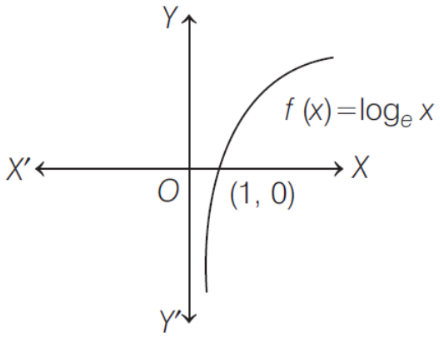
(i) Domain of $f(x)=(0, \infty)$ or $R^{+}$
(ii) Range of $f(x)=(-\infty, \infty)$ or $R$
To find the limit of functions involving logarithmic function, we use the following theorem Theorem $\lim _{x \rightarrow 0} \frac{\log _e(1+x)}{x}=1$
Based on above information, answer the following questions.
(i) $\lim _{x \rightarrow 0} \frac{\log _e(1+5 x)}{x}$ is equal to
(a) 5 (b) 4 (c) 3 (d) 1
(ii) $\lim _{x \rightarrow 0} \frac{\log _e(1+6 x)-5 x^2}{x}$ is equal to
(a) 1 (b) 2 (c) 3 (d) 6
(iii) $\quad \lim _{x \rightarrow 0} \frac{\sqrt{1+x}-1}{\log (1+x)}$ is equal to
(a) 1 (b) $\frac{1}{2}$ (c) $\frac{1}{3}$ (d) $\frac{3}{2}$
(iv) $\quad \lim _{x \rightarrow 5} \frac{\log x-\log 5}{x-5}$ is equal to
(a) $\frac{1}{5}$ (b) $\frac{3}{5}$ (c) $\frac{1}{4}$ (d) $\frac{2}{3}$
(v) $\quad \lim _{x \rightarrow 0} \frac{\log (5+x)-\log (5-x)}{x}$ is equal to
(a) $\frac{1}{5}$ (b) $\frac{2}{5}$ (c) $\frac{3}{5}$ (d) $\frac{4}{5}$
→→(i) Domain of $f(x)=(0, \infty)$ or $R^{+}$
(ii) Range of $f(x)=(-\infty, \infty)$ or $R$
To find the limit of functions involving logarithmic function, we use the following theorem Theorem $\lim _{x \rightarrow 0} \frac{\log _e(1+x)}{x}=1$
Based on above information, answer the following questions.
(i) $\lim _{x \rightarrow 0} \frac{\log _e(1+5 x)}{x}$ is equal to
(a) 5 (b) 4 (c) 3 (d) 1
(ii) $\lim _{x \rightarrow 0} \frac{\log _e(1+6 x)-5 x^2}{x}$ is equal to
(a) 1 (b) 2 (c) 3 (d) 6
(iii) $\quad \lim _{x \rightarrow 0} \frac{\sqrt{1+x}-1}{\log (1+x)}$ is equal to
(a) 1 (b) $\frac{1}{2}$ (c) $\frac{1}{3}$ (d) $\frac{3}{2}$
(iv) $\quad \lim _{x \rightarrow 5} \frac{\log x-\log 5}{x-5}$ is equal to
(a) $\frac{1}{5}$ (b) $\frac{3}{5}$ (c) $\frac{1}{4}$ (d) $\frac{2}{3}$
(v) $\quad \lim _{x \rightarrow 0} \frac{\log (5+x)-\log (5-x)}{x}$ is equal to
(a) $\frac{1}{5}$ (b) $\frac{2}{5}$ (c) $\frac{3}{5}$ (d) $\frac{4}{5}$

A teacher conducted a surprise test of Mathematics, Physics and Chemistry for class XI on Monday. The mean and standard deviation of marks obtained by 50 students of the class in three subjects are given below:
i. Which of the three subjects shows the highest variability? (1)
ii. What is the coefficient of variation of marks obtained by the students in Chemistry? (1)
iii. What is the coefficient of variation of marks obtained by the students in Physics? (2)
OR
What is the coefficient of variation of marks obtained by the students in Mathematics? (2)
| Subject | Mathematics | Physics | Chemistry |
| Mean | 42 | 32 | 40.9 |
| Standard deviation | 12 | 15 | 20 |
i. Which of the three subjects shows the highest variability? (1)
ii. What is the coefficient of variation of marks obtained by the students in Chemistry? (1)
iii. What is the coefficient of variation of marks obtained by the students in Physics? (2)
OR
What is the coefficient of variation of marks obtained by the students in Mathematics? (2)
Ordered Pairs The ordered pair of two elements a and 3 is denoted by (a, b) : a is first element (or first component) and d is second element (or second component). Two ordered pairs are equal if their corresponding elements are equal. ie. (a, b) = (c, d)
→⇒ a = c and b = d
Cartesian Product of Two Sets For two non-empty sets A and B, the cartesian product A . B is the set of all ordered pairs of elements from sets Aand B. In symbolic form, it can be written as
$\text{A}\cdot\text{B}=\{(\text{a},\text{b}):\text{a}\in\text{A},\text{b}\in\text{B}\}$
Based on the above topics, answer the following questions.
If (a - 3, 6 + 7) = (3, 7), then the value of aand d are:
6, 0
3, 7
7, 0
3, -7
If (x + 6, y - 2) = (0, 6), then the value of x and y are:
6, 8
-6, -8
-6, 8
6, -8
If (x + 2, 4) = (5, 2x + y), then the value of x and y are:
-3, 2
3, 2
-3, -2
Let A and B be two sets such that A . B consists of 6 elements. If three elements of A . B are (1, 4), (2, 6) and (3, 6), then
(A . B) = (B . A)
$(\text{A}\cdot\text{B})\neq(\text{B}\cdot\text{A})$
A . B = {(1, 4), (1, 6), (2, 4)}
None of the above
If m(A . B) = 45, then n(A) cannot be
15
17
5
9
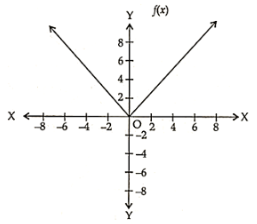
Consider the graphs of the functions f(x), h(x) and g(x).
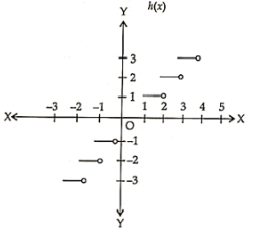
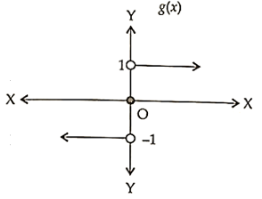
i. Find the range of h(x). (1)
ii. Find the domain of f(x). (1)
iii. Find the value of f(10). (2)
OR
Find the range of g(x). (2)
i. Find the range of h(x). (1)
ii. Find the domain of f(x). (1)
iii. Find the value of f(10). (2)
OR
Find the range of g(x). (2)

Five students Ajay, Shyam, Yojana, Rahul and Akansha are sitting in a playground in a line.
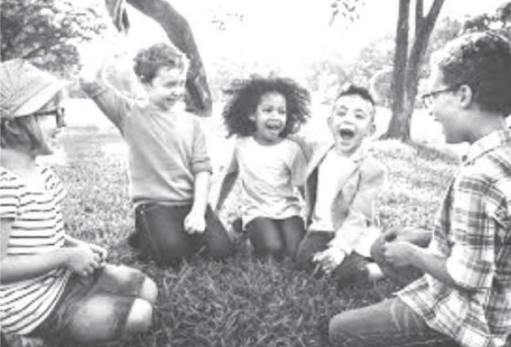
Based on the above information, answer the following questions.
(i) Total number of ways of sitting arrangement of five students is
(a) 120 (b) 60 (c) 24 (d) None of these
(ii) Total number of arrangement of sitting, if Ajay and Yojana sit together, is
(a) 60 (b) 48 (c) 72 (d) 120
(iii) Total number of arrangement 'Yojana and Rahul sitting at extreme position' is
(a) 24 (b) 36 (c) 48 (d) 12
(iv) Total number of arrangement, if shyam is sitting in the middle, is
(a) 24 (b) 12 (c) 6 (d) 36
(v) Total number of arrangement sitting Yojana and Rahul not sit together, is
(a) 72 (b) 120 (c) 60 (d) 144
Based on the above information, answer the following questions.
(i) Total number of ways of sitting arrangement of five students is
(a) 120 (b) 60 (c) 24 (d) None of these
(ii) Total number of arrangement of sitting, if Ajay and Yojana sit together, is
(a) 60 (b) 48 (c) 72 (d) 120
(iii) Total number of arrangement 'Yojana and Rahul sitting at extreme position' is
(a) 24 (b) 36 (c) 48 (d) 12
(iv) Total number of arrangement, if shyam is sitting in the middle, is
(a) 24 (b) 12 (c) 6 (d) 36
(v) Total number of arrangement sitting Yojana and Rahul not sit together, is
(a) 72 (b) 120 (c) 60 (d) 144

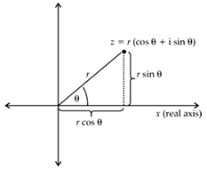
Consider the complex number Z = 2 - 2i.
Complex Number in Polar Form
i. Find the principal argument of Z. (1)
ii. Find the value of $z \overline { Z }$ ? (1)
iii. Find the value of $| Z |$. (2)
OR
Find the real part of Z. (2)
→Complex Number in Polar Form
i. Find the principal argument of Z. (1)
ii. Find the value of $z \overline { Z }$ ? (1)
iii. Find the value of $| Z |$. (2)
OR
Find the real part of Z. (2)