Question
Ordered Pairs The ordered pair of two elements a and 3 is denoted by (a, b) : a is first element (or first component) and d is second element (or second component). Two ordered pairs are equal if their corresponding elements are equal. ie. (a, b) = (c, d)

⇒ a = c and b = d

Cartesian Product of Two Sets For two non-empty sets A and B, the cartesian product A . B is the set of all ordered pairs of elements from sets Aand B. In symbolic form, it can be written as 

$\text{A}\cdot\text{B}=\{(\text{a},\text{b}):\text{a}\in\text{A},\text{b}\in\text{B}\}$

Based on the above topics, answer the following questions.

If (a - 3, 6 + 7) = (3, 7), then the value of aand d are:

6, 0

3, 7

7, 0

3, -7

If (x + 6, y - 2) = (0, 6), then the value of x and y are:

6, 8

-6, -8

-6, 8

6, -8

If (x + 2, 4) = (5, 2x + y), then the value of x and y are:

-3, 2

3, 2

-3, -2

Let A and B be two sets such that A . B consists of 6 elements. If three elements of A . B are (1, 4), (2, 6) and (3, 6), then

(A . B) = (B . A)

$(\text{A}\cdot\text{B})\neq(\text{B}\cdot\text{A})$

A . B = {(1, 4), (1, 6), (2, 4)}

None of the above

If m(A . B) = 45, then n(A) cannot be

15

17

5

9

Answer

1

Need a full question paper?

Generate a complete, print-ready paper with questions like this in minutes — across 16+ boards, with answer keys.

Start Generating Free

Similar questions

Method to Find the Sets When Cartesian Product is Given For finding these two sets, we write first element of each ordered pair in first set say A and corresponding second element in second set B (say). Number of Elements in Cartesian Product of Two Sets If there are p elements in set A and g elements in set B, then there will be pq elements in A . B i.e. if n(A) = p and n(B) = q, then n(A . B) = pq.
Based on the above two topic, answer the following questions.
  1. If A . B = {(a, 1), (b, 3), (a, 3), (b, 1), (a, 2), (b, 2)}. Then, A and B are:
  1. {1, 3, 2}, {a, b}
  2. {a, b}, {1, 3}
  3. {a, b}, {1, 3, 2}
  4. None of these
  1. If the set A has 3 elements and set B has 4 elements, then the number of elements in A . B is:
  1. 3
  2. 4
  3. 7
  4. 12
  1. A and B are two sets given in such a way that A . B contains 6 elements. If three elements of A . B are (1, 3), (2, 5) and (3, 3), then A, B are:
  1. {1, 2, 3}, {3, 5}
  2. {3, 5,}, {1, 2, 3}
  3. {1, 2}, {3, 5}
  4. {1, 2, 3}, {5}
  1. The remaining elements of A . B in (iii) is:
  1. (5, 1), (3, 2), (3, 5)
  2. (1, 5), (2, 3), (3, 5)
  3. (1, 5), (3, 2), (5, 3)
  4. None of the above
  1. The cartesian product P . P has 16 elements among which are found (a, 1) and (b, 2). Then, the set P is:
  1. {a, b}
  2. {1, 2}
  3. {a, b,1, 2}
  4. {0, b, 1, 2, 4}
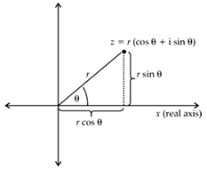
Consider the complex number Z = 2 - 2i.
Complex Number in Polar Form 
Image

i. Find the principal argument of Z. (1)
ii. Find the value of $z \overline { Z }$ ? (1)
iii. Find the value of $| Z |$. (2) 
OR
Find the real part of Z. (2)
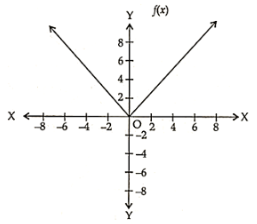
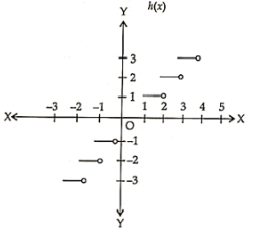
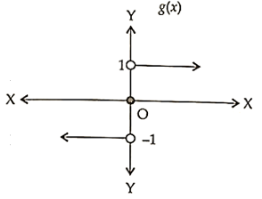
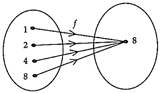
Consider the graphs of the functions f(x), h(x) and g(x). 
Image
Image
Image

i. Find the range of h(x). (1)
ii. Find the domain of f(x). (1)
iii. Find the value of f(10). (2)
OR
Find the range of g(x). (2)
A manufacturing company produces certain goods. The company manager used to make a data record on daily basis about the cost and revenue of these goods separately. The cost and revenue function of a product are given by $C(x)=20 x+4000$ and $R(x)=60 x+2000$, respectively, where $x$ is the number of goods produced and sold.

Based on above information, answer the following questions.

(i) How many goods must be sold to realise some profit?
(a) $\mathrm{x}<\mathbf{5 0}$
(b) $x>50$
(c) $x \geq 50$
(d) $\mathbf{x} \leq \mathbf{5 0}$

(ii) If the cost and revenue functions of a product are given by $C(x)=3 x+400$ and $R(x)=$ $5 x+20$ respectively, where $x$ is the number of items produced by the manufacturer, then how many items must be sold to realise some profit?
(a) $x \leq 190$
(b) $x \geq 190$
(c) $x<190$
(d) $x>190$

(iii) Let $\mathbf{x}$ and $\mathbf{b}$ are real numbers. If $\mathbf{b} > \mathbf{0}$ and $\mathbf{x}< \mathbf{b}$, then
(a) $x$ is always positive
(b) $\mathbf{X}$ is always negative
(c) $\mathrm{x}$ is real number
(d) None of these

(iv) The solution set of $\mathbf{3}-\mathbf{5}<\mathrm{x}+\mathbf{7}$, when $\mathrm{x}$ is a whole number is given by
(a) $\{0,1,2,3,4,5\}$
(b) $(-\infty, 6)$
(c) $[0,5]$
(d) None of these

(v) Graph of inequality $x>2$ on the number line is represented by
(a) Image
(b)Image 
(c) Image
(d) None of the above
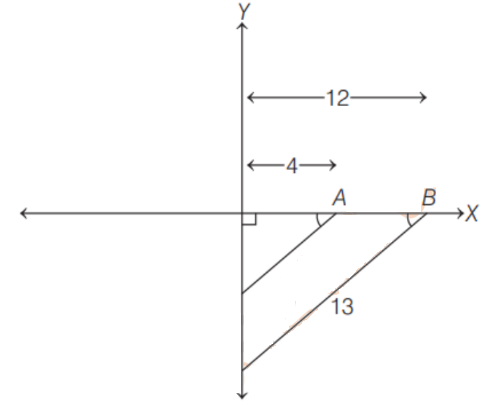
Rajiv constructs two right angled triangles in the fourth quadrant in such a way that the measure of triangle gives $\cos A=\frac{4}{5}$ and $\cos B=\frac{12}{13}$, where $\frac{3 \pi}{2} < A$ and $B > 2 \pi$.
Image
Based on the above information, answer the following questions.
(i) Find the value of $\cos (A+B)$
(ii) Find the value of $\sin (A-B)$
(iii) Find the value of $\tan (\mathbf{A}+\mathbf{B})$