MCQ
'Mirage' is a phenomenon due to
  • A
    Reflection of light
  • B
    Refraction of light
  • Total internal reflection of light
  • D
    Diffraction of light

Answer

Correct option: C.
Total internal reflection of light
c
(c) Mirage is a phenomenon observed due to the total internal reflection of light when light travels from a denser medium to a rarer medium. When the angle of incidence of light is more than the critical angle for the two adjacent media, the light gets totally internally reflected.

Need a full question paper?

Generate a complete, print-ready paper with questions like this in minutes — across 16+ boards, with answer keys.
Start Generating Free

Similar questions

One face of a rectangular glass plate $6 \,cm$ thick is silvered. An object held $8\, cm$ in front of the first face, forms an image $12\, cm$ behind the silvered face. The refractive index of the glass is
A body is projected horizontally with a velocity of $4\,m / s$ from the top of a high tower. The velocity of the body after $0.7\,s$ is nearly $.....\,m/s$ (take $g=10\,m / s ^2$ )
A body of mass $1kg$ is thrown upwards with a velocity $20 m/s.$ It momentarily comes to rest after attaining a height of $18 m.$ How much energy is lost due to air friction $? ........... \mathrm{J}$ $ (g = 10\ m/s^2)$
The measured value of the length of a simple pendulum is $20 \mathrm{~cm}$ with $2 \mathrm{~mm}$ accuracy. The time for $50$ oscillations was measured to be $40$ seconds with $1$ second resolution. From these measurements, the accuracy in the measurement of acceleration due to gravity is $\mathrm{N} \%$. The value of $\mathrm{N}$ is:
The resistance of a bulb filmanet is $100\,\Omega$ at a temperature of $100\,^o  C$. If its temperature coefficient of resistance be $0.005$ per $^o C$, its resistance will become $200\,\Omega$ at a temperature of ................ $^oC$
A litre of dry air at $STP$ expands adiabatically to a volume of $3$ litres. If $\gamma=1.40,$ the work done by air is$(3^{1.4}=4.6555)$ [Take air to be an ideal gas $]$
The resistance of a conductor is $5\, ohm$ at $50\,^oC$ and $6\, ohm$ at $100\,^oC$. Its resistance at $0\,^oC$ is ................ $ohm$
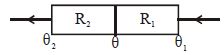
Consider two insulating sheets with thermal resistances $R_1$ and $R_2$ as shown. The temperatures $\theta $ is
Dark lines on solar spectrum are due to
On the $x-$axis and a dsitance $x$ from the origin, the gravitational field due to a mass distribution is given by $\frac{A x}{\left(x^{2}+a^{2}\right)^{3 / 2}}$ in the $x-$direction. The magnitude of gravitational potential on the $x-$axis at a distance $x,$ taking its value to be zero at infinity, is