MCQ
Molecules of a gas behave like
  • A
    Inelastic rigid sphere
  • B
    Perfectly elastic non-rigid sphere
  • Perfectly elastic rigid sphere
  • D
    Inelastic non-rigid sphere

Answer

Correct option: C.
Perfectly elastic rigid sphere
c
The molecules behave as rigid spheres. Pressure is due to collisions between the molecules and the walls of the container. All collisions, both between the molecules themselves, and between the molecules and the walls of the container, are perfectly elastic.

Need a full question paper?

Generate a complete, print-ready paper with questions like this in minutes — across 16+ boards, with answer keys.
Start Generating Free

Similar questions

A particle excutes $SHM$ on a straight line path. The amplitude of oscillation is $2\,cm$. When the displacement of the particle from the mean position is $1\,cm$, the numerical value of magnitude of acceleration is equal to the numerical value of magnitude of velocity. The frequency of $SHM$ is (in $second^{-1}$)
Consider the following statements.
$A.$ The coefficient of linear expansion has dimension $K^{-1}$.
$B.$ The coefficient of volume expansion has dimension $K^{-1}$.
$Newton/metr{e^{\rm{2}}}$ is the unit of
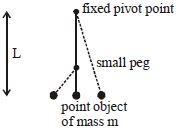
A simple pendulum of length $L$ is constructed from a point object of mass $m$ suspended by a massless string attached to a fixed pivot point. $A$ small peg is placed a distance $2L/3$ directly below the fixed pivot point so that the pendulum would swing as shown in the figure below. The mass is displaced $5$ degrees from the vertical and released. How long does it take to return to its starting position?
A wagon of $200\, kg$ is moving on a smooth track with a velocity of $2\, m/s$. A man of $80\, kg$ also runs in the wagon with a velocity such that the speed of centre of mass of the system is zero. Find the relative velocity of man w.r.t. wagon ...... $m/s$
The maximum velocity and the maximum acceleration of a body moving in a simple harmonic oscillator are $2\,m/s$ and $4\,m/{s^2}.$ Then angular velocity will be ..... $rad/sec$
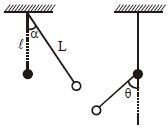
A simple pendulum consisting of a mass $M$ attached to a string of length $L$ is released from rest at an angle $\alpha$. $A$ pin is located at a distance $l$ below the pivot point. When the pendulum swings down, the string hits the pin as shown in the figure. The maximum angle $\theta$ which string makes with the vertical after hitting the pin is :-
A bus appears to go with a speed of $25 \,km / hr$ to a car driver, driving at the rate $7 \,km / hr$ northwards. If the bus actually travels in east direction, its speed is ......... $km / h$
The distance covered by a particle moving with initial velocity and acceleration a in the $x ^{\text {th }}$ second will be :
Which one of the following represents the displacement time graph of two objects $A$ and $B$ moving with zero relative speed?