Question
Image
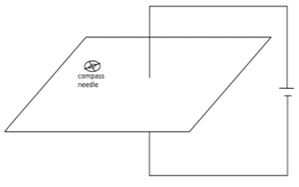
Mona was doing an experiment with a magnetic compass and a straight current-carrying wire. She observed that as she moved the compass away from the current-carrying wire, the deflection of the compass needle reduced.
A. Explain why the deflection of the compass needle reduced as Mona moved away the compass needle from the current carrying wire.
B. Mention one thing that could have changed in the circuit of the wire that could increase the deflection of the needle.
C. Explain with reason what will be the direction of the magnetic field associated with the wire for the case described by the above figure.
Answer

A. Magnetic field strength is inversely proportional to the distance from the current carrying wire. Hence when Mona moved the compass away from the current carrying wire, the magnetic effect was less on it and hence the deflection was less. (1)
B. Magnetic field strength is directly proportional to the current in the wire. So, Mona could increase the current in the circuit to observe a greater deflection in the compass needle. (1)
C. The battery suggests that the current is going from top of the plane to the bottom of the plane. Using the right hand thumb rule we can say that the magnetic field will be clockwise. (1)

Need a full question paper?

Generate a complete, print-ready paper with questions like this in minutes — across 16+ boards, with answer keys.

Start Generating Free

Similar questions

A convex lens of focal length 20cm can produce a magnified virtual as well as real image. Is this a correct statement? If yes, where shall the object be placed in each case for obtaining these images?
A glass prism is able to produce a spectrum when white light passes through it but a glass slab does not produce any spectrum. Explain why is it so?
A magnifying lens has a focal length of 100mm. An object whose size is 16mm is placed at some distance from the lens so that an image is formed at a distance of 25cm in front of the lens.
  1. What is the distance between the object and the lens?
  2. Where should the object be placed if the image is to form at infinity?
Explain the phenomenon of “biological magnification.” How does it affect organisms belonging to different trophic levels particularly the tertiary consumers?
State the rule to determine the direction of a,
  1. Magnetic field produced around a straight conductor-carrying current.
  2. Force experienced by a current-carrying straight conductor placed in a magnetic field which is perpendicular to it, and,
  3. Current induced in a coil due to its rotation in a magnetic field.
What is the advantage of using a convex mirror as a rear-view mirror in vehicles as compared to a plane mirror? Illustrate your answer with the help of labelled diagrams.
The two rays chosen for the construction of ray diagram is:

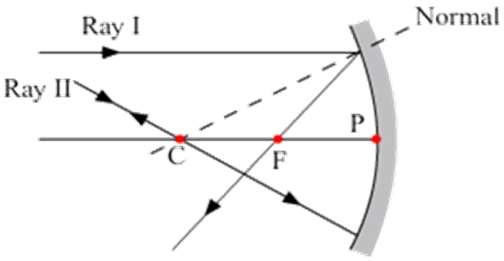
Ray 1: When the incident ray is parallel to the principal axis, the reflected ray will pass through the focus of concave mirror or it appears to pass through the focus of convex mirror.
Ray 2: When the incident ray passes through or appears to pass through the centre of curvature, the light, after reflection from the spherical mirror, reflects back along the same path.
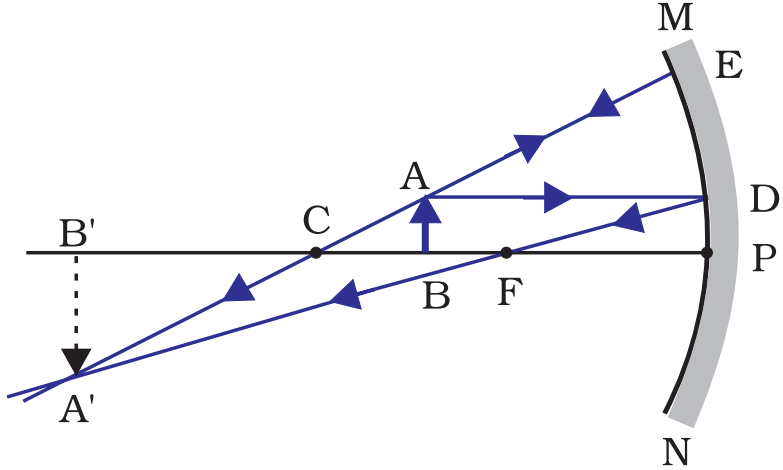
The image formed is real, inverted, magnified and is formed beyond the centre of curvature.
Consider two elements 'A' (Atomic number 17) and 'B' (Atomic number 19):
  1. Write the positions of these elements in the modern periodic table giving justification.
  2. Write the formula of the compound formed when 'A' combines with 'B.'
  3. Draw the electron dot structure of the compound and state the nature of the bond formed between the two elements.
A metal that exists as a liquid at room temperature is obtained by heating its sulphide in the presence of air. Identify the metal and its ore and give the reaction involved.
What makes the candle flame yellow and luminous?