Question
Moon has no atmosphere because

Answer

The escape velocity (the minimum velocity with which a body is to be projected so as to escape from the gravitational pull) on the surface of moon is very much less than the rms velocity of the molecules of gas at the surface temperature of moon. Therefore, the molecules will escape and therefore moon cannot hold an atmosphere.

The expression for escape velocity is $\sqrt{2 gR }$, the value of escape velocity on earth is $11200 \; m / s$. The value of escape velocity on moon is $2400 \; m / s$ (approximately) The moon's surface temperature cycles between $-155^{\circ} C$ and $100^{\circ} C$. As temperature increases the speed of molecules become more than the escape velocity.

Need a full question paper?

Generate a complete, print-ready paper with questions like this in minutes — across 16+ boards, with answer keys.
Start Generating Free

Similar questions

Find out the surface charge density at the intersection of point $x =3\, m$ plane and $x$ -axis, in the region of uniform line charge of $8\, nC / m$ lying along the $z$ -axis in free space.
If a star is moving towards the earth, then the lines are shifted towards
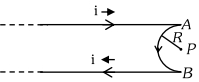
A very long conducting wire is bent in a semicircular shape from $A$ to $B$ as shown in figure. The magnetic field at point $P$ for steady current configuration is given by:
It is earier to pull a lawn mower than to push it because
If m is the mass of electron, v its velocity, r is the radius of stationary circular orbit around a nucleus with charge Ze, then from Bohr's second postulate, the radius of the quantised orbit in CGS system is given by:
If $4 \times {10^{20}}eV$ energy is required to move a charge of $0.25$ coulomb between two points. Then what will be the potential difference between them......$V$
The central fringe of the interference pattern produced by light of wavelength $6000 \mathring A$ is found to shift to the position of $4^{\text {th}}$ bright fringe after a glass plate of refractive index $1.5$ is introduced in front of one slit in Young's experiment. The thickness of the glass plate will be ......... $\mu m$
A body is thrown with a velocity of $9.8 \,m/s$ making an angle of $30^o$ with the horizontal. It will hit the ground after a time ....... $\sec$
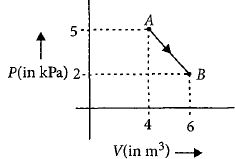
One mole of an ideal diatomic gas undergoes a transition from $A$ to $B$ along a path $AB$ as shown in the figure. 

The change in internal energy of the gas during the transition is ............$\;kJ$
In open organ pipe, if fundamental frequency is $n$ then the other frequencies are