MCQ
Most acidic among given compound is
  • A
    $Pr(OH)_3$
  • B
    $Gd(OH)_3$
  • C
    $Sm(OH)_3$
  • $Er(OH)_3$

Answer

Correct option: D.
$Er(OH)_3$
d

Need a full question paper?

Generate a complete, print-ready paper with questions like this in minutes — across 16+ boards, with answer keys.
Start Generating Free

Similar questions

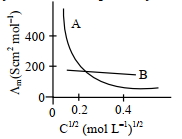
The molar conductivity for electrolytes $A$ and $B$ are plotted against $C^{1 / 2}$ as shown below. Electrolytes $A$ and $B$ respectively are:
Which of the following is an ideal solution
$4\,g$  of copper was dissolved in concentrated nitric acid. The copper nitrate solution on strong heating gave $5\,g$ of its oxide. The equivalent weight of copper is
A depolarizer used in dry cell batteries is
Electrolytic reduction of alumina to aluminium by Hall$-$Heroult process is carried out $......$
Plotting $1 / \Lambda_{\mathrm{m}}$ against $\mathrm{c} \Lambda_{\mathrm{m}}$ for aqueous solutions of a monobasic weak acid ($HX$) resulted in a straight line with $y$-axis intercept of $\mathrm{P}$ and slope of $S$. The ratio $\mathrm{P} / \mathrm{S}$ is

$\left[\Lambda_{\mathrm{m}}=\right.$ molar conductivity

$\Lambda_{\mathrm{m}}^{\circ}=$ limiting molar conductivity

$\mathrm{c}=$ molar concentration

$\mathrm{K}_{\mathrm{a}}=$ dissociation constant of $\mathrm{HX}$ ]

Consider the following molecules : $\mathrm{Br}_3 \mathrm{O}_8, \mathrm{~F}_2 \mathrm{O}, \mathrm{H}_2 \mathrm{~S}_4 \mathrm{O}_6, \mathrm{H}_2 \mathrm{~S}_5 \mathrm{O}_6$, and $\mathrm{C}_3 \mathrm{O}_2$.

Count the number of atoms existing in their zero oxidation state in each molecule. Their sum is . . . . .
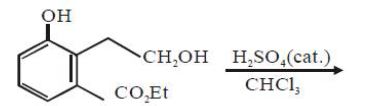
The major product of the following reaction is
The molar conductance of $\mathrm{NaCl}, \mathrm{HCl}$ and $\mathrm{CH}_{3} COONa$ at infinite dilution are $126.45,426.16$ and $91.0\, \mathrm{~S} \,\mathrm{~cm}^{2} \,\mathrm{~mol}^{-1}$ respectively. The molar conductance of $\mathrm{CH}_{3} \mathrm{COOH}$ at infinite dilution is. Choose the right option for your answer. (In $\mathrm{~S} \mathrm{~cm}^{2} \mathrm{~mol}^{-1}$)
In a reaction $N_2(g) + 3H_2(g) \longrightarrow 2NH_3(g)$ the rate of appearance of $NH_3$ is $2.5 \times 10^{-4}\,mol\,L^{-1}sec^{-1}$. The Rate of reaction and rate of disappearance of $H_2$ will be (In $mol\,L^{-1}sec^{-1})$