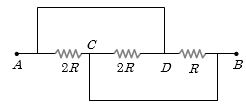
$n$ equal cell having emf $E$ and internal resistance $r$, are connected in a circuit of a resistance $R$ . Same current flows in circuit either they are connected in series or parallel, if
Medium


Download our appand get started for free
Experience the future of education. Simply download our apps or reach out to us for more information. Let's shape the future of learning together!No signup needed.*
Similar Questions
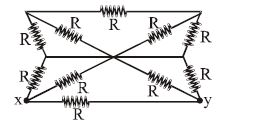
- 1What will be equivalent resistance of circuit between $x$ and $y$View Solution
- 2Assertion : The current density $\vec J$ at any point in ohmic resistor is in direction of electric field $\vec E$ at that point.View Solution
Reason : A point charge when released from rest in a region having only electrostatic field always moves along electric lines of force.
- 3View SolutionCarbon resistor has resistance specified by three bands having colours red, yellow and black. If the resistor is remolded to make a resistor twice of previous length, the new colour code will be
- 4The resistors of resistances $2$ $\Omega$, $4$ $\Omega$ and $8$ $\Omega$ are connected in parallel, then the equivalent resistance of the combination will beView Solution
- 5When a potential difference $V$ is applied across a wire of resistance $R$, it dissipates energy at a rate $W$. If the wire is cut into two halves and these halves are connected mutually parallel across the same supply, the same supply, the energy dissipation rate will become:View Solution
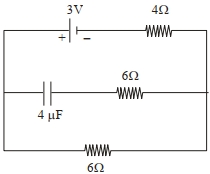
- 6In the network shown below, the charge accumulated in the capacitor in steady state will be ........... $\mu C$View Solution
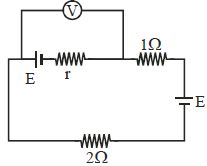
- 7In the given circuit reading of ideal voltmeter is $\frac{E}{2}$ then internal resistance of cell is ............. $\Omega$View Solution
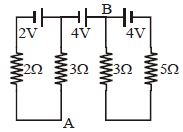
- 8In the given circuit calculate potential difference between $A$ and $B$ ............... $\mathrm{V}$View Solution
- 9Two resistances of $400\,\Omega $ and $800\,\Omega $ are connected in series with a $6\,volt $ battery of negligible internal resistance. A voltmeter of resistance $10,000\,\Omega $ is used to measure the potential difference across $400\,\Omega $ . The error in the measurement of potential difference (in volt) approximately isView Solution
- 10What is the equivalent resistance between $A$ and $B$View Solution