MCQ
$n-$ $moles$ of an ideal gas with constant volume heat capacity $C_v$ undergo an isobaric expansion by certain volume. The ratio of the work done in the process, to the heat supplied is
  • A
    $\frac{{nR}}{{{C_v} - nR}}$
  • $\frac{{nR}}{{{C_v} + nR}}$
  • C
    $\frac{{4nR}}{{{C_v} + nR}}$
  • D
    $\frac{{4nR}}{{{C_v} - nR}}$

Answer

Correct option: B.
$\frac{{nR}}{{{C_v} + nR}}$
b
$\mathrm{w}=\mathrm{n} \mathrm{R} \Delta \mathrm{T}$

$\Delta \mathrm{H}=\left(\mathrm{C}_{\mathrm{v}}+\mathrm{n} \mathrm{R}\right) \Delta \mathrm{T}$

$\frac{\omega}{\Delta H}=\frac{n R}{C_{v}+n R}$

Need a full question paper?

Generate a complete, print-ready paper with questions like this in minutes — across 16+ boards, with answer keys.

Start Generating Free

Similar questions

A bicyclist comes to a skidding stop in $10m.$ During this process, the force on the bicycle due to the road is $200N$ and is directly opposed to the motion. The work done by the cycle on the road is:
A cricket player catches a ball of mass $120 \mathrm{~g}$ moving with $25 \mathrm{~m} / \mathrm{s}$ speed. If the catching process is completed in $0.1 \mathrm{~s}$ then the magnitude of force exerted by the ball on the hand of player will be (in SI unit):
A solid sphere of mass $1\,kg$ rolls without slipping on a plane surface. Its kinetic energy is $7 \times 10^{-3}\,J$. The speed of the centre of mass of the sphere is $.........cm s ^{-1}$.
A bullet weighing $10 \,g$ and moving with a velocity $300 \,m / s$ strikes a $5 \,kg$ block of ice and drop dead. The ice block is kept on smooth surface. The speed of the block after the collision is ........ $cm / s$
An object start sliding on a frictionless inclined plane and from same height another object start falling freely
A free neutron decays to a proton but a free proton does not decay to a neutron. This is because:
The specific heat of a gas in isothermal process is:
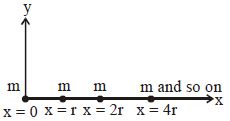
Consider an infinite distribution of point masses (each of mass $m$) placed on $x$ -axis  as shown in the diagram. What is the gravitational force acting on the point mass  placed at the origin ?
Solve the previous question if the closed loop is completely enclosed in the circuit containing the switch.
A thin $1 \,m$ long rod has a radius of $5\, mm$. A force of $50\,\pi kN$ is applied at one end to determine its Young's modulus. Assume that the force is exactly known. If the least count in the measurement of all lengths is $0.01\, mm$, which of the following statements is false ?