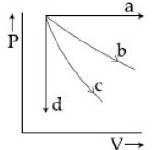
Neon gas of a given mass expands isothermally to double volume. What should be the further fractional decrease in pressure, so that the gas when adiabatically compressed from that state, reaches the original state?
Medium
Download our app for free and get started
(a)
$P_1 V_1=P_2 V_2$ [for isothermal]
$P V=P \times 2 V$
$\frac{P}{2}=P^{\prime}$
$P_1 V_1^\gamma=P_2 V_2^\gamma$ [for adiabatic]
$\frac{P}{2} \times(2 V)^{5 / 3}=P_2(V)^{5 / 3}$ $[\gamma$ for neon $=5 / 3]$
$P=P_2 \cdot(2)^{-2 / 3}$
Fractional decrease $=\frac{P_2-P}{P_2}=\frac{P_2-P_2 \cdot(2)^{-2 / 3}}{P_2}=1-2^{-2 / 3}$

Download our appand get started for free
Experience the future of education. Simply download our apps or reach out to us for more information. Let's shape the future of learning together!No signup needed.*
Similar Questions
- 1View SolutionAn adiabatic process occurs at constant
- 2Three samples of the same gas $A, B$ and $C(\gamma = 3/2)$ have initially equal volume. Now the volume of each sample is doubled. The process is adiabatic for $A$ isobaric for $B $ and isothermal for $C$. If the final pressures are equal for all three samples, the ratio of their initial pressures areView Solution
- 3The coefficient of performance of a Carnot refrigerator working between ${30^o}C$ and ${0^o}C$ isView Solution
- 4$\Delta U + \Delta W = 0$ is valid forView Solution
- 5A monoatomic gas is taken through a process $TP^{-1/3} =$ constant. If heat is given to the gasView Solution
- 6$2$ moles of a monoatomic gas are expanded to double its initial volume, through a process $P/V =$ constant. If its initial temperature is $300\,\, K$, then which of the following is not true.View Solution
- 7$Assertion :$ When a glass of hot milk is placed in a room and allowed to cool, its entropy decreases.View Solution
$Reason :$ Allowing hot object to cool does not violate the second law of thermodynamics. - 8An insulator container contains $4\, moles$ of an ideal diatomic gas at temperature $T.$ Heat $Q$ is supplied to this gas, due to which $2 \,moles$ of the gas are dissociated into atoms but temperature of the gas remains constant. ThenView Solution
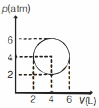
- 9An ideal gas undergoes a circular cycle centred at $4 \,atm , 4 L$ as shown in the diagram. The maximum temperature attained in this process is close toView Solution
- 10View SolutionThe given diagram shows four processes i.e., isochoric, isobaric, isothermal and adiabatic. The correct assignment of the processes, in the same order is given by