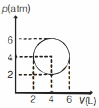
An ideal gas undergoes a circular cycle centred at $4 \,atm , 4 L$ as shown in the diagram. The maximum temperature attained in this process is close to
KVPY 2015, Advanced
Download our app for free and get started
(a)
From given cyclic process,
Process equation is
$(p-4)^2+(V-4)^2=4 \quad \dots(i)$
Now, from $p V=n R T$
We can say that $T$ is maximum when $p V$ is maximum.
Now, for given cyclic process, $p V$ maximum occur when $p^2 V^2$ is maximum.
Now,
$p^2 V^2=p^2\left(4-(p-4)^2\right)$ [from Eq. $(i)$]
Now, $p^2 V^2$ is maximum when $\frac{d}{d p} p^2 V^2=0$
$\Rightarrow \quad \frac{d}{d p}\left(p^2 \cdot\left(p^2 \cdot\left(4-(p-4)^2\right)=0\right.\right.$
$\Rightarrow \quad p^2-8 p+14=0$
$=4 \pm \sqrt{2}$
and from Eq. $(i)$, we get
$p=4 \pm \sqrt{2}, V=4 \pm \sqrt{2}$
Taking positive values, we have
$(p V)_{\max } \Rightarrow p=4+\sqrt{2}$
and $V=4+\sqrt{2}$
So, by gas equation, we have
$T_{\max } =\frac{(p V)_{\max }}{R} \quad \text { [for } 1 \,mol \text { of gas] }$
$=\frac{(4+\sqrt{2})(4+\sqrt{2})}{R}$
$=\frac{16+2+2 \times 4 \times \sqrt{2}}{R}$
$=\frac{29.32}{R}=\frac{30}{R}$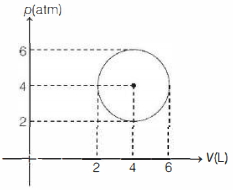

Download our appand get started for free
Experience the future of education. Simply download our apps or reach out to us for more information. Let's shape the future of learning together!No signup needed.*
Similar Questions
- 1A thermodynamic cycle takes in heat energy at a high temperature and rejects energy at a lower temperature. If the amount of energy rejected at the low temperature is $3$ times the amount of work done by the cycle, the efficiency of the cycle isView Solution
- 2$Assertion :$ In isothermal process whole of the heat supplied to the body is converted into internal energy.View Solution
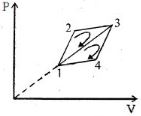
$Reason :$ According to the first law of thermodynamics : $\Delta Q = \Delta U + p\Delta V$ - 3The efficiency of a thermodynamic cycle $1-2-3- 1$ (see picture) is $20\%$ and for another thermodynamic cycle $1 - 3-4 - 1$ efficiency is equal to $10\%$. Determine the efficiency $\eta $ (in $\%$) of the thermodynamic cycle $1-2-3-4- 1.$The gas is assumed to be idealView Solution
- 4A thermodynamic system is taken form an initial state $i$ with internal energy $U_1=100 \ J$ to the final state along two different paths iaf and ibf, as schematically shown in the fire. The work done by the system along the paths $af$, ib and bf are $W _{ af }=200 \ J , W _{ ID }=50 \ J$ and $W _{ br }=100 \ J$ respectively. The heat supplied to the system along the path iaf, ib and bf are $Q_{\mid a t l} Q_{b r}$ and $Q_{10}$ respectively. If the internal energy of the sytem in the state $b$ is $U_b=$ $200 \ J$ and $Q_{l a t}=500 \ J$, the ratio $Q_{b J} / Q_{10}$ is:View Solution
- 5When an ideal gas $(\gamma = 5/3$) is heated under constant pressure, then what percentage of given heat energy will be utilised in doing external workView Solution
- 6View SolutionWhen a gas expands adiabatically
- 7The latent heat of vaporisation of water is $2240\, J/gm$. If the work done in the process of expansion of $1 \,g$ is $168 \,J$, then increase in internal energy is ....... $J$View Solution
- 8An ideal gas is expanded adiabatically at an initial temperature of $300 K$ so that its volume is doubled. The final temperature of the hydrogen gas is $(\gamma = 1.40)$View Solution
- 9For an ideal heat engine, the temperature of the source is $127\,^{\circ} C$. In order to have $60\, \%$ efficiency the temperature of the sink should be $........\,{ }^{\circ} C$. (Round off to the Nearest Integer)View Solution
- 10View SolutionWhat is the nature of change in internal energy in the following three thermodynamical processes shown in figure