MCQ
The continuous X-rays spectrum produced by an X-ray machine at constant voltage has
  • A
    A maximum wavelength
  • A minimum wavelength
  • C
    A single wavelength
  • D
    A minimum frequency

Answer

Correct option: B.
A minimum wavelength
Continuous spectrum of $X$-rays consists of radiations of all possible wavelength range having a definite short wavelength limit.

Need a full question paper?

Generate a complete, print-ready paper with questions like this in minutes — across 16+ boards, with answer keys.
Start Generating Free

Similar questions

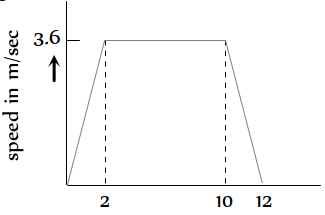
A lift is going up. The total mass of the lift and the passenger is $1500\  kg.$ The variation in the speed of the lift is as given in the graph. The tension in the rope pulling the lift at t=
Image
For protecting a sensitive equipment from the external magnetic field, it should be
A rod of length $l$ having uniformly distributed charge $Q$ is rotated about one end with constant frequency $'f'.$ Its magnetic moment
An ammeter reads upto $1\, ampere$. Its internal resistance is $0.81\, ohm$. To increase the range to $10\, A$ the value of the required shunt is ............ $\Omega $
Which of one is correct
A beaker containing liquid is placed on a table, underneath a microscope which can be moved along a vertical scale. The microscope is focussed, through the liquid onto a mark on the table when the reading on the scale is $a$. It is next focussed on the upper surface of the liquid and the reading is $b$. More liquid is added and the observations are repeated, the corresponding readings are $c$ and $d$. The refractive index of the liquid is
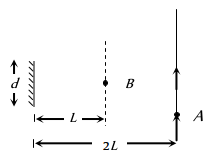
A point source of light $B$ is placed at a distance $L$ in front of the centre of a mirror of width $d$ hung vertically on a wall. A man walks in front of the mirror along a line parallel to the mirror at a distance $2 L$ from it as shown. The greatest distance over which he can see the image of the light source in the mirror is
Image
The image formed by an objective of a compound microscope is
In the Young's double slit experiment, if the phase difference between the two waves interfering at a point is $\phi$, the intensity at that point can be expressed by the expressionWhere $A$ and $B$ depend upon the amplitudes of the two waves.
In a common base amplifier the phase difference between the input signal voltage and the output voltage is