નીચે આપેલી પ્રક્રિયામાં $C{H_3} - C{H_2} - C{H_2} - C{H_3} \xrightarrow[475\, K]{H_2SO_4}$
AIIMS 1983, Medium
Download our app for free and get started
a
(a) \(C{H_3} - C{H_2} - C{H_2} - C{H_3} \xrightarrow[475\, K]{H_2SO_4}\) \(\mathop {C{H_3} - CH = CH - C{H_3}}\limits_{{\rm{More \,symmetrical\,}}\,({\rm{major}}\,{\rm{\,product)}}} \)
(a) \(C{H_3} - C{H_2} - C{H_2} - C{H_3} \xrightarrow[475\, K]{H_2SO_4}\) \(\mathop {C{H_3} - CH = CH - C{H_3}}\limits_{{\rm{More \,symmetrical\,}}\,({\rm{major}}\,{\rm{\,product)}}} \)
\(C{H_3} - C{H_2} - C{H_2} - C{H_3}\xrightarrow[{475\,K}]{{{H_2}S{O_4}}} \)\(\mathop {C{H_2} = CH - C{H_2} - C{H_3}}\limits_{{\text{Less}}{\mkern 1mu} {\text{symmetrical}}{\mkern 1mu} {\text{or}}{\mkern 1mu} {\text{unsymmetrical}}{\mkern 1mu} ({\text{minor}}{\mkern 1mu} {\text{product}})} \)
It is based on Saytzeff's rule. According to this more symmetrical or more alkylated alkene predominates.

Download our appand get started for free
Experience the future of education. Simply download our apps or reach out to us for more information. Let's shape the future of learning together!No signup needed.*
Similar Questions
- 1બેન્ઝિનમાં બધા જ કાર્બનો વચ્ચે $C - C$ બંધ લંબાઈ સમાન છે કારણ કે...View Solution
- 2$CH_3-C \equiv C - CH_3$ $\xrightarrow{{NaN{H_2}}}$ $X$ તો $X$ =.........View Solution
- 3View Solutionનીચે આપેલા પૈકી ક્યું સંયોજન એ એરોમેટિક સંયોજન નથી?
- 4કયા પદાર્થ એમોનિકલ $AgNO_3$ ના દ્રાવણ સાથે પ્રક્રીયા કરવા સક્ષમ છે ?View Solution
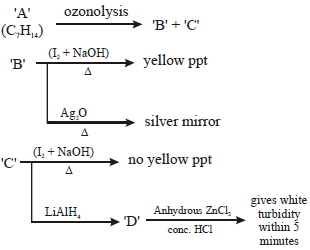
- 5નીચેની પ્રક્રિયાઓ ધ્યાનમાં લો , $A$ શું છે?View Solution
- 6View Solutionઆમાંના કયા પ્રતિ-માર્કોનિકોવના નિયમનું પાલન કરતા નથી
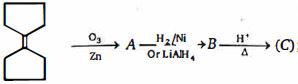
- 7આ પ્રકિયા માં નીપજ $(C)$ શું હશે ?View Solution
- 8View Solutionનીચેનામાથી દહન ઉષ્મા વિશે કયું ખોટું વિધાન છે?
- 9$C{H_2} = C{H_2}\mathop {\xrightarrow{{KMn{O_4}}}}\limits_{KOH/{H_2}O} X\, = \,......$View Solution
- 10નીચેની શૃંખલામાં $Z$ શું હશે?View Solution
$C{H_2} = C{H_2}\xrightarrow{{HBr}}X\xrightarrow{{{\text{Hydrolysis}}}}Y\mathop {\xrightarrow{{N{a_2}C{O_3}}}}\limits_{{I_2}{\text{ excess}}} Z$