MCQ
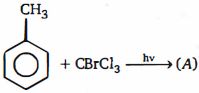
(no ring substitution) Product $(A)$ is
- A$Ph -CH_2 -Cl$
- ✓$Ph -CH_2 -Br$
- C$Ph -CH_2 -CCl_3$
- D$Ph -CH_2 -CBrCl_2$
$\begin{gathered}
CBrC{l_3}\xrightarrow{{hv}}B{r^ \bullet }{ + ^ \bullet }CC{l_3} \hfill \\
PhC{H_3}\xrightarrow{{ \bullet CC{l_3}}}CHC{l_3} + PhC{H_2\bullet},\xrightarrow{{CBrC{l_3}}}PhC{H_2}Br + \,\,\bullet CC{l_3} \hfill \\
\end{gathered}$, etc
Attack by the free radical on toluene occurs at the methyl side chain and not in the ring because the $C - H$ bond in $Me$ is weaker than that of a ring- hydrogen atom and the benzyl free radical is far more stable than an aryl free radical.
The other point that requires explanation is why toluene is attacked by the $CCl_3$ free radical and not by the bromine free radical. Activation energies involving free radicals are usually very low and so the controlling factor is the heat of reaction (or, more correctly, the free energy of reaction). The more exothermic the reaction (greater is $\Delta G$), the more favoured is that reaction. If the bromine atom attacks, the result is $HBr$ , the bond of which is much weaker than the $C - H$ bond formed when $^\bullet CCl_3$ attacks. Hence, reaction
proceeds by the later route.
Generate a complete, print-ready paper with questions like this in minutes — across 16+ boards, with answer keys.
$A_{2(g)} + B_{2(g)} \rightleftharpoons 2AB_{(g)}$
At equilibrium, the concentration of $A_2= 3.0 \times 10^{-3} \, M,$ of $B_2= 4.2 \times 10^{-3} \, M,$ of $AB= 2.8 \times 10^{-3} \, M,$
If the reaction takes place in a sealed vessel at $527^o C,$ then the value of $K_c$ will be