Question
Number of molecules which must collide simultaneously to give product is called molecularity. It is equal to sum of coefficients of reactants present in stoichiometric chemical equation.
For reaction, $m_1A + m_2B \rightarrow$ Product
Molecularity $= [m_1 + m_2]$
ln complex reaction each step has its own molecularity which is equal to the sum of coefficients of reactants present in a particular step. Molecularity is a theoretical property. Its value is any whole number. Number of concentration terms on which rate of reaction depends is called order of reaction or sum of powers of concentration terms present in the rate equation is called order of reaction.
If rate equation ofreaction is: Rate $=\text{k}\cdot\text{C}^{\text{m}_1}_\text{A}\cdot\text{C}^{\text{m}_2}_\text{B}$
Then order of reaction $= m_1 + m_2.$
ln simple reaction, order and molecularity are same.
ln complex reaction, order of slowest step is the order ofover all reaction. This step is known as rate determining step. Order is an experimental property. Its value may be zero, fractional or negative.
The following questions are multiple choice questions. Choose the most appropriate answer:
  1. Higher order$(> 3)$ reactions are rare due to:
  1. Shifting of equilibrium towards reactants due to elastic collisions.
  2. Loss of active species on collision.
  3. Low probability of simultaneous collision of all the reacting species.
  4. Increase in entropy and activation energy as more molecules are involved.
  1. The molecularity of the reaction:
$6\text{FeSO}_4+3\text{H}_2\text{SO}_4+\text{KClO}_3\rightarrow\text{KCl}+3\text{Fe}_2(\text{SO}_4)_3+3\text{H}_2\text{O}$ is:
  1. $6$
  2. $10$
  3. $3$
  4. $7$
  1. Which of the following statements is false in the following?
  1. Order of a reaction may be even zero.
  2. Molecularity of a reaction is always a whole number.
  3. Molecularity and order always have same values for a reaction.
  4. Order of a reaction depends upon the mechanism of the reaction.
  1. The rate of reaction, $A + 2B →$ products, is given by the following equation:
$-\frac{\text{d}[\text{A}]}{\text{dt}}=\text{k}[\text{A}][\text{B}]^2$

If $B$ is present in large excess, the order of the reaction is:
  1. Zero
  2. First
  3. Second
  4. Third
  1. The rate of the reaction, $A + B + C →$ products, is given by $\text{r}=\frac{\text{d}[\text{A}]}{\text{dt}}=\text{k}[\text{A}]^\frac{1}{2}[\text{B}]^\frac{1}{3}[\text{C}]^\frac{1}{4}.$ The order of the reaction is:
  1. $\frac{1}{3}$
  2. $\frac{1}{4}$
  3. $\frac{1}{2}$
  4. $\frac{13}{12}$

Answer

  1. (c) Low probability of simultaneous collision of all the reacting species.
Explanation:
The reactions of higher order are very rare because of the less chances of the molecules to come together simultaneously and collide.
  1. (c) $3$
Explanation:
The total number of reactant molecules participating in a chemical reaction is known as its molecularity, hence the molecularity $= 6 + 3 + 1 = 10.$
  1. (c) Molecularity and order always have same values for a reaction.
Explanation:
Molecularity may or may not be equal to the order of a reaction.
  1. (b) First
Explanation:
From the expression
$-\frac{\text{d}[\text{A}]}{\text{dt}}=\text{k}[\text{A}][\text{B}]^2$
when B is present in large excess, rate will be independent upon the change in cone. of B, therefore order of reaction will be one.
  1. (d) $\frac{13}{12}$
Explanation:
Order of reaction $=\frac{1}{2}+\frac{1}{3}+\frac{1}{4}=\frac{6+4+3}{12}=\frac{13}{12}$

Need a full question paper?

Generate a complete, print-ready paper with questions like this in minutes — across 16+ boards, with answer keys.

Start Generating Free

Similar questions

Read the passage given below and answer the following questions:
The halogen elements show great resemblances to one another in their chemical behaviour and properties of their compounds with other elements. There is, however, a progressive change in properties from F through $Cl, Br,$ and I to At. F is most reactive among the halogens and in fact, from all other elements and it has certain other properties that set it apart from the other halogens.
In these questions (Q.No. i - iv), a statement of assertion followed by a statement of reason is given. Choose the correct answer out of the following choices.
  1. Assertion and reason both are correct statements and reason is correct explanation for assertion.
  2. Assertion and reason both are correct statements but reason is not correct explanation for assertion.
  3. Assertion is correct statement but reason is wrong statement.
  4. Assertion is wrong statement but reason is correct statement.
  1. Assertion: $F_2 $ has high reactivity.
Reason: $F_2$ has low bond dissociation enthalpy.
  1. Assertion: The bond between $F - F$ is weaker than between $Cl - Cl.$
Reason: Atomic size of $F$ is smaller than that of $Cl.$
  1. Assertion: Fluoride does not show oxidation number greater than zero.
Reason: The halogens chlorine, bromine and iodine can show positive oxidation state of $+1, +3$ and $+7.$
  1. Assertion: F atom has less negative electron affinity than Cl atom.
Reason: Additional electrons are repelled more effectively by $3p-$electrons in $Cl$ than by $2p-$electrons in Fatom.
  1. Assertion: Fluorine is strongest oxidising agent in halogens.
Reason: It displaces other halogens from its aqueous solution.
Read the passage given below and answer the following questions:
The concentration of a solute is very important in studying chemical reactions because it determines how often molecules collide in solution and thus indirectly determine the rate of reactions and the conditions at equilibrium. There are several ways to express the amount of solute present in a solution. The concentration of a solution is a measure of the amount of solute that has been dissolved in a given amount of solvent or solution. Concentration can be expressed in terms of molarity, molality, parts per million, mass percentage, volume percentage, etc.
The following questions are multiple choice questions. Choose the most appropriate answer:
  1. A solution is prepared using aqueous Kl which is turned out to be $20\%$ w/w Density of Kl is $1.202$ g/mL the molality of the given solution and mole fraction of solute are respectively.
  1. $1.95m, 0.120$
  2. $1.5m, 0.0263$
  3. $2.5m, 0.0569$
  4. $3.0m, 0.0352$
  1. The molarity $($in $mol\ L^{-1})$ of the given solution will be.
  1. $1.56$
  2. $1.89$
  3. $0.263$
  4. $1.44$
  1. Which of the following is correct relationship between mole fraction and molality?
  1. $\text{x}_2=\frac{\text{mM}_1}{1+\text{mM}_1}$
  2. $\text{x}_2=\frac{\text{mM}_1}{1-\text{mM}_1}$
  3. $\text{x}_2=\frac{1+\text{mM}_1}{\text{mM}_1}$
  4. $\text{x}_2=\frac{1-\text{mM}_1}{\text{mM}_1}$
  1. Which of the following is temperature dependent?
  1. Molarity
  2. Molality
  3. Mole fraction
  4. Mass percentage
  1. Which of the following is true for an aqueous solution of the solute in terms of concentration?
  1. $1M = 1m$
  2. $1M > 1m$
  3. $1M < 1m$
  4. Cannot be predicted
Read the passage given below and answer the following questions:
Under the normal conditions, noble gases are monoatomic and have closed shell electronic configuration. Lighter noble gases have low boiling points due to weak dispersion forces between the atoms and the absence of other interatomic interactions. Xenon, one of the important noble gas, forms a series of compounds with fluorine with oxidation number $+2, +4$ and $+6.$ All xenon fluorides are strong oxidising agents. $XeF_4$ reacts violently with water to give $XeO_3.$ The geometry of xenon compounds can be deduced by considering the total number of electron pairs in their valence shell.
The following questions are multiple choice questions. Choose the most appropriate answer:
  1. Among noble gases (from He to Xe) only xenon reacts with fluorine to form stable xenon fluorides because xenon.
  1. Has the largest size.
  2. Has the lowest ionisation enthalpy.
  3. Has the highest heat ofvapourisation.
  4. Is the most readily available noble gas.
  1. The structure of $XeO_3$ is:
  1. Square planar.
  2. Pyramidal.
  3. Linear.
  4. T-shaped.
  1. $XeF_6$ is expected to be.
  1. Oxidising agent.
  2. Reducing agent.
  3. Unreactive.
  4. Strongly basic.
  1. In the preparation of compound of xenon, Bartlett had taken $\text{O}_2^+\text{PtF}_6^-$ as a base compound. This is because,
  1. Both $O_2$ and $Xe$ have same size.
  2. Both $Xe$ and $O_2$ have same electron gain enthalpy.
  3. Both have almost same ionisation enthalpy.
  4. Both $Xe$ and $O_2$ are gases.
  1. The oxidation state of xenon in $XeO_3$ is:
  1. $+4$
  2. $+2$
  3. $+8$
  4. $+6$
In these questions, a statement of assertion followed by a statement of reason is given. Choose the correct answer out of the following choices.
Assertion: Soap and detergent are macromolecular colloids.
Reason: Macromolecular colloids are formed by molecules of large size.
The potential of each electrode is known as electrode potential. Standard electrode potential is the potential when concentration of each species taking part in electrode reaction is unity and the reaction is taking place at 298K. By convention, the standard electrode potential of hydrogen (SHE) is $0.0V.$ The electrode potential value for each electrode process is a measure of relative tendency of the active species in the process to remain in the oxidised/ reduced form. The negative electrode potential means that the redox couple is stronger reducing agent than $\frac{\text{H}^+}{\text{H}_2}$ couple. A positive electrode potential means that the redox couple is a weaker reducing agent than the $\frac{\text{H}^+}{\text{H}_2}$ couple. Metals which have higher positive value of standard reduction potential form the oxides of greater thermal stability.
In these questions (Q. No. i-iv), a statement of assertion followed by a statement ofreason is given. Choose the correct answer out of the following choices.
  1. Assertion and reason both are correct statements and reason is correct explanation for assertion.
  2. Assertion and reason both are correct statements but reason is not correct explanation for assertion.
  3. Assertion is correct statement but reason is wrong statement.
  4. Assertion is wrong statement but reason is correct statement.
  1. Assertion: An electrochemical cell can be set-up only if the redox reaction is spontaneous.
Reason: A reaction is spontaneous if the free energy change is negative.
  1. Assertion: The standard electrode potential of hydrogen is $0.0V.$
Reason: It is by convention.
  1. Assertion: The more negative is the standard reduction potential, greater is its ability to displace $H_2$ from acid.
Reason: Strength of reducing agent increases with the increase in negative value of the standard reduction potential.
  1. Assertion: The negative value of standard reduction potential means that reduction takes place on this electrode with reference to hydrogen electrode.
Reason: The standard electrode potential of a half cell has a fixed value.
  1. Assertion: The absolute value of electrode potential cannot be determined experimentally.
Reason: The electrode potential values are generally determined with respect to SHE.
Read the passage given below and answer the following questions:
Aldehydes and ketones are reduced to primary and secondary alcohols respectively by $NaBH_4$ or $LiAlH_4$ as well as catalytic hydrogenation. The carbonyl group of aldehydes and ketones is reduced to group on treatment with Zn-Hg and cone. HCl (Clemmensen reduction) or with hydrazine followed by NaOH or KOH in highly boiling solvent such as ethylene glycol (Wolff-Kishner reduction).Aldehydes differ from ketones in their oxidation reactions. Aldehydes are easily oxidised to carboxylic acids on treatment with $HNO_3, KMnO_4, K_2Cr_2O_7$ etc. Even mild oxidising agents mainlyTollens' reagent and Fehling's solution also oxidise aldehydes. Ketones are generally oxidised under vigorous conditions i.e., strong oxidising agents and at elevated temperatures, to give mixture of carboxylic acids having lesser number of C-atoms than the parent ketone.
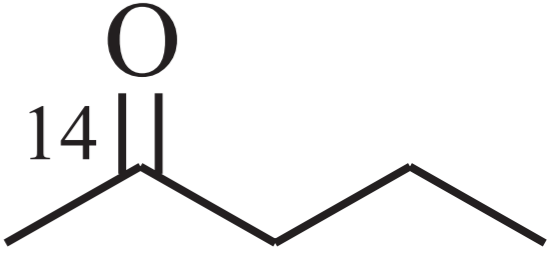
The following questions are multiple choice questions. Choose the most appropriate answer:
  1. Which of the following cannot be made by reduction of ketone or aldehyde with $NaBH_4$ in methanol?
  1. 1-Butanol
  2. 2-Butanol
  3. 2-Methyl-1-propanol
  4. 2-Methyl-2-propanol
  1. The carbonyl compound producing an optically active product by reaction with $LiAlH_4$ is:
  1. Propanone
  2. Butanone
  3. 3-pentanone
  4. Benzophenone
  1. A substance $C_4H_{10}O (X)$ yields on oxidation a compound $C_4H_8O$ which gives an oxime and a positive iodoform test. The substance X on treatment with cone. $H_2SO_4$ gives $C_4H_8$. The structure of the compound (X) is:
  1. $CH_3CH_2CH_2CH_2OH$
  2. $CH_3CH(OH)CH_2CH_3$
  3. $(CH_3)_3COH$
  4. $CH_3CH_2- O - CH_2CH_3$
  1. In the oxidation of by acidified $K_2Cr_2O_7​​​​​​​$, the products are:
  1. $\ \ \ \ \ \ \ \ \ \ \ \ \ \ \ \ \text{O}\\\ \ \ \ \ \ \ \ \ \ \ \ \ \ \ \ ||\\\text{CH}_3-\ ^\text{14}\text{C}-\text{OH}$ and $\text{CH}_3\text{CH}_2\text{COOH}$
  2. $\ \ \ \ \ \ \ \ \ \ \ \ \ \ \ \ \ \ \ \ \ \ \ \ \ \ \ \ \ \ \ \ \ \ \ \ \text{O}\\ \ \ \ \ \ \ \ \ \ \ \ \ \ \ \ \ \ \ \ \ \ \ \ \ \ \ \ \ \ \ \ \ \ \ \ \ \ ||\\\text{CH}_3(\text{CH}_2)_2\text{COOH}-\text{C}-\text{OH}$ and $ \ \ \ \ \ \ \ 14\\\text{CH}_3\text{CH}_2\text{COOH}$
  3. $\ \ \ \ \ \ \ \ \ \ \ \ \ \ \ \ \ \ \ \ \ \ \ \ \ \ \ \ \ \ \ \ \ \ \ \ \ \ \ \ \ \ 14\\\text{CH}_3\text{CH}_2\text{CH}_2\text{COOH}+\text{HCOOH}$
  4. None of these.
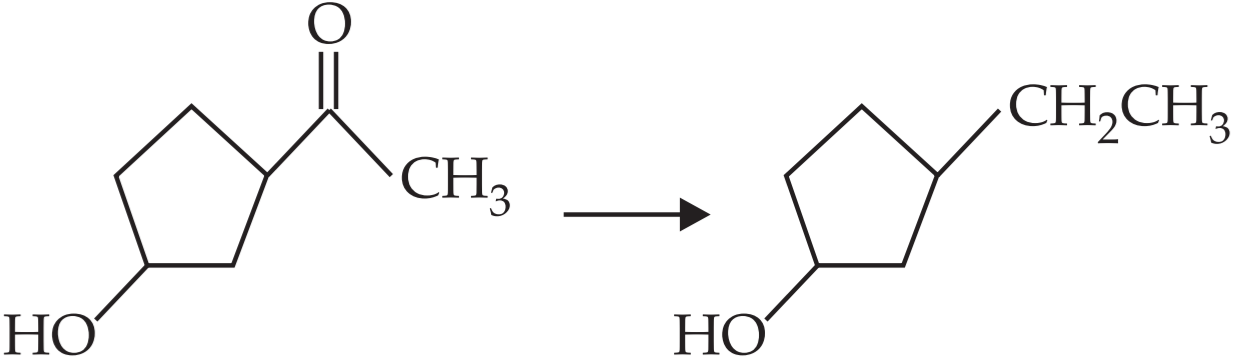
  1. The appropriate reagent for the following transformation is:
  1. $\text{Na}_2\text{NH}_2,^-\text{OH}$
  2. $\text{NaBH}_4$
  3. $\frac{\text{H}_2}{\text{Ni}}$
  4. $\text{AICl}_3$
Read the passage given below and answer the following questions:
All the elements of group $16$ have $ns^2np^4$ configuration in their outermost shell. Therefore, the atoms of these elements try to gain or share two electrons to achieve noble gas configuration. Sulphur and other elements of group $16$ are less electronegative than oxygen, so, they cannot accept electrons easily. By sharing of two electrons with other elements, these elements acquire $ns^2np^6$ configuration and exhibit $+2$ oxidation state. Except oxygen, group $16$ elements have vacant d-orbitals in their valence shell to which electrons Call be promoted from P- and s-orbitals of the same shell As a result, they Call show $+4$ and $+6$ oxidation states also.
The following questions are multiple choice questions. Choose the most appropriate answer:
  1. Oxygen shows $+2$ oxidation state in.
  1. $OF_2$​​​​​​​
  2. $H_2O$
  3. $CI_2O$
  4. $H_2O_2$
  1. Like sulphur, oxygen is not able to show $+4$ and $+6$ oxidation states because?
  1. Oxygen is a gas while sulphur is a solid.
  2. Sulphur has high ionisation enthalpy as compared to oxygen.
  3. Oxygen has nod-orbitals in its valence shell.
  4. Oxygen has high electron affmity as compared to sulphur.
  1. Compounds of sulphur with $+4$ oxidation state acts as a/ an.
  1. Oxidising agent.
  2. Reducing agent.
  3. Both oxidising as well as reducing agen.
  4. Cannot be predicted.
  1. Oxidation state of sulphur in $Na_2S_4O_6$​​​​​​​ is:
  1. $\frac{7}{2}$
  2. $\frac{5}{2}$
  3. $\frac{1}{2}$
  4. $\frac{3}{2}$
  1. The oxidation states of sulphur in $S_8, SO_3​​​​​​​$​​​​​​​ and $H_2S$ are respectively.
  1. $0, +6$ and $-2$
  2. $+6, 0$ and $-2$
  3. $-2, 0$ and $+6$
  4. $+2, +6$ and $-2$
Read the passage given below and answer the following questions:
Fehling's reagent: Fehling's reagent is a mixture of two solutions. Fehllng's solution A is aqueous copper sulphate solution. Fehling's solution Bis alkaline sodium potassium tartarate (Rochelle salt).
$\ \ \ \ \ \ \ \ \ \ \ \ \ \ \ \ \ \ \ \ \text{CH(OH)COONa}\\\text{CuSo}_{4\text{(aq)}}+|\\\ \ \ \ \ \ \ \ \ \ \ \ \ \ \ \ \ \ \ \ \text{CH(OH)COOK}$
It is a mild oxidising agent. It is weaker than Tollens' reagent. It oxidises only aliphatic aldehydes to carboxylate ions and itself gets reduced to reddish brown precipitate of cuprous oxide. Aromatic aldehydes do not respond to Fehling's test. This reaction is used for the test of aliphatic aldehydes known as Fehling's reagent test.
In these questions (Q. No. l-iv), a statement of assertion followed by a statement ofreason is given. Choose the correct answer out of the following choices.
  1. Assertion and reason both are correct statements and reason is correct explanation for assertion.
  2. Assertion and reason both are correct statements but reason is not correct explanation for assertion.
  3. Assertion is correct statement but reason is wrong statement.
  4. Assertion is wrong statement but reason is correct statement.
  1. Assertion: Fehling's solution can be used to distinguish between acetaldehyde and acetone.
Reason: Fehling's reagent is a mixture of two solutions.
  1. Assertion: Aromatic aldehydes can be distinguished from aliphatic aldehydes by Fehling's solution.
Reason: Aromatic aldehydes reduce Fehling's solution, but aliphatic aldehydes do not.
  1. Assertion: Fehling's solution oxidises acetaldehyde to acetic acid but not benzaldehyde to benzoic acid.
Reason: The $C-H$ bond of $-CHO$ group in benzaldehyde is stronger than in acetaldehyde.
  1. Assertion: $CH_3CHO$ and $C_6H_5CH_2CHO$ cannot be distinguished chemically by Fehling's solution.
Reason: $CH_3CHO$ and $C_6H_5CH_2CHO$ cannot be distinguished chemically by Fehling's solution.
  1. Assertion: Formaldehyde, when heated with Fehling's reagent produces a reddish brown ppt, of Cu.
Reason: Fehling's reagent oxidises fonnaldehyde to formate ion.
Nemst equation relates the reduction potential of an electrochemical reaction to the standard potential and activities of the chemical species undergoing oxidation and reduction.
Let us consider the reaction, $\text{M}^{\text{n+}}_{(\text{aq})}\xrightarrow{\ \ \ \ \ \ \ \ }\text{nM}_\text{(s)}$
For this reaction, the electrode potential measured with respect to standard hydrogen electrode can be given as
$\text{E}_{\Big(\frac{\text{M}^{\text{n+}}}{\text{M}}\Big)}=\text{E}^\circ_{\Big(\frac{\text{M}^\text{n+}}{\text{M}}\Big)}-\frac{\text{RT}}{\text{nF}}\text{ln}\frac{[\text{M}]}{[\text{M}^{\text{n}+}]}$
In these questions (Q. No. i-iv), a statement of assertion followed by a statement ofreason is given. Choose the correct answer out of the following choices.
  1. Assertion and reason both are correct statements and reason is correct explanation for assertion.
  2. Assertion and reason both are correct statements but reason is not correct explanation for assertion.
  3. Assertion is correct statement but reason is wrong statement.
  4. Assertion is wrong statement but reason is correct statement.
  1. Assertion: For concentration cell, $\text{Zn}_{(\text{s})}|\text{ Zn}^{2+}_{\text{(aq)}}||\text{ Zn}^{2+}_{(\text{aq})}|\text{ Zn}\\\ \ \ \ \ \ \ \ \ \ \ \ \text{C}_1\ \ \ \ \ \ \ \ \text{C}_2$
For spontaneous cell reaction, $C_1 < C_2$
Reason: For concentration cell, $\text{E}_\text{cell}=\frac{\text{RT}}{\text{nF}}\log\frac{\text{C}_2}{\text{C}_1}$
For spontaneous reaction, $\text{E}_\text{cell}=+\text{ve}\Rightarrow\text{C}_2>\text{C}_1$
  1. Assertion: For the cell reaction, $\text{Zn}_{(\text{s})}+\text{Cu}^{2+}_{(\text{aq})}\xrightarrow{\ \ \ \ \ }\text{Zn}^{2+}_{(\text{aq})}+\text{Cu}_{(\text{s})}$ voltmeter gives zero reading at equilibrium.
Reason: At the equilibrium, there is no change in concentration of Cu2+ and Zn2+ ions.
  1. Assertion: The Nernst equation gives the concentration dependence of emf of the cell.
Reason: In a cell, current flows from cathode to anode.
  1. Assertion: Increase in the concentration of copper half cell in a cell, increases the emfofthe cell.
Reason: $\text{E}_\text{cell}=\text{E}^\circ_\text{cell}+\frac{0.059}{2}\log\frac{[\text{Cu}^{2+}]}{[\text{Zn}^{2+}]}$
  1. Assertion: Electrode potential for the electrode $\frac{\text{Mn}^+}{\text{Mn}}$ with concentration is given by the expression under STP conditions.
$\text{E}=\text{E}^\circ+\frac{0.059}{\text{n}}\log[\text{Mn}^{+}]$
Reason: STP conditions require the temperature to be 273K.
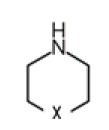
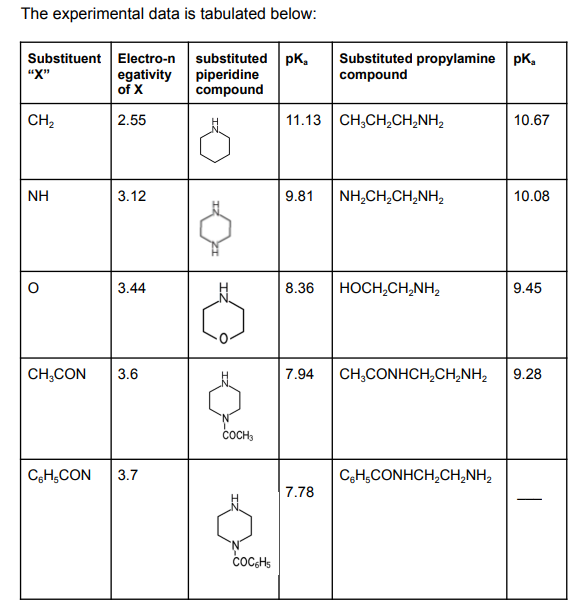
Amines are basic in nature. The $pK_b$ value is a measure of the basic strength of an amine. Lower the value of $pK_b$ more basic is the amine. The effect of substituent on the basic strength of amines in aqueous solution was determined using titrations. The substituent $"X"$ replaced $"-CH_2"$ group in piperidine $($ compound $1)$ and propylamine $CH_3CH_2CH_2NH_2, ($compound $2).$
Compound $1:$
Image
Compound $2: HXCH_2CH_2NH_2$
Image
(source: Hall Jr, $H. K. (1956).$ Field and inductive effects on the base strengths of amines. Journal of the American Chemical Society, $78(11), 2570-2572.) $
Study the above data and answer the following questions:
$a.$ Plot a graph between the electronegativity of the substituent vs $pK_b$ value of the corresponding substituted propyl amine $($ given that $pK_a + pK_b =14).$ Is there any relation between the electronegativity of the substituent and its basic strength?
$b.$ The electronegativity of the substituent $"C6H5CON\ "$ is $3.7,$ what is the expected pKa value of compound $C_6H_5CONHCH_2CH_2NH_2?$
$(i) \ 9.9 \ (ii) \ 9.5 \ (iii) \ 9.3 \ (iv) \ 9.1$
$c.$ The pKa value of the substituted piperidine formed with substituent $"X\ "$ is found to be $8.28.$ What is the expected electronegativity of $"X\ "$
$(i)\ 3.5 \ (ii)\ 3.4 \ (iii)\ 3.8\ (iv) \ 3.1$