Question
Read the passage given below and answer the following questions:
Under the normal conditions, noble gases are monoatomic and have closed shell electronic configuration. Lighter noble gases have low boiling points due to weak dispersion forces between the atoms and the absence of other interatomic interactions. Xenon, one of the important noble gas, forms a series of compounds with fluorine with oxidation number $+2, +4$ and $+6.$ All xenon fluorides are strong oxidising agents. $XeF_4$ reacts violently with water to give $XeO_3.$ The geometry of xenon compounds can be deduced by considering the total number of electron pairs in their valence shell.
The following questions are multiple choice questions. Choose the most appropriate answer:
Under the normal conditions, noble gases are monoatomic and have closed shell electronic configuration. Lighter noble gases have low boiling points due to weak dispersion forces between the atoms and the absence of other interatomic interactions. Xenon, one of the important noble gas, forms a series of compounds with fluorine with oxidation number $+2, +4$ and $+6.$ All xenon fluorides are strong oxidising agents. $XeF_4$ reacts violently with water to give $XeO_3.$ The geometry of xenon compounds can be deduced by considering the total number of electron pairs in their valence shell.
The following questions are multiple choice questions. Choose the most appropriate answer:
- Among noble gases (from He to Xe) only xenon reacts with fluorine to form stable xenon fluorides because xenon.
- Has the largest size.
- Has the lowest ionisation enthalpy.
- Has the highest heat ofvapourisation.
- Is the most readily available noble gas.
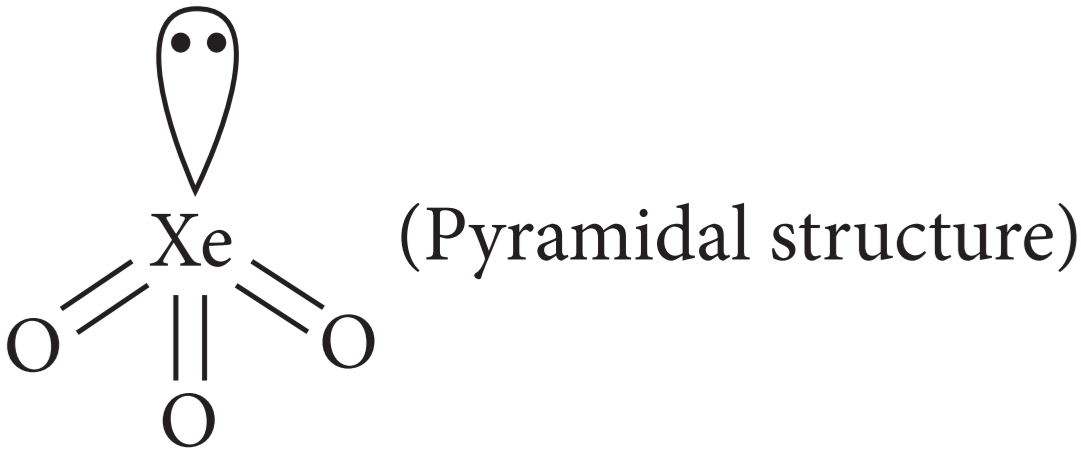
- The structure of $XeO_3$ is:
- Square planar.
- Pyramidal.
- Linear.
- T-shaped.
- $XeF_6$ is expected to be.
- Oxidising agent.
- Reducing agent.
- Unreactive.
- Strongly basic.
- In the preparation of compound of xenon, Bartlett had taken $\text{O}_2^+\text{PtF}_6^-$ as a base compound. This is because,
- Both $O_2$ and $Xe$ have same size.
- Both $Xe$ and $O_2$ have same electron gain enthalpy.
- Both have almost same ionisation enthalpy.
- Both $Xe$ and $O_2$ are gases.
- The oxidation state of xenon in $XeO_3$ is:
- $+4$
- $+2$
- $+8$
- $+6$