MCQ
Number of moles of methane required to produce $22 \mathrm{~g} \mathrm{CO}_{2(\mathrm{~g})}$ after combustion is $\mathrm{x} \times 10^{-2}$ moles. The value of $\mathrm{x}$ is
- A$30$
- B$40$
- ✓$50$
- D$60$
$\mathrm{n}_{\mathrm{CO}_2}=\frac{22}{44}=0.5 \mathrm{moles}$
So moles of $\mathrm{CH}_4$ required $=0.5$ moles i.e. $50 \times 10^{-2} \mathrm{~mole}$
x=$50$
Generate a complete, print-ready paper with questions like this in minutes — across 16+ boards, with answer keys.
$\begin{array}{*{20}{c}}
{C{H_3} - C{H_2} - CH - C{H_3}}\\
{\,\,\,\,\,\,\,\,\,|}\\
{\,\,\,\,\,\,\,\,\,\,F\,}
\end{array}$ $\xrightarrow[\Delta ]{{alc.\,KOH}}$ $X$ (Major)
when attached to $sp^3$ hybridised carbon, their leaving group ability in nucleophilic substitution reaction decrease in the order.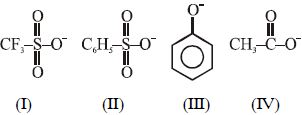
$2N{O_2}\left( g \right) \rightleftharpoons {N_2}{O_4}\left( g \right)$ is
$\left( {R = \frac{{25}}{3}J/K.mol,\ln 2 = 0.7,\ln 3 = 1.1} \right)$