Question
$O$ is any point inside a rectangle $\text{ABCD}$.Prove that: $OB^2+ OD^2= OC^2+ OA^2$.

Answer


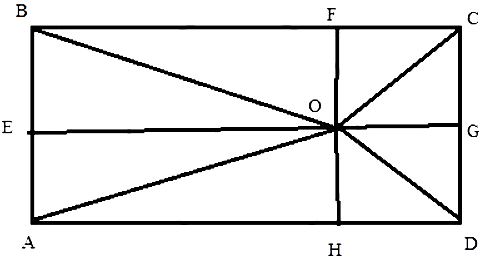
Draw rectangle $\text{ABCD}$ with arbitrary point $O$ within it,
and then draw lines $O A, O B, O C, O D$.
Then draw lines from point $O$ perpendicular to the sides: $OE , OF , OG , OH$.
Pythagoras theorem states that in a right$-$angled triangle,
the square on the hypotenuse is equal to the sum of the squares on the remaining two sides.
Using Pythagorean theorem we have from the above diagram:
$ O A^2=A H^2+O H^2=A H^2+A^2$
$ O C^2=C G^2+O G^2= EB ^2+ HD ^2$
$ O B^2=E O^2+ BE ^2=A H^2+ BE ^2$
$ O D^2= HD ^2+ OH ^2= HD ^2+ AE ^2$
Adding these equalities we get:
$O A^2+O C^2=A H^2+H D^2+A E^2+E B^2$
$ O B^2+O D^2=A H^2+H D^2+A E^2+E B^2$
From which we prove that for any point within the rectangle there is the relation
$O A^2+O C^2=O B^2+O D^2$
Hence Proved.

Need a full question paper?

Generate a complete, print-ready paper with questions like this in minutes — across 16+ boards, with answer keys.
Start Generating Free

Similar questions

The sum of the radii of two circles is 84 cm and the difference of their areas is $5544 cm ^2$ Calculate the radii of the two circles.
If $\left(x-\frac{1}{x}\right)=8$, find the values of  $\left(x^2-\frac{1}{x^2}\right)$.
A $\triangle ABC$ has $\angle B = \angle C$.Prove that: The perpendiculars from the mid$-$point of $BC$ to $AB$ and $AC$ are equal.
In the given figure, ABCD is a quadrilateral in which $BC =3 cm$, $AD =13 cm, DC =12 cm$ and $\angle ABD =$ $\angle BCD =90$. Calculate the length of AB .
Image
A room is $5\ m$ long, $2\ m$ broad and $4\ m$ high. Calculate the number of persons it can accommodate if each person needs $0.16\ m^3$ of air.
If two sides of a triangle are unequal, then the greater side has greater angle opposite to it.
Given: $\quad A \triangle A B C$ in which $A C > A B$.
To prove: $\quad \angle ABC >\angle ACB$.
Construction : Mark a point D on AC such that $AD = AB$. Join BD.
Proof.
Image

In $\triangle ABC, AB = AC$ and $BD$ is perpendicular to $AC.$Prove that: $BD^2- CD^2= 2CD \times AD.$
Solve the following simultaneous equations :$3(2u + v) = 7uv;3(u + 3v) = 11uv$
Image
The cross-section of a piece of metal 2 m in length is shown in the adjoining figure.
Calculate : (i) the area of its cross-section;
(ii) the volume of piece of metal;
(iii) the weight of piece of metal to the nearest kg, if 1 $cm ^3$ of the metal weighs 6.5 g.
Prove that:
$\left(\frac{x^a}{x^b}\right)^{\frac{1}{a b}} \cdot\left(\frac{x^b}{x^c}\right)^{\frac{1}{b c}} \cdot\left(\frac{x^c}{x^a}\right)^{\frac{1}{a c}}=1$