MCQ
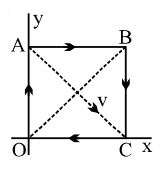
$OABC$ is a current carrying square loop an electron is projected from the centre of loop along its diagonal $AC$ as shown. Unit vector in the direction of initial acceleration will be
  • A
    $\hat k$
  • $ - \,\left( {\frac{{\hat i\, + \,\hat j}}{{\sqrt 2 }}} \right)$
  • C
    $=- \hat k$
  • D
    $\frac{{\hat i\, + \,\hat j}}{{\sqrt 2 }}$
Answer

Correct option: B.
$ - \,\left( {\frac{{\hat i\, + \,\hat j}}{{\sqrt 2 }}} \right)$
b
$\vec{F}=-e(\vec{V} \times \vec{B})$

Force will be along $B O$ or unit vector

$=-\frac{\hat{i}+\hat{j}}{\sqrt{2} a}$

Need a full question paper?

Generate a complete, print-ready paper with questions like this in minutes — across 16+ boards, with answer keys.

Start Generating Free

Similar questions

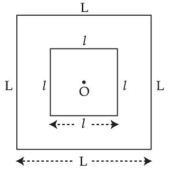
A small square loop of wire of side $l$ is placed inside a large square loop of wire $L(L \gg l)$. Both loops are coplanar and their centres coincide at point $O$ as shown in figure. The mutual inductance of the system is.
A laser beam of pulse power $10^{12}$ watt is focussed on an object are $10^{-4} \mathrm{~cm}^2$. The energy flux in watt/ $\mathrm{cm}^2$ at the point of focus is
Two wires of same material have length L and 2L and cross–sectional areas 4A and A respectively. The ratio of their specific resistance would be
Carbon resistor has resistance specified by three bands having colour red, yellow and black. If this resistor is cut into two pieces of equal length then the new colour code of each one will be (Neglect tolerance of $4^{th}$ band)
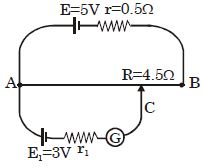
In the given potentiometer circuit length of the wire $AB$ is $3\,m$ and resistance is $R = 4.5 \,\Omega.$ The length $AC$ for no deflection in galvanometer is ................ $\mathrm{m}$
The work function of a certain metal is $2.3 \,eV$. ff light of wave number $2 \times 10^5 \,m ^{-1}$ falls on it, the kinetic energies of fastest and slowest ejected electron will be respectively
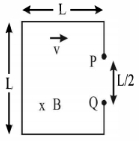
The loop shown moves with a velocity $v$ in a uniform magnetic field of magnitude B, directed into the paper. The potential difference between $P$ and $Q$ is e. Then :
A current of 10 ampere is flowing in a wire of length 1.5 m. A force of 15 N acts on it when it is placed in a uniform magnetic field of 2 tesla. The angle between the magnetic field and the direction of the current is
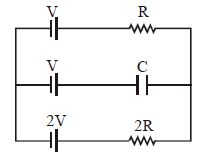
In the given circuit, with steady current, the potential drop across the capacitor must be
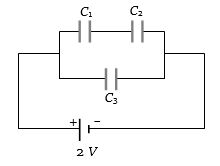
Two capacitors ${C_1} = 2\,\mu \,F$ and ${C_2}\, = \,6\,\mu \,F$ in series, are connected in parallel to a third capacitor ${C_3} = \,4\,\mu \,F$. This arrangement is then connected to a battery of $e.m.f.$ $=$ $2V$, as shown in the figure. How much energy is lost by the battery in charging the capacitors