Question
Image
Observe that the circular hole is the same as the centre of the square.
Construct a “Square with a Hole” as shown in the given figure. The centre of the hole is the same as the center of the square.
Hint: Think where the centre of the circle should be.

Answer

The centre of a square is the point of intersection of its diagonals. This centre is also the centre of the hole in the figure.
Step 1. Using a ruler, draw a line AB equal to 5 cm, say. Using a protractor, draw perpendicular lines at A and B. Using a ruler, mark point P on the perpendicular line at A such that AP = 5 cm. Using a ruler, mark point Q on the perpendicular line at B such that BQ = 5 cm. Join P and Q using a ruler. Erase the lines above P and Q (Fig. 1).
Image
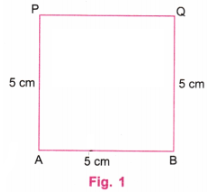
Step 2. Draw diagonals AQ and BP using a ruler. Let the diagonals intersect at C. This point is the centre of the square ABQP. Erase the diagonals AQ and BP. (Fig. 2).
Image
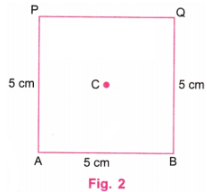
Step 3. With centre at C and a radius of 1.5 cm, say, draw a circle using a compass. (Fig. 3)
Image
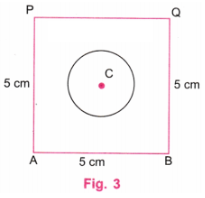
Step 4. Fig. 3 is the required “Square with a Hole”.

Need a full question paper?

Generate a complete, print-ready paper with questions like this in minutes — across 16+ boards, with answer keys.

Start Generating Free

Similar questions

Use a pair of compasses and construct the following angles: $150^\circ $
In a college, out of $4320$ students, $2300$ are girls. Find the ratio of number of boys to the total number of students.
How many little squares are there in each shape of the sequence of stacked squares? Which number sequence does this give? Can you explain, why?
The pictograph shown different subject books which are kept in a library.

$i.\ $How many English books are there in the library?
$ii.\ $How many maths books are there?
$iii.\ $Which books are maxmimum in number?
$iv.\ $Which books are minimum in number?
Fill in the missing fraction: $\square-\frac3{21}\;=\;\frac5{21}$
What part of a revolution have you turned through if you stand facing south and turn clockwise to face east?
Draw a reactangle whose two adjacent sides are $5.4\ cm$ and $3.5\ cm.$
In a mathematics test following marks were obtained by $40$ students of class $VI$. Arrange these marks in a table using, tally marks.
$8$
$1$
$3$
$7$
$6$
$5$
$5$
$4$
$4$
$2$
$4$
$9$
$5$
$3$
$7$
$1$
$6$
$5$
$2$
$7$
$7$
$3$
$8$
$4$
$2$
$8$
$9$
$5$
$8$
$6$
$7$
$4$
$5$
$6$
$9$
$6$
$4$
$4$
$6$
$6$
$i.\ $Find how many students obtained marks equal to or more than $7$?
$ii.\ $How many students obtained marks below $4$?
How many little triangles are there in each shape of the sequence of stacked triangles? Which number sequence does this give? Can you explain why?
Find. Write and indicate how you solved this. Is $\frac9{16}$ equal to$\frac59$?