Question
Observe the toothpick pattern given below: 

$a.$ Imagine that this pattern continues. Complete the table to show the number of toothpicks in the first six terms.
Pattern
$1$
$2$
$3$
$4$
$5$
$6$
Toothpicks
$4$
 
 
$15$
 
 
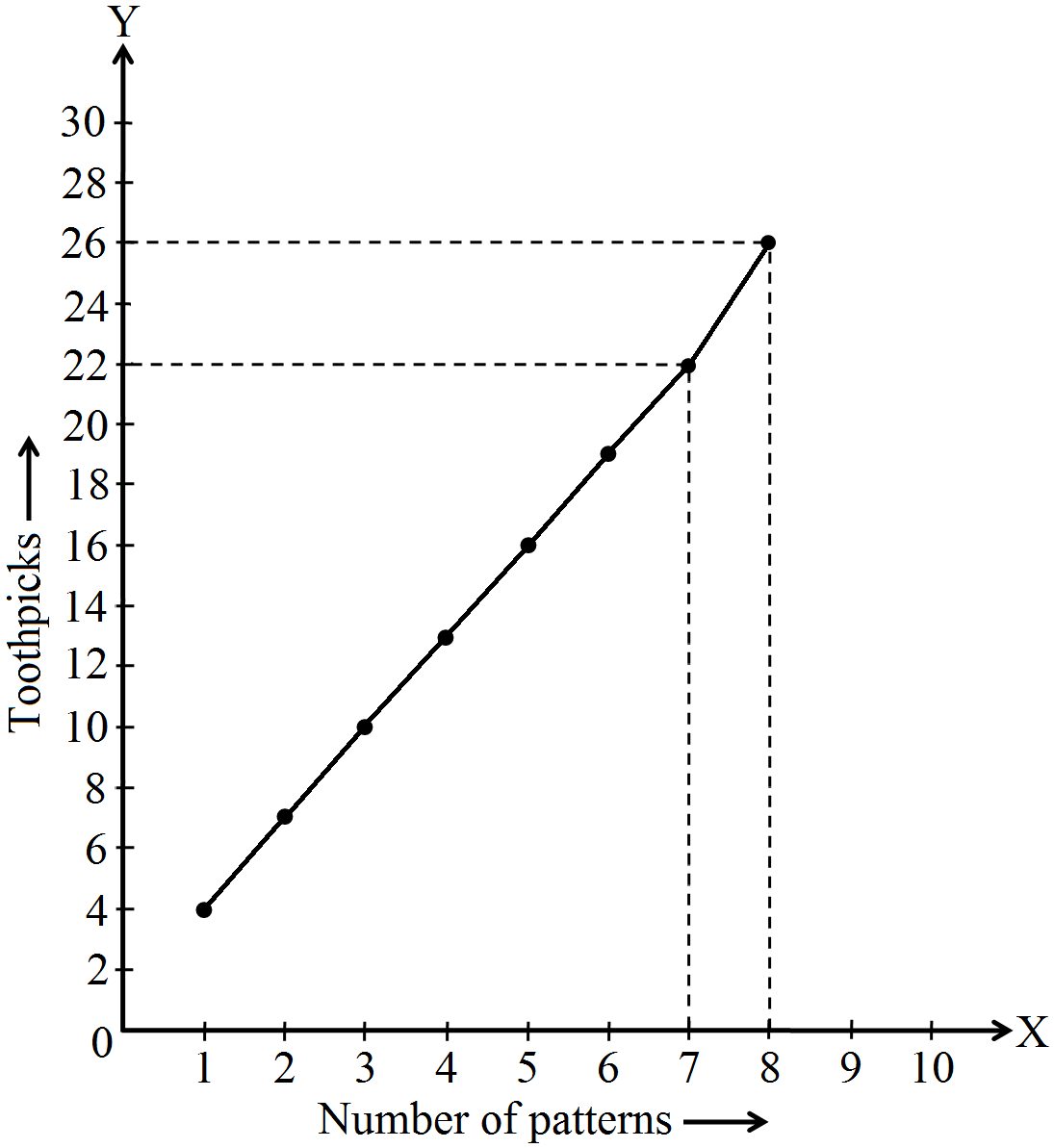
$b.$ Make a graph by taking the pattern numbers on the horizontal axis and the number of toothpicks on the vertical axis. Make the horizontal axis from $0$ to $10$ and the vertical axis from $0$ to $30.$
$c.$ Use your graph to predict the number of toothpicks in patterns $7$ and $8$. Check your answers by actually drawing them.
$d.$ Would it make sense to join the points on this graph? Explain.
Answer

$a.$ On the basis of given patterns, we can arrange the following table which show the number of toothpicks in the first six terms.
Pattern
$1$ $2$ $3$ $4$ $5$ $6$
Toothpicks
$4$ $7$ $10$ $15$ $16$ $19$
Pattern and toothpicks shows the following relation as
$1 \rightarrow 4, 2 \rightarrow 4 + 3 = 7$
$3 \rightarrow 7 + 3 = 10, 4 \rightarrow 10 + 3 = 13$
$5 \rightarrow 13 + 3 = 16, 6 \rightarrow 16, 3 + 19$
$b.$On the basis of given condition, we can draw the following graph

$c.$ the graph follows the $y = 3x + 1$ pattern. If $x = 7$, then $y = 3 × 7 + 1 = 21 + 1 = 22$ and if $x = 8$, then $y = 3 × 8 + 1 = 24 + 1 = 25$
$x$ $7$ $8$
$y$ $22$ $25$
$d.$ Yes, it shows the relation between $x$ and $y$ follows the given pattern $y = 3x + 1$

Need a full question paper?

Generate a complete, print-ready paper with questions like this in minutes — across 16+ boards, with answer keys.

Start Generating Free

Similar questions

Following data gives the number of children in $40$ families: $1, 2, 6, 5, 1, 5, 1, 3, 2, 6, 2, 3, 4, 2, 0, 0, 4, 4, 3, 2, 2, 0, 0, 1, 2, 2, 4, 3, 2, 1, 0, 5, 1, 2, 4, 3, 4, 1, 6, 2, 2.$ Represent it in the form of a frequency distribution.
Find whether, or not the first polynomial is a factor of the second:
$\frac{10\text{a}^2-9\text{a}-5}{2\text{a}-3}$
In the following figure, $F D\|B C\| A E$ and $A C \| E D$. Find the value of $x$.
Image
Find following product:
$ (7 a b) \times\left(-5 a b^2 c\right) \times\left(6 a b c^2\right) $
(i) $(-1)^2=1$. Is -1, a square root of 1?
(ii) $(-2)^2=4$. Is -2, a square root of 4?
(iii) $(-9)^2=81$. Is -9, a square root of 81?
Solve the following equations :
$3 m=5 m-\frac{8}{5}$
The given table shows the crop production of a State in the year $2008$ and $2009$. Observe the table given below and answer the given questions.
Crop
$2008$ Harvest $($Hectare$)$
Increase/ Decrease $($Hectare$)$ in $2009$
Bajra
$1.4 \times 10^3$
$-100$
Jowar
$1.7 \times 10^6$
$-440,000$
Rice
$3.7 \times 10^3$
$-100$
Wheat
$5.1 \times 10^5$
$+190,000$
$a.$ For which crop$(s)$ did the production decrease?
$b.$ Write the production of all the crops in $2009$ in their standard form.
$c.$ Assuming the same decrease in rice production each year as in $2009$, how many acres will be harvested in $2015? $Write in standard form.
$12$ men can dig a pond in $8$ days. How many men can dig it in $6$ days?
The angles of a quadrilateral are in the ratio $1 : 2 : 3 : 4$. Find the measure of each angle.
How many persons can be accommodated in a hall of length $16\ m$. Breadth $12.5\ m$ and height $4.5\ m$, assuming that $3.6m^3$ of air is required for each person?