Question
Solve the following equations :
$3 m=5 m-\frac{8}{5}$

Answer

We have, $\quad \frac{2 x}{3}+1=\frac{7 x}{15}+3$
$\Rightarrow \quad \frac{2 x}{3}-\frac{7 x}{15}=3-1\quad$ [transposing $\frac{7 x}{15}$ to LHS and 1 to RHS]
$\Rightarrow \quad \frac{10 x-7 x}{15}=2 \quad[\because$ LCM of 3 and 15 is 15$]$
$\Rightarrow \quad \frac{3 x}{15}=2$
$\Rightarrow \quad \frac{3 x}{15} \times 5=2 \times 5 \quad$ [multiplying both sides by 5]
$\Rightarrow \quad \frac{15 x}{15}=2 \times 5 \Rightarrow x=2 \times 5$
$\Rightarrow \quad x=10$, which is the required solution.
Check For $x=10$
LHS $=\frac{2(10)}{3}+1=\frac{23}{3}$
RHS $=\frac{7(10)}{15}+3=\frac{23}{3}$
$\therefore \quad$ LHS $=$ RHS $\quad$ [as required]

Need a full question paper?

Generate a complete, print-ready paper with questions like this in minutes — across 16+ boards, with answer keys.
Start Generating Free

Similar questions

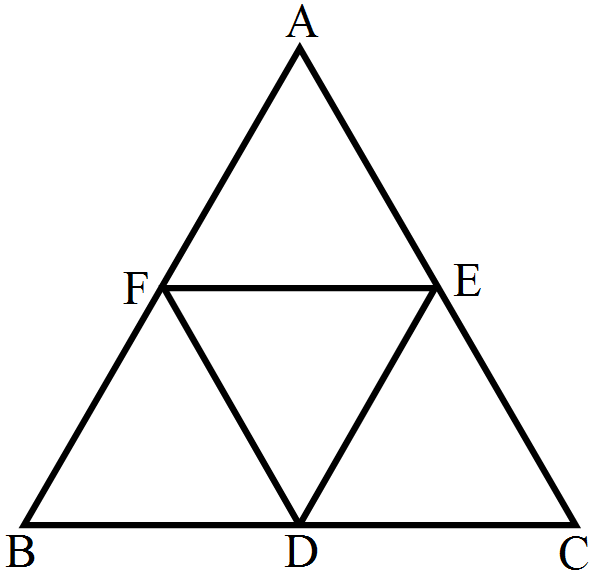
In the figure, $BDEF$ and $DCEF$ are each a parallelogram. It is true that $BD = DC?$ Why or why not$?$
Ayesha announced a festival discount of $25\%$ on all the items in her mobile phone shop. Ramandeep bought a mobile phone for himself. He got a discount of Rs. $1,960$. What was the marked price of the mobile phone?
Re-arrange suitably and find the sum in the following:
$\frac{-6}{7}+\frac{-5}{6}+\frac{-4}{9}+\frac{-15}{7}$
Express product as a monomials and verify the result for $x = 1, y = 2$: $\big(−\frac{4}{7}\text{a}^2\text{b}\big)×\big(−\frac{2}{3}\text{b}^2\text{c}\big)×\big(−\frac{7}{6}\text{c}^2\text{a}\big)$
An electric pole, $14$ metres high, casts a shadow of $10$ metres. Find the height of a tree that casts a shadow of $15$ metres under similar conditions.
Anil borrowed a sum of $Rs. 9600$ to install a handpump in his dairy. If the rate of interest is $5\frac{1}{2}\%$ per annum compounded annually, determine the compound interest which Anil will have to pay after $3$ years.
What will be the ones digit in the square of the following numbers?
(i) 1234 $\quad$ $\quad$(ii) 26387 $\quad$ (iii) 52698
(iv) 99880 $\quad$ (v) 21222 $\quad$ (vi) 9106
Find the smallest number by which the given number must be divided so that the resulting number is a perfect square: $2904$
Verify Euler's relation for the following: A cube.
Re-arrange suitably and find the sum in the following: $\frac{1}{8}+\frac{5}{12}+\frac{2}{7}+\frac{7}{12}+\frac{9}{7}+\frac{-5}{16}$