Question
Obtain an expression for the induced e.m.f. in a coil rotating with uniform angular velocity in uniform magnetic field. Plot a graph of variation of induceed e.m.f. against phase (0= wt) over one cycle.

Answer

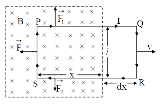
a) Consider a rectangular loop of conducting wire ‘PQRS’ partly placed in uniform
magnetic field of induction ‘B’ as shown in figure.
Image
b) Let ‘l’ be the length of the side PS and ‘x’ be the length of the loop within the field.
∴ A = lx = area of the loop, which lies inside the field.
c) The magnetic flux (φ) through the area A at certain time ‘t’ is Φ = BA = Blx
d) The loop is pulled out of the magnetic field of induction ‘B’ to the right with a uniform
velocity ‘v’.
e) The rate of change of magnetic flux is given by, \(\frac{d \phi}{d t}=\frac{d}{d t}(B l x)\)
\(\therefore \quad \frac{ d \phi}{ dt }= B l\left(\frac{ dx }{ dt }\right)\)
But, \(\left(\frac{d x}{d t}\right)=v\)
\(\therefore \quad \frac{ d \phi}{ dt }= B / v\)...(i)
f) Due to change in magnetic flux, induced current is set up in the coil. The direction of
this current is clockwise according to Lenz’s law. Due to this, the sides of the coil
experience the forces, F1, F2 and F as shown in figure. The directions of these forces is
given by Fleming’s left hand rule.
g) The magnitude of force ‘F’ acting on the side PS is given by, F = BIl.
h) The force \(\vec{F}_1\)  and \(\vec{F}_2\) are equal in magnitude and opposite in direction, therefore they cancel out. The only unbalanced force which opposes the motion of the coil is \(\vec{F}\) Hence, work must be done against this force in order to pull the coil.
i) The work done in time ‘dt’ during the small displacement ‘dx’ is given by, dW = −Fdx
− ve sign shows that F and ‘dx’ are opposite to each other.
∴ dW = − (BIl) dx ….(ii)
j) Mechanical power is given by,
\(P =\frac{ dW }{ dt }= BI l\left(\frac{ dx }{ dt }\right)\)
\(\therefore \quad P = BI / v \quad\left[\because \frac{ dx }{ dt }= v \right]\)
k) This external work provides the energy needed to maintain the induced current I
through the loop (coil).
l. If ‘e’ is the e.m.f induced then,
electric power \(=\frac{d W}{d t}=e I\)
∴ dW = eIdt .…(iii)
m) From equations (ii) and (iii), we have, eIdt = − BIl dx
\(\therefore e=-B l \frac{d x}{d t}\)
\(\therefore e =- B / v \ldots\) (iv)
n. From equation (i) and (iv), we have,
\(e=-\frac{d \phi}{d t}\)
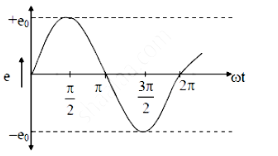
o) Graph of variation of induced e.m.f. against phase (θ = ωt) over one cycle
Image

Need a full question paper?

Generate a complete, print-ready paper with questions like this in minutes — across 16+ boards, with answer keys.

Start Generating Free

Similar questions

State Ampere’s law. Explain how is it useful in different situations.
If the effective current in a $50$ cycle $AC$ circuit is $5\ A,$ what is the peak value of current? What is the current $1/600$ sec.after if was zero ?
Three point masses $M_1, M_2$ and $M_3$ are located at the vertices of an equilateral triangle of side $a$. What is the moment of inertia of the system about an axis along the altitude of the triangle passing through $M _1$ ?
With the help of neat diagrams, explain how a polar dielectric material acquires a dipole moment in an external electric field.
OR
Explain the behaviour of polar dielectric material in an external electric field.
A set of 12 tuning forks is arranged in the increasing order of frequencies. Each tuning fork produce ' \(Y\) ' beats per second with previous one. The last tuning fork is an octave of the first. The fifth tuning fork has the frequency \(90 Hz\). Find \(Y\) and hence find the frequency of the last fork.
A $100 V$ battery is connected across the combination of capacitors of capacities $4 \mu F$ and $8 \mu F$ in parallel and then in series. Calculate the charge on each capacitor in parallel and in series combination.
In a metre bridge experiment, with a resistance $R_1$ in the left gap and a resistance $X$ in the right gap, the null point is obtained at $40 \ cm$ from the left end of the wire. With a resistance $R_2$ in the left gap and the same resistance $X$ in the right gap, the null point is obtained at 50 $cm$ from the left end of the wire. Where will be the null point if $R_1$ and $R_2$ are connected first in series and then in parallel in the left gap, the right gap still containing $X$ ?
The angular position of a rotating object is given by $\theta(t)=\left(1.55 t^2-7.75 t+2.87\right)$ rad, where $t$ is measured in second.
(i) When is the object momentarily at rest?
(ii) What is the magnitude of its angular acceleration at that time?
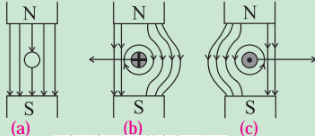
If a wire without any current is kept in a magnetic field, then it experiences no force as shown in figure (a). But when the wire is carrying a current into the plane of the paper in the magnetic field, a force will be exerted on the wire towards the left as shown in the figure (b). The field will be strengthened on the right side of the wire where the lines of force are in the same direction as that of the magnetic field and weakened on the left side where the field lines are in opposite direction to that of the applied magnetic field. For a wire carrying a current out of the plane of the paper, the force will act to the right as shown in figure (c).

Image

State the factors which the magnetic force on a charge depends upon. Hence state the expression for the Lorentz force on a charge due to an electric field as well as a magnetic field.
Hence discuss the magnetic force on a charged particle which is
(i) moving parallel to the magnetic field
(ii) stationary.