Question
Obtain an expression for the magnetic induction produced by a current in a wire in the shape of a circular arc at its centre of curvature. Hence obtain an expression for the magnetic induction at the centre of a circular coil carrying a current.
Answer

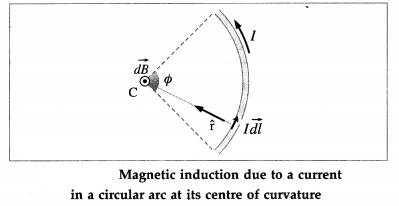
Consider a wire in the shape of a circular arc of radius of curvature $R$ and carrying a current I. The unit vector $\hat{ r }$ from each current element I $\overrightarrow{d l}$ towards
Image

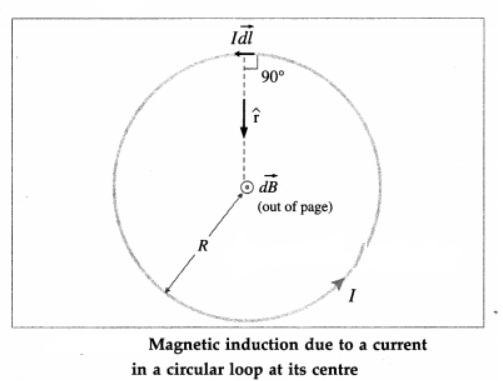
the centre of the loop is perpendicular to $\overrightarrow{I d l}$, i.e., the angle $\theta$ between them is $90^{\circ}$. The direction of the incremental magnetic induction $\overrightarrow{d B}$ due to each current element is in the same direction, viz., perpendicular to the plane of the loop, and out of the plane of the figure for the sense of the current shown in above figure.
Since every current element is equidistant from the centre of curvature $C$, the magnetic field at $C$ due to each current element in the arc by Biot-Savart's law is
$
d \vec{B}=\left(\frac{\mu_0}{4 \pi}\right) \frac{I \overrightarrow{d l} \times \hat{ r }}{r^2}....(1)
$
In magnitude,
$
\begin{aligned}
d B & =\left(\frac{\mu_0}{4 \pi}\right) \frac{I d l \sin \theta}{r^2} \\
& =\left(\frac{\mu_0}{4 \pi}\right) \frac{I d l \sin 90^{\circ}}{r^2}=\left(\frac{\mu_0}{4 \pi}\right) \frac{I d l}{r^2}...(2)
\end{aligned}
$
If the arc subtends an angle 0 at its centre of curvature $C$, the total field at $C$ due to all the elements on the arc is
$
\begin{aligned}
B & =\int d B=\int_0^\phi \frac{\mu_0}{4 \pi} \frac{i R d \phi}{R^2}=\frac{\mu_0 i}{4 \pi R}=\int_0^\phi d \phi \\...(3)
& =\frac{\mu_0}{4 \pi} \frac{I \phi}{R}....(4)
\end{aligned}
$
where $\Phi$ is in radian.
The magnitude of the total induction $\vec{B}$ at the centre of a circular coil is, from Eq. (3),
$
B=\frac{\mu_0 I}{4 \pi R} \int_0^{2 \pi} d \phi=\frac{\mu_0 I}{4 \pi R}(2 \pi)=\frac{\mu_0 I}{2 R}
$
Image
If a circular coil has $N$ turns, each of radius $r$ and carries a current $I$, the magnetic induction at its centre has a magnitude
$
B =\frac{\mu_0 N I}{2 R}..(6)
$

Need a full question paper?

Generate a complete, print-ready paper with questions like this in minutes — across 16+ boards, with answer keys.

Start Generating Free

Similar questions

Show that the energy of a charged capacitor is $\frac{1}{2} CV ^2$. Also, express this in other forms.
OR
Derive an expression for the energy stored in a charged capacitor. Express it in different forms.
Twenty seven droplets of water, each of radius $0.1 mm$ coalesce into a single drop. Find the change in surface energy. Surface tension of water is $0.072 N / m$.
A device $Y$ is connected across an $AC$ source of emf $e = e_0$ sinωt. The current through $Y$ is given as $i = i_0 \sin(\omega t + \pi /2)$
a) Identify the device $Y$ and write the expression for its reactance.
b) Draw graphs showing variation of emf and current with time over one cycle of AC for $Y$.
c) How does the reactance of the device $Y$ vary with the frequency of the $AC$ ? Show graphically
d) Draw the phasor diagram for the device $Y$.
A dipole with its charges, -q and + q located at the points (0, -b, 0) and (0 +b, 0) is present in a uniform electric field E whose equipotential surfaces are planes parallel to the YZ planes.
(a) What is the direction of the electric field E?
(b) How much torque would the dipole experience in this field?
State and explain the theorem of parallel axes.
Calculate the viscous force acting on a rain drop of diameter $1 mm$, falling with a uniform velocity $2 m / s$ through air. The coefficient of viscosity of air is $1.8 \times 10^{-5} Ns / m ^2$.
 
State and explain Ampere's circuital law.State Ampere's circuital law.
Find an expression for the power expended in pulling a conducting loop out of a magnetic field.
A string $1$m long is fixed at one end. Transverse vibrations of frequency $15$ Hz are imposed at the free end. Due to this, a stationary wave with four complete loops, is produced on the string. Find the speed of the progressive wave which produces the stationary wave.[Hint: Remember that the free end is an antinode.] [Ans: $6.67\ ms^{-1}$]
Derive an expression for the work done during an isothermal process
$104 J$ of work is done on certain volume of a gas. If the gas releases $125 \ kJ$ of heat, calculate the change in internal energy of the gas.