Maharashtra BoardEnglish MediumSTD 12 SciencePhysicsQuestion Bank [ 2022 ]4 Marks
Question
State and explain the theorem of parallel axes.
✓
Answer
Statement: The moment of inertia $\left(I_0\right)$ of an object about any axis is the sum of its moment of inertia $\left(I_c\right)$ about an axis parallel to the given axis, and passing through the centre of mass and the product of the mass of the object and the square of the distance between the two axes. Mathematically, $I _{ O }= I _{ c }+ Mh ^2$
Proof:
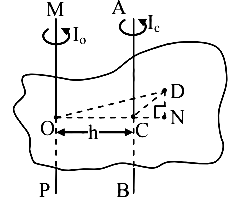
i. Consider an object of mass M. Axis MOP is an axis passing through point O .
ii. Axis $A C B$ is passing through the centre of mass $C$ of the object, parallel to the axis MOP, and at a distance $h$ from it $(\therefore h = CO )$.
The theorem of parallel axes
Consider a mass element ‘dm’ located at point D. Perpendicular on OC (produced) from point D is DN.
Th
e moment of inertia of the object about the axis ACB is $I_c = \int (DC)^2 $dm, and about the axis MOP, it is$ I_o = \int (DO)^2 dm.$
NC is the distance of a point from the centre of mass. Any mass distribution is symmetric about the centre of mass. Thus, from the definition of the centre of mass, ∫ NC . dm = 0
$\therefore I_o = I_c + Mh^2$ This is the mathematical form of the theorem of parallel axes.
Need a full question paper?
Generate a complete, print-ready paper with questions like this in minutes — across 16+ boards, with answer keys.