Question
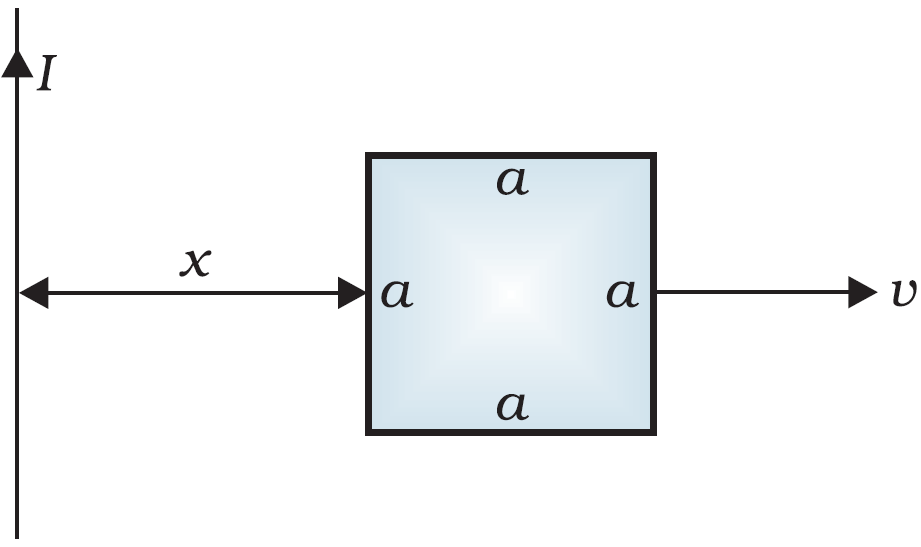
  1. Obtain an expression for the mutual inductance between a long straight wire and a square loop of side a as shown in Fig.
  2. Now assume that the straight wire carries a current of $50A$ and the loop is moved to the right with a constant velocity $, v = 10\ m/s.$ Calculate the induced emf in the loop at the instant when $x = 0.2\ m$. Take $a = 0.1\ m$ and assume that the loop has a large resistance.
Answer

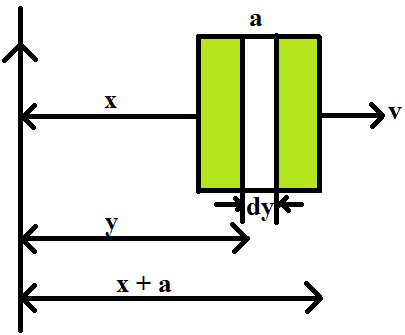
  1. Take a small element dy in the loop at a distance $y$ from the long straight wire $ ($as shown in the given figure$)$.
  2. Magnetic flux associated with element dy, $\text{d}\phi=\text{BdA}$
    Where,
    $dA =$ Area of element $dy = \text{ady}$
    $B =$ Magnetic field at distance $y$
    $=\frac{\mu_0\text{I}}{2\pi\text{y}}\text{s}$
    $I = $ Current in the wire
    $\mu_0=\text{Permeability of free space}=4\pi\times10^{-7}\text{Tm}\text{A}^{-1}$
    $\therefore\ \text{d}\phi=\frac{\mu_0\text{Ia}}{2\pi}\frac{\text{dy}}{\text{y}}\text{s}$
    $\phi=\frac{\mu_0\text{Ia}}{2\pi}\int\frac{\text{dy}}{\text{y}}$
    $y$ tends from $x$ to $a + x.s$
    $\therefore\ \phi=\frac{\mu_0\text{I}\text{a}^{\text{a}+\text{x}}}{2\pi}\int_{\text{x}}\frac{\text{dy}}{\text{y}}$
    $=\frac{\mu_0\text{Ia}}{2\pi}\big[\log_{\text{e}}\text{ y}\big]_{\text{x}}^{\text{a}+\text{x}}$
    $=\frac{\mu_0\text{Ia}}{2\pi}\log_{\text{e}}\Big(\frac{\text{a}+\text{x}}{\text{x}}\Big)$
    For mutual inductance $M,$ the flux is given as:
    $\phi=\text{mI}$
    $\therefore\ \text{mI}=\frac{\mu_0\text{Ia}}{2\pi}\log_{\text{e}}\Big(\frac{\text{a}}{\text{x}}+1\Big)$
    $\text{m}=\frac{\mu_0\text{a}}{2\pi}\log_{\text{e}}\Big(\frac{\text{a}}{\text{x}}+1\Big)$
  3. Emf induced in the loop, $\text{e}=\text{B}'\text{av}\Big(\frac{\mu_0}{2\pi}\Big)\text{av}$ Given,
  4. $I = 50A$
    $x = 0.2m$
    $a = 0.1m$
    $v = 10m/s$
    $\text{BQv}=\frac{\text{M}\text{v}^2}{\text{r}}$
    $\therefore\ \text{B}2\pi\text{r}\lambda\text{r}^2=\frac{\text{Mv}}{\text{r}}$
    $\text{v}=\frac{\text{B}2\pi\text{r}\lambda\text{r}^2}{\text{M}}$
    For $\text{r}\leq\text{a}$ and $\text{a}<\text{R},$ we get
    $(\text{i})=-\frac{2\text{B}_0\text{a}^2\lambda}{\text{MR}}\text{k}$
  5. $e = 5 \times 10^{-5}V$

Need a full question paper?

Generate a complete, print-ready paper with questions like this in minutes — across 16+ boards, with answer keys.

Start Generating Free

Similar questions

What are X-rays? If a X-ray tube is operated at V volt then prove that the minimum wavelength of X-rays emitted from the tube is given by: $\lambda_{min}=(12375/V)Å$
A jar of height $h$ is filled with a transparent liquid of refractive index $\mu ($Fig$)$. At the centre of the jar on the bottom surface is a dot. Find the minimum diameter of a disc, such that when placed on the top surface symmetrically about the centre, the dot is invisible.
Define total internal reflection. Establish the relation between $u, v$ and $f$ for a spherical mirror. Draw the necessary ray diagram. ### Define lateral displacement. Derive the lens maker formula.
$
\frac{1}{f}=\left(n_{21}-1\right)\left(\frac{1}{R_1}-\frac{1}{R_2}\right)
$
Draw the necessary ray diagram. (Where the signs have their usual meanings.)
A ball of mass $100g$ and having a charge of $4.9 \times 10^{-5}C$ is released from rest in a region where a horizontal electric field of $2.0 \times 10^4NC^{-1}$ exists.
  1. Find the resultant force acting on the ball.
  2. What will be the path of the ball?
  3. Where will the ball be at the end of $2s?$
Write the nature, properties and difference among $\alpha$-, $\beta$- and $\gamma$-rays.
Two charged conducting spheres of radii a and b are connected to each other by a wire. What is the ratio of electric fields at the surfaces of the two spheres? Use the result obtained to explain why charge density on the sharp and pointed ends of a conductor is higher than on its flatter portions.
There are two sources of light, each emitting with a power of $100W.$ One emits $X-$rays of wavelength $1\ nm$ and the other visible light at $500\ nm.$ Find the ratio of number of photons of $X-$rays to the photons of visible light of the given wavelength?
Find the $rms$ speed of hydrogen molecules in a sample of hydrogen gas at $300K.$ Find the temperature at which the $rms$ speed is double the speed calculated in the previous part.
When an electron goes from the valence band to the conduction band in silicon, its energy is increased by 1.1eV. The average energy exchanged in a thermal collision is of the order of kT which is only 0.026eV at room temperature. How is a thermal collision able to take some of the electrons from the valence band to the conduction band?
A small plane area is rotated in an electric field. In which orientation of the area is the flux of electric field through the area maximum? In which orientation is it zero?