Question
Write the nature, properties and difference among $\alpha$-, $\beta$- and $\gamma$-rays.

Answer

Comparative Vision of Properties of $\alpha-, \beta$ - and $\gamma-$ rays
Properties $\alpha$-rays $\beta$-rays $\gamma$-rays
1. Nature Helium
nucleus $\left({ }_2^4 He \right)$
electron $\left({ }_1^0 \beta\right)$
Fast moving Electro-magnetic wave or proton
2. Charge $+3.2 \times 10^{-19}$ coulomb $1.6 \times 10^{-19}$ coulomb Zero
3. Mass $6.62 \times 10^{-27} kg$ $9.1 \times 10^{-31} kg$ Rest mass is zero
4. Velocity (Between $1.4 \times 10^7$ m/sec and $\left.2.2 \times 10^7 m / sec \right)$ $1 \%$ to $99 \%$ of velocity of light $3 \times 10^8 m / sec$ i.e.,elocity of light
5. Ionising power 100 times of $\beta$-rays 100 times of $\gamma$-rays minimum
6. Penetrating power Minimum 100 times of $\alpha$-rays 100 times of $\beta$-rays
7. Effect of electric and magnatic fields Direction of deflection shows the positive charge on these parti-cles (rays). Direction of deflection shows the negative charge on these parti-cles (rays). There is no deflection of these rays.

Need a full question paper?

Generate a complete, print-ready paper with questions like this in minutes — across 16+ boards, with answer keys.
Start Generating Free

Similar questions

A boy riding on a bicycle going at 12km/h towards a vertical wall whistles at his dog on the ground. If the frequency of the whistle is 1600Hz and the speed of sound in air is 330m/s, find
  1. The frequency of the whistle as received by the wall.
  2. The frequency of the reflected whistle as received by the boy.
Differentiate between self induction and mutual induction with examples.
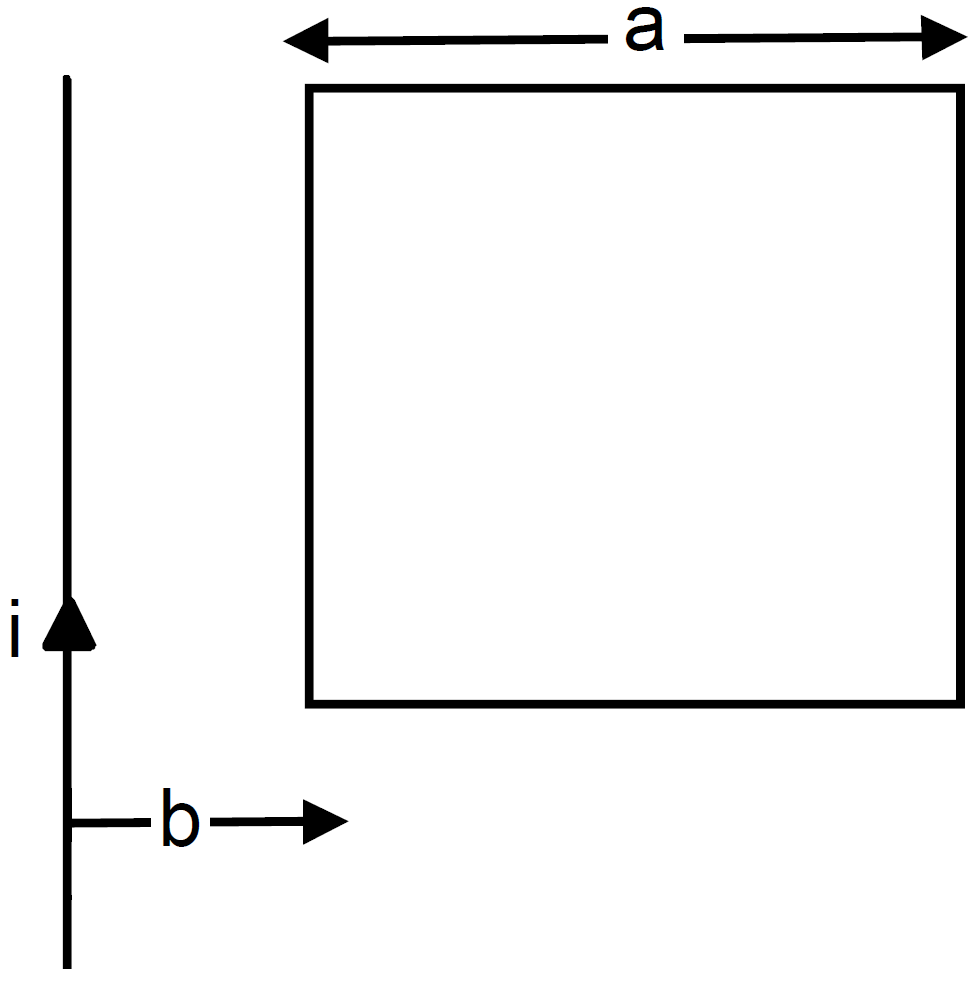
Figure shows a square frame of wire having a total resistance r placed coplanarly with a long, straight wire. The wire carries a current i given by $\text{i}=\text{i}_0\sin\omega\text{t}.$ Find
  1. The flux of the magnetic field through the square frame.
  2. The emf induced in the frame.
  3. The heat developed in the frame in the time interval 0 to $\frac{20\pi}{\omega}.$
A capacitor of capacitance $10\mu\text{F}$ is connected to a battery of emf 2V. It is found that it takes 50ms for the charge of the capacitor to become $12.6\mu\text{C}.$ Find the resistance of the circuit.
A solenoid of length $20\ cm$, area of cross-section $4.0\ cm^2$ and having $4000$ turns is placed inside another solenoid of $2000$ turns having a cross$-$sectional area $8.0\ cm^2$ and length $10\ cm$. Find the mutual inductance between the solenoids.
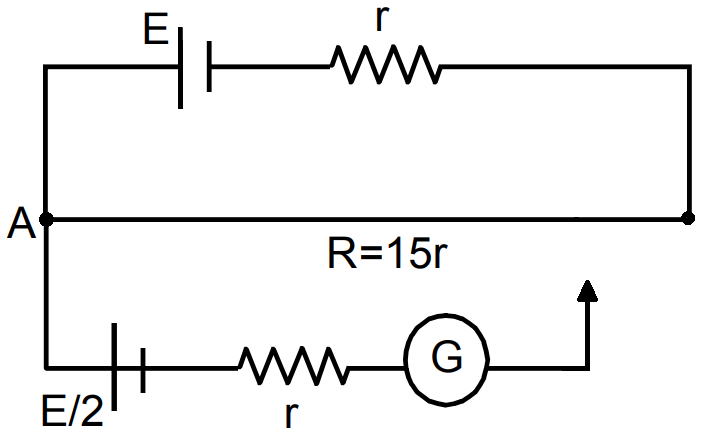
Consider the potentiometer circuit as arranged in the figure. The potentiometer wire is $600\ cm$ long. $(a)$ At what distance from the point $A$ should the jockey touch the wire to get zero deflection in the galvanometer? $(b)$ If the jockey touches the wire at a distance of $560\ cm$ from $A,$ what will be the current in the galvanometer?
Answer the following question:
Some scientists have predicted that a global nuclear war on the earth would be followed by a severe ‘nuclear winter’ with a devastating effect on life on earth. What might be the basis of this prediction?
Three particles of masses 1.0kg, 2.0kg and 3.0kg are placed at the corners A, B and C respectively of an equilateral triangle ABC of edge 1m. Locate the centre of mass of the system.
A point object is placed at a distance of $15\ cm$ from a convex lens. The image is formed on the other side at a distance of $30\ cm$ from the lens. When a concave lens is placed in contact with the convex lens, the image shifts away further by $30\ cm.$ Calculate the focal lengths of the two lenses.
  1. For what kinetic energy of a neutron will the associated de Broglie wavelength be $1.40 \times 10^{–10} m$?
  2. Also find the de Broglie wavelength of a neutron, in thermal equilibrium with matter, having an average kinetic energy of $(3/2) kT at 300 K.$