Question
Define total internal reflection. Establish the relation between $u, v$ and $f$ for a spherical mirror. Draw the necessary ray diagram. ### Define lateral displacement. Derive the lens maker formula.
$
\frac{1}{f}=\left(n_{21}-1\right)\left(\frac{1}{R_1}-\frac{1}{R_2}\right)
$
Draw the necessary ray diagram. (Where the signs have their usual meanings.)
Answer

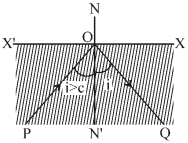
Total Internal Reflection : When the value of the angle of incidence in a dense medium is increased slightly beyond the critical angle, then the entire incident light gets reflected according to the laws of reflection and returns back to the dense medium. As shown in the fig. below. This phenomenon is called total internal reflection of light.
Image
Fig. : Total internal reflection
Relation between $u, v$ and $f$ for the Spherical Mirror :
Formula for spherical mirror :
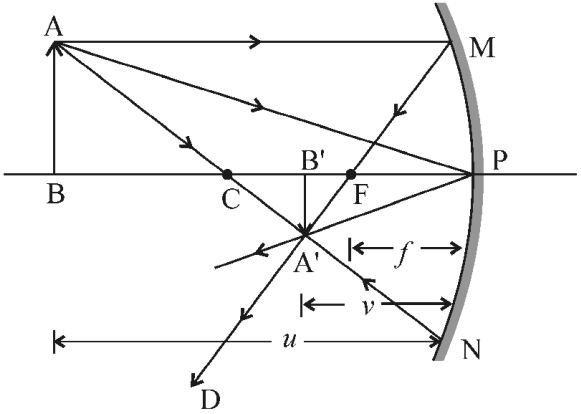
The relationship between $u, v$ and $f$ is shown in the figure to form an image from a concave mirror. At point B on the principal axis, a parallel ray AM from the object AB hits the surface of the mirror AM and passes through the focus after reflection. Ray AC from point A hits the mirror and returns to the same path due to being normal. These two reflected rays meet each other at point $A^{\prime}$. Hence the image of $A B$ becomes $B ^{\prime} A ^{\prime}$. Draw lines joining AP and AP . In the figure $\triangle MPF$ and $\triangle A ^{\prime} F ^{\prime} B , \angle A ^{\prime} FB ^{\prime}=\angle MFP$ due to opposite angle (mirror is of small aperture) hence MP is a straight line.
Since $\angle FPM =\angle A ^{\prime} FB B ^{\prime}$ is a right angle, so due to which $\triangle MPF , \triangle AF ^{\prime} B ^{\prime}$ is a similar triangle.
Therefore,$\frac{B^{\prime} A^{\prime}}{PM}=\frac{B^{\prime} F}{FP}$
$
\text { or } \quad \frac{B^{\prime} A^{\prime}}{BA}=\frac{B^{\prime} F}{FP}(\because PM=AB) \ldots(1)
$
Because $\angle APB =\angle APB ^{\prime}$, right angled triangles ABP and ABP are also similar.
Therefore, $\quad \frac{ B ^{\prime} A ^{\prime}}{ BA }=\frac{ B ^{\prime} P }{ BP } \ldots(2) $
By comparing equation (1) and (2), we will get
$
\frac{B^{\prime} F}{F P}=\frac{B^{\prime} P-F P}{F P}=\frac{B^{\prime} P}{B P} \ldots(3)
$
Equation (3) involves the magnitudes of distances. According to Cartesian sign convention, the signs of these three will be negative, hence
$
B^{\prime} P=-v, FP=-f, BP=-u
$
Image
Fig. : Ray diagram of image formation by a concave mirror
Using these in equation (3), we get
$\frac{-v+f}{-f}=\frac{-v}{-u}$
or $\quad \frac{v-f}{f}=\frac{v}{u}$
$\frac{v}{f}-1=\frac{v}{u}$
or $\quad\frac{v}{f}=\frac{v}{u}+1=\frac{v+u}{u}$
or $\quad \frac{1}{f}=\frac{v+u}{u v}=\frac{v}{u v}+\frac{u}{u v}$
or $\quad \frac{1}{v}+\frac{1}{u}=\frac{1}{f}$ $\ldots(4)$
This relation is called mirror equations
OR

A ray of light travels in a definite straight line. After refraction through the glass slab, it emerges in a direction parallel to the original direction but slightly displaced from the line. This is called lateral displacement.
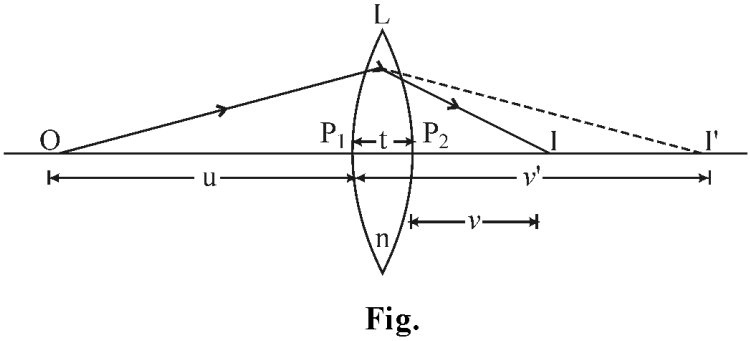
When the medium on either side of the lens is same : In the following figure, a thin lens L is placed in the air. Refractive index of the lens material relative to air is $n$ and the radii of curvature of its first and second surfaces are $R _1$ and $R _2$ respectively. Let the thickness of the lens be $t$.
Image
A point object $O$ is placed on the principal axis of the lens at a distance $u$ from the pole $P _1$ of its first surface. Due to refraction on the first surface, the image of object $O$ is formed at $I ^{\prime}$. Let the distance of $I ^{\prime}$ from the pole $P _1$ of the surface be $v^{\prime}$. Then according to the formula of refraction at a single spherical surface
$
\frac{n}{v^{\prime}}-\frac{1}{u}=\frac{n-1}{R_1} \ldots(1)
$
The image thus formed is $I^{\prime}$ for the second surface of the lens whose radius of curvature is $R _2$ will work as an object. The distance of I' from the pole $P _2$ of the other surface will be $\left(v^{\prime}-t\right)$. The image of second surface of I is I' at a distance from $v$. In this way the final image of the O of entire lens becomes at I .
On the second surface, because the light ray enters the air through the refractive index $n$, hence in the formula of refraction, writin $1 / n$ at place of $n$.
$
\frac{1 / n}{v}-\frac{1}{\left(v^{\prime}-1\right)}=\frac{\frac{1}{n}-1}{R_2} \ldots(2)
$
For thin lenses. The value of $t$ is negligible compared to $v^{\prime}$. So in comparison of $v$, on omitting $t$, the equation (2) will be as follows :
$\frac{1}{v}-\frac{n}{v^{\prime}}=\frac{-(n-1)}{ R _2} \ldots(3) $
By adding equations (1) and (3)
$
\frac{1}{v}-\frac{1}{u}=(n-1)\left(\frac{1}{R_1}-\frac{1}{R_2}\right) \ldots(4)
$
When the object is placed at infinity, the image will be formed at the second focus (principal focus) of the lens. That is $u=\infty$, then $v=f$, where $f$ is the second focal length (primary focal length) of the lens.
Putting the value in equation (4)
$
\frac{1}{f}-\frac{1}{\infty}=(n-1)\left(\frac{1}{R_1}-\frac{1}{R_2}\right)
$
or $\quad \frac{1}{f}=(n-1)\left(\frac{1}{R_1}-\frac{1}{R_2}\right) \ldots(5) $
Which is called lens makers formula.

Need a full question paper?

Generate a complete, print-ready paper with questions like this in minutes — across 16+ boards, with answer keys.

Start Generating Free

Similar questions

A parallel $-$ plate capacitor of plate area $40\ cm^2$ and separation between the plates $0.10\ mm,$ is connected to a battery of emf $2.0V$ through a $16\Omega$ resistor. Find the electric field in the capacitor $10\ ns$ after the connections are made.
A parallel-plate capacitor of capacitance $5\mu\text{F}$ is connected to a battery of emf 6V. The separation between the plates is 2mm:
  1. Find the charge on the positive plate.
  2. Find the electric field between the plates.
  3. A dielectric slab of thickness 1mm and dielectric constant 5 is inserted into the gap to occupy the lower half of it. Find the capacitance of the new combination.
  4. How much charge has flown through the battery after the slab is inserted?
Explain Hertz experiment for communication of electromagnetic waves. Draw labelled diagram of apparatus used in the experiment.
$(or)$
Explain Hertz experiment related with electromagnetic waves and also explain experiments of Jagdish Chandra Basu and Marconi.
$(or)$
Critically evaluate Hertz experiment of production and communication of electromagnetic waves.
Draw a labelled diagram of a refracting telescope. Obtain an expression for its magnifying power. Write two main disadvantages of refracting telescope as compared to reflecting telescope. What is meant by telescope? Draw the ray diagram of image formation by a refracting telescope. Briefly describe its working and derive the formula for its magnifying power.
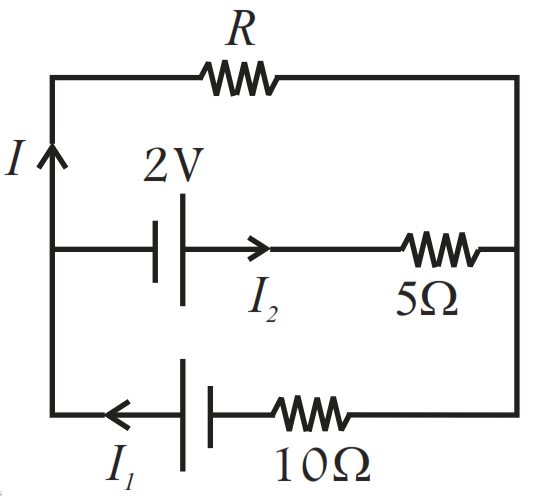
Two cells of voltage $10V$ and $2V $ and internal resistances $10\Omega$ and $5\Omega$ respectively, are connected in parallel with the positive end of $10V$ battery connected to negative pole of $2V$ battery $($Fig$).$ Find the effective voltage and effective resistance of the combination.
An adiabatic vessel of total volume $V$ is divided into two equal parts by a conducting separator. The separator is fixed in this position. The part on the left contains one mole of an ideal gas $(U = 1.5\ nRT)$ and the part on the right contains two moles of the same gas. Initially, the pressure on each side is $p$. The system is left for sufficient time so that a steady state is reached. Find,
  1. The work done by the gas in the left part during the process.
  2. The temperature on the two sides in the beginning.
  3. The final common temperature reached by the gases.
  4. The heat given to the gas in the right part.
  5. The increase in the internal energy of the gas in the left part.
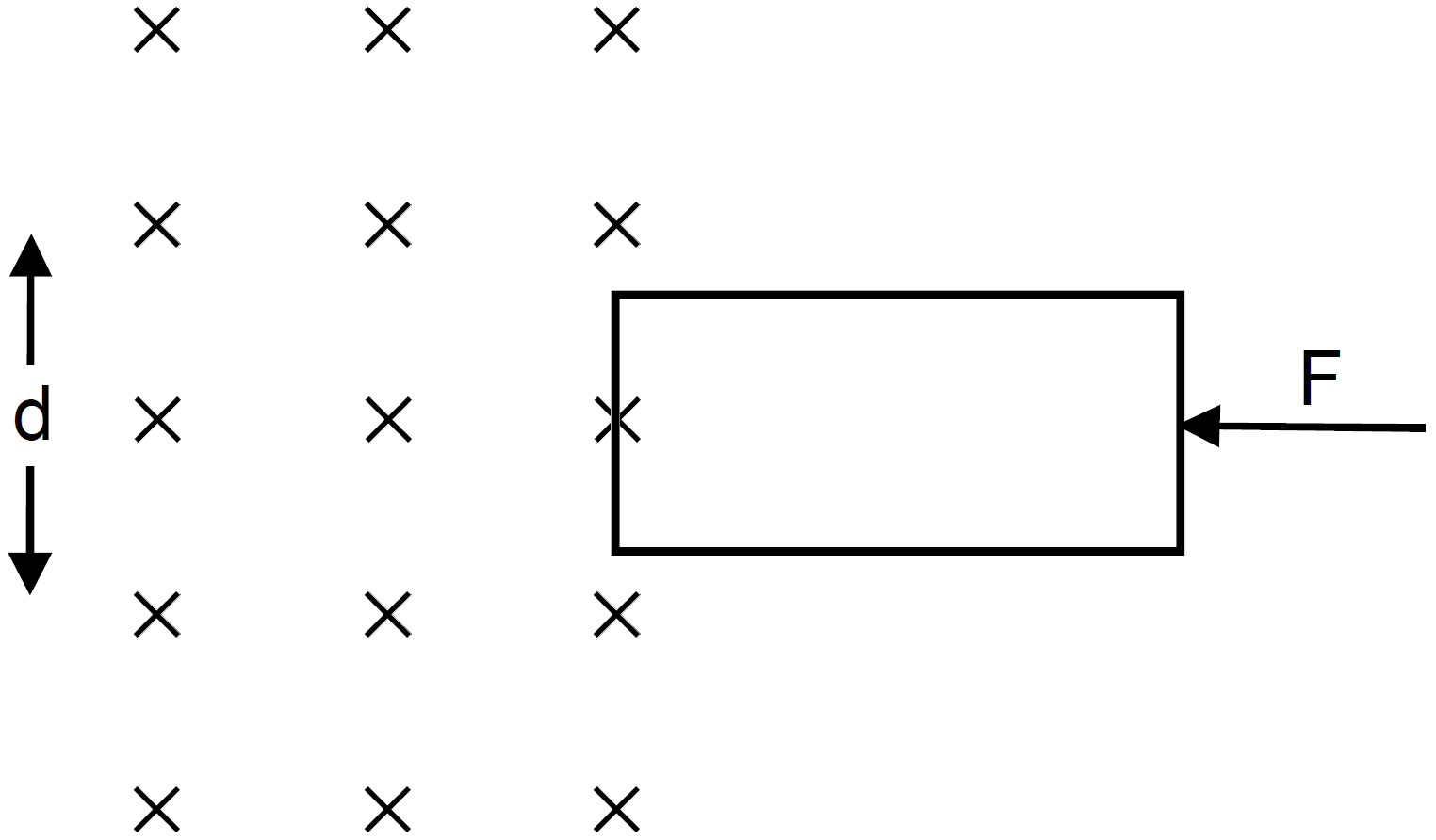
The rectangular wire-frame, shown in figure, has a width $d$, mass m, resistance $R$ and a large length. A uniform magnetic field $B$ exists to the left of the frame. A constant force $F$ starts pushing the frame into the magnetic field at $t = 0.$
  1. Find the acceleration of the frame when its speed has increased to $v.$
  2. Show that after some time the frame will move with a constant velocity till the whole frame enters into the magnetic field. Find this velocity $v_0.$
  3. Show that the velocity at time t is given by $\text{v}=\text{v}_0\Big(1-\text{e}^{-\frac{\text{ft}}{\text{mv}_0}}\Big)$
A copper wire having resistance $0.01$ ohm in each metre is used to wind a $400-$turn solenoid of radius $1.0\ cm$ and length $20\ cm.$ Find the emf of a battery which when connected the solenoid will eauee a magnetic field of $1.0 \times 10^{-2}T$ near the centre of the solenoid.
Explain the function of base region of a transistor. Why is this region made thin and lightly doped?  Draw a circuit diagram to study the input and output characteristics of n-p-n transistor in a common emitter (CE) configuration. Show these characteristics graphically. Explain how current amplification factor of the transistor is calculated using output characteristics.
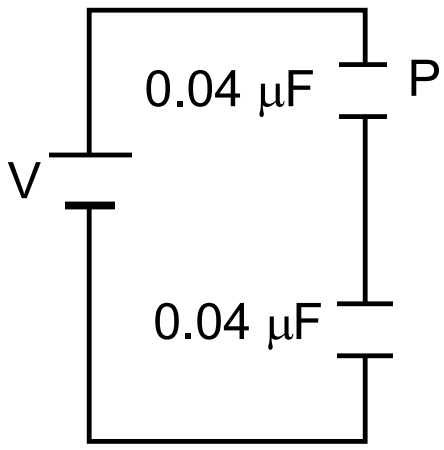
The particle $P$ shown in figure has a mass of $10\ mg$ and a charge of $-0.01\mu\text{C}.$ Each plate has a surface area $100\ cm^2$ on one side. What potential difference $V$ should be applied to the combination to hold the particle $P$ in equilibrium?