Question
Obtain an expression for work done by a gas in an isothermal expansion.

Answer

For a small change in volume, work done is given by, dW = P dV We know, PV = nRT
$\therefore\text{P}=\frac{\text{nRT}}{\text{V}}$ For T = constant, $\text{dW}=\text{nRT}\frac{\text{dV}}{\text{d}}$ Net work done under isothermal condition to change the volume from $V_i$ to $V_f$ is, $\text{W}=\int\limits^{\text{V}_\text{f}}_{\text{V}_\text{i}}\text{dW}=\text{nRT}\int\limits^{\text{V}_\text{f}}_{\text{V}_\text{i}}\text{}\frac{\text{dV}}{\text{V}}$
$=\text{nRT}\Big|\log_\text{e}\text{V}\Big|^{\text{V}_\text{f}}_{\text{V}_\text{i}}$
$=\text{nRT}\log_\text{e}\Big(\frac{\text{V}_\text{f}}{\text{ V}_\text{i}}\Big)$
$\therefore\text{W}=2.3026\text{ nRT }\log_{10}\Big(\frac{\text{V}_\text{f}}{\text{V}_\text{i}}\Big)$ Where n is the number of moles. If $P_f$ and $P_i$ are the pressures, we can also write, $\text{W}=2.3026\text{ nRT }\log_{10}\Big(\frac{\text{P}_\text{i}}{\text{P}_\text{f}}\Big)$

Need a full question paper?

Generate a complete, print-ready paper with questions like this in minutes — across 16+ boards, with answer keys.
Start Generating Free

Similar questions

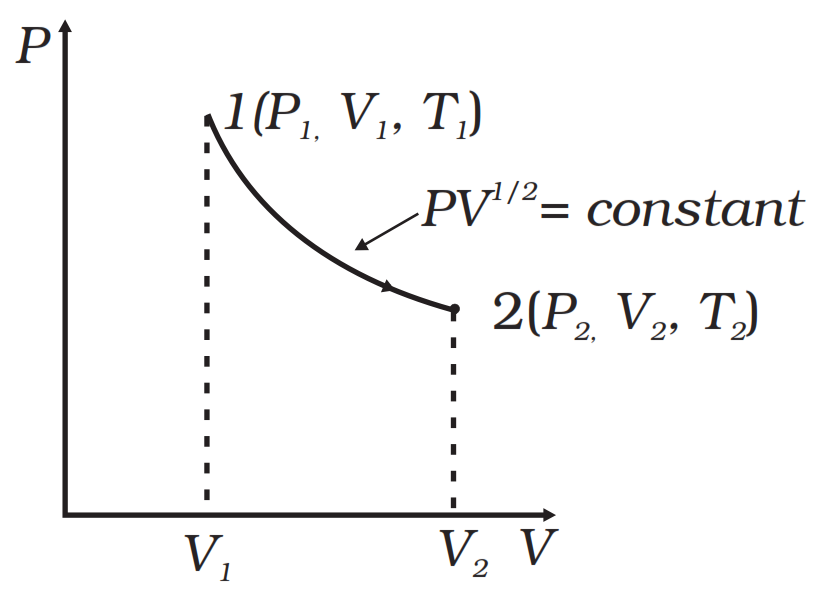
Consider a P-V diagram in which the path followed by one mole of perfect gas in a cylindrical container is shown in Fig.

Given the internal energy for one mole of gas at temperature T is (3/2) RT, find the heat supplied to the gas when it is taken from state (1) to (2) with $V_2 = 2V_{1.}$​​​​​​​
The physicists think at a level far higher than a normal individual. Explain.
Calculate the energy that can be obtained from $1 kg$ of water through the fusion reaction
${ }^2 \mathrm{H}+{ }^2 \mathrm{H} \rightarrow{ }^3 \mathrm{H}+\text { p. }$
Assume that $1.5 \times 10^{-2} \%$ of natural water is heavy water $\mathrm{D}_2 \mathrm{O}$ (by number of molecules) and all the deuterium is used for fusion.
Find the angular velocity for an object to experience weightlessness at the equator of earth. Under this condition, also find the duration of a day.
Calculate the radius of new bubble formed when two bubbles of radius $r_1$ and $r_2$ coalesce?
Calculate the speed of sound in a gas in which two waves of wavelengths 1.00m and 1.01m produce 10 beats in 3 seconds.
The mass of a spaceship is $1000kg$. It is to be launched from the earth's surface out into free space. The value of g and R (radius of earth) are $10m/ s^2$ and $6400km$, respectively. What is the required energy for this work done?
A block of mass 30.0kg is being brought down by a chain. If the block acquires a speed of 40.0cm/s in dropping down 2.00m, find the work done by the chain during the process.
Name a varying mass system. Derive an expression for velocity of propulsion of a rocket at any instant.
Establish relation between two specific heats of a gas. Which is greater and why?