Question
Obtain an inclusive continuous frequency distribution from the following data :
Lower Boundary Point or more $44.5$ $49.5$ $54.5$ $59.5$ $64.5$ $69.5$ $74.5$ $79.5$ -
Cumulative Frequency  $500$ $470$ $390$ $290$ $240$ $90$ $10$ $0$ -

Answer

Given data is ‘more than’ type cumulative frequency distribution.
$\therefore $ Class length $=$ Difference between the adjoining lower boundary points $= 54.5 – 49.5 = 5$
Now, upper boundary point of the class $=$ lower boundary point $+$ class length
For initial class lower boundary point $= 44.5$
$\therefore $ initial class is $44.5 – 49.5$.
For inclusive continuous frequency distribution lower limit of initial class $= 44.5 + 0.5 = 45$ and
upper limit of initial class $= 49.5 – 0.5 = 49.$
Thus, for given data the initial class in inclusive form, we get $45-49.$
In this manner, we will obtain the class for each lower boundary point.
We will find the frequency of each class from the given ‘more than’ cumulative frequency as follows :
Frequency of a class $= \ ($‘more than’ cumulative frequency of a class$) \ – \ ($‘more than cumulative frequency of immediate following class$)$
Frequency of class for $44.5 = ($‘more than’ cumulative frequency of a class for $44.5) \ – \ ($‘more than cumulative frequency of immediate following class for $49.5)$
$= (500 – 470) = 30$
In this manner we will obtain the frequency for the rest of classes.
For the given data, we get the inclusive continuous frequency distribution as follows :
Lower Boundrary Point or more More then cumulative frequency $CF$ class Frequency $f$
$44.5$ $500$ $45-49$ $500-470=30$
$49.5$ $470$ $50-54$ $470-390=80$
$54.5$ $390$ $55-59$ $390-290=100$
$59.5$ $290$ $60-64$ $290-240=50$
$64.5$ $240$ $65-69$ $240-90=150$
$69.5$ $90$ $70-74$ $90-10=80$
$74.5$ $10$ $75-79$ $10-0=10$
$79.5$ $0$ $80-84$ $=0$
- - Total $n=500$

Need a full question paper?

Generate a complete, print-ready paper with questions like this in minutes — across 16+ boards, with answer keys.

Start Generating Free

Similar questions

Using all the digits $2, 5, 7, 8$, four digit numbers are to be formed.
$(1)$ How many such numbers can be made ?
$(2)$ How many of them will be even numbers ?
$(3)$ How many of them will be divisible by $5 ?$
$(4)$ How many of them will be greater than $5000 ?$
The daily expense of $40$ students of a hostel is as follows.
Represent it in a suitable continuous frequency distribution.
$14.25,13.75,10.50,11.76,12.00,11.20,13.00,14.10,12.40$, $16.60,13.25,10.00,14.85,15.15,14.00,15.25,13.90,15.95$, $15.00,12.75,16.25,13.20,11.80,14.10,11.10,13.10,15.45$, $12.60,13.75,15.55,14.20,15.80,12.25 .14 .10,15.50,14.70$, $12.30,13.50,14.75,14.50 .$
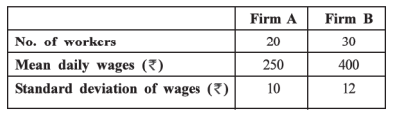
The following results are obtained on the basis of daily wages (in ?) paid to workers of two firms $A$ and $B$ :

Answer the following questions using the above information.
$1.$ Which firm is paying more total daily wages to their workers ?
$2.$ Determine which firm shows more relative variation in wages paid to its workers.
$3.$ Find the combined mean and combined standard deviation for the two firms.
The information of the salary of $200$ employees of company is given below. Find the standard deviation of the salary Of the employees :
Salary (thousand $Rs.$) Less than $10$ Less than $20$ Less than $30$ Less than $40$ Less than $50$ Less than $60$ Less than$ 70$
No. of persons $5$ $17$ $47$ $92$ $142$ $179$ $200$
The frequency distribution of units of power consumed in an hour for different machines during a production process of factory is as follows. Find coefficient of skewness by Bowley’s method.
Units of power consumed $10 – 15$ $15 – 20$ $20 – 25$ $25 – 30$ $30 – 35$ $35 – 40$
No. of machines $5$ $10$ $15$ $20$ $25$ $30$
The distribution of age of $150$ spectators in a theater is as follows :
Age (years) $15 – 20$ $20– 25$ $25-30$ $30- 40$ $40 – 50$ $50 -60$ $60 -80$
No. of spectators $6$ $13$ $19$ $52$ $34$ $18$ $8$
Find the mode for age of spectators using graphical method.
Discrete frequency distribution showing the number of children in $50$ families The data regarding the number of children of $50$ families residing in a certain area are given below. Prepare an appropriate frequency distribution.
$1, 1, 2, 1, 1, 1, 1, 2, 1, 0,$
$0, 2, 2, 0, 3, 3, 2, 1, 2, 1,$
$2, 1, 3, 1, 1, 2, 2, 2, 1, 2,$
$3, 0, 3, 0, 2, 1, 2, 3, 3, 2, 1,$
The frequency distribution of paid up share capital out of the issued share capital for $31$ manufacturing companies is as follows. Find skewness and its coefficient by Bowley s method and state the type of skewness.
Paid up share capital (lakh ₹) Less than $100$ Less than $300$ Less than $500$ Less than $700$ Less than $900$ Less than $1000$ Less than $1300$
No. of companies $0$ $6$ $16$ $19$ $23$ $27$ $31$

Image
The students of standard $11$ have collected the data about profits (in crore Rs.) of $IT$ companies.
Find Karl Pearson's coefficient of skewness from these data and interpret it.
Profit (crore₹)
$5-7$ $7-9$ $9-11$ $11-13$ $13-15$ $15-17$
No. of companies
$5$ $12$ $20$ $8$ $3$ $2$