Question
Obtain the angular magnification for the image formed at infinity for simple microscope.

Answer

Image
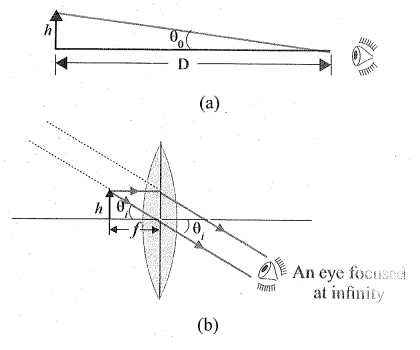
→When an object of height $h$ is placed at the near point as shown in the figure (a), the angle subtended at the eye by the object is $\theta_0$.
→from figure, $\tan \theta_0=\frac{h}{ D }$
for small angle, $\tan \theta_0 \approx \theta_0=\frac{h}{ D }......(1)$
→As shown in figure (b), if an object of height $h$ is placed at the principal focus, its image will be at an infinite distance. This time, the angle subtended at the eye by the object is $\theta_i$.
→from figure, $\tan \theta_i=\frac{h}{f}$
but for small angle, $\tan \theta_i \approx \theta_i=\frac{h}{f}......(2)$
→angular magnification of lens,
$\begin{aligned}m & =\frac{\theta_i}{\theta_0}=\frac{\frac{h}{f}}{\frac{h}{ D }}=\frac{h}{f} \times \frac{ D }{h} \\\therefore m & =\frac{ D }{f}\end{aligned}$
→This is the magnification when the image is at infinity.
→Thus, the magnification obtained with simple microscope is between $\frac{ D }{f}$ to $1+\frac{ D }{f}$.

Need a full question paper?

Generate a complete, print-ready paper with questions like this in minutes — across 16+ boards, with answer keys.
Start Generating Free

Similar questions

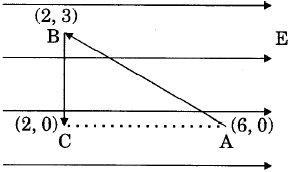
A test charge 'q' is moved without acceleration from A to C along the path from A to B and then from B to C in electric field E as shown in the figure. (i) Calculate the potential difference between A and C. (ii) At which point (of the two) is the electric potentialmore and why?
Briefly explain Geiger-Marsden experiment. Show the variation of the number of particles scattered (N) with scattering angle $(\theta)$ in this experiment. What is the main conclusion that can be inferred from this plot?
An electron is not deflected while passing through any field. Is it possible that there is no magnetic field present at that place? Explain.
A book is lifted from the floor and is kept in an almirah. One person says that the potential energy of the book is increased by 20J and the other says it is increased by 30J. Is one of them necessarily wrong?
When an electron in hydrogen atom jumps from the third excited state to the ground state, how would the de Broglie wavelength associated with the electron change? Justify your answer.
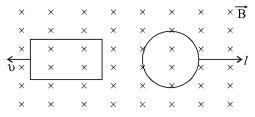
A rectangular loop and a circular loop are moving out of a uniform magnetic field with a constant velocity $v$ as shown in the figure :
Image
Magnetic field is perpendicular to the plane of loops. Explain in which loop, the magnitude of induced emf will remain constant while emerging out of magnetic field?
Write the formula for the torque acting on a current$-$carrying coil placed in uniform magnetic field and explain its stable and unstable equilibrium states.
Consider two particles A and B having equal charges and placed at some distance. The particle A is slightly displaced towards B. Does the force on B increase as soon as the particle A is displaced? Does the force on the particle A increase as soon as it is displaced?
Write characteristics of electro magnetic waves.
A gas of hydrogen-like ions is prepared in a particular excited state A. It emits photons having wavelength equal to the wavelength of the first line of the Lyman series together with photons of five other wavelengths. Identify the gas and find the principal quantum number of the state A.