Obtain the resonant frequency and Q-factor of a series LCR circuit with L = 3.0H, C = 27μF, and R = 7.4Ω. It is desired to improve the sharpness of the resonance of the circuit by reducing its ‘full width at half maximum’ by a factor of 2. Suggest a suitable way.
Exercise
Download our app for free and get started
Inductance, $L = 3.0H$
Capacitance, $C = 27\mu F = 27 \times 10^{-6}F$
Resistance, $\text{R}=7.4\Omega$
At resonance, angular frequency of the source for the given LCR series circuit is given as:
$\omega_{\text{r}}=\frac{1}{\sqrt{\text{LC}}}$
$=\frac{1}{\sqrt{3\times27\times10^{-6}}}=\frac{10^3}{9}=111.11\text{rad }\text{s}^{-1}$
Q-factor of the series:
$\text{Q}=\frac{\omega_{\text{r}}\text{L}}{\text{R}}$
$=\frac{111.11\times3}{7.4}=45.0446$
To improve the sharpness of the resonance by reducing its 'full width at half maximum'
by a factor of 2 without changing $\omega_{\text{r}},$ we need to reduce R to half i.e.,
$\text{Resistance}=\frac{\text{R}}{2}=\frac{7.4}{2}=3.7\Omega.$
Capacitance, $C = 27\mu F = 27 \times 10^{-6}F$
Resistance, $\text{R}=7.4\Omega$
At resonance, angular frequency of the source for the given LCR series circuit is given as:
$\omega_{\text{r}}=\frac{1}{\sqrt{\text{LC}}}$
$=\frac{1}{\sqrt{3\times27\times10^{-6}}}=\frac{10^3}{9}=111.11\text{rad }\text{s}^{-1}$
Q-factor of the series:
$\text{Q}=\frac{\omega_{\text{r}}\text{L}}{\text{R}}$
$=\frac{111.11\times3}{7.4}=45.0446$
To improve the sharpness of the resonance by reducing its 'full width at half maximum'
by a factor of 2 without changing $\omega_{\text{r}},$ we need to reduce R to half i.e.,
$\text{Resistance}=\frac{\text{R}}{2}=\frac{7.4}{2}=3.7\Omega.$

Download our appand get started for free
Experience the future of education. Simply download our apps or reach out to us for more information. Let's shape the future of learning together!No signup needed.*
Similar Questions
- 1View SolutionPlot a graph showing the variation of binding energy per nucleon as a function of mass number. Which property of nuclear force explains the approximate constancy of binding energy in the range 30 < A < 170? How does one explain the release of energy in both the processes of nuclear fission and fusion from the graph?
- 2View SolutionConsider the situation of the previous problem. Find the average electric field energy stored in the capacitor and the average magnetic field energy stored in the coil.
- 3Use Bohr's postulates hydrogen atom to deduce the expression for the kinetic energy (K.E.) of the electron revolving in the $\mathrm{n}^{\text {th }}$ orbit and show that, K.E. $\frac{\mathrm{e}^2}{8 \pi \varepsilon_0 e_n}$, where $r_n$ is the radius of the $n^{\text {th }}$ orbit. How is the orbit. How is the potential energy in the orbit related to the orbital radius orbit related to the orbital radius $r_n$ ?View Solution
- 4A sinusoidal voltage of peak value $283 V$ and frequency $50 Hz$ is applied to a series $L C R$ circuit in which $R =3 \Omega, L=25.48 mH$, and $C =796 \mu F$. Find (a) the impedance of the circuit; (b) the phase difference between the voltage across the source and the current; (c) the power dissipated in the circuit; and (d) the power factor.View Solution
- 5Two harmonic waves of monochromatic light$\text{y}_{1} = \text{a} \cos\omega\text{t}\text{ and } \text{y}_{2} = \text{a} \cos(\omega\text{t} + \Phi)$View Solution
are superimposed on each other. Show that maximum intensity in interference pattern is four times the intensity due to each slit. Hence write the conditions for constructive and destructive interference in terms of the phase angle$\Phi$. - 6View Solution
- Distinguish between a conductor and a semi conductor on the basis of energy band diagram.
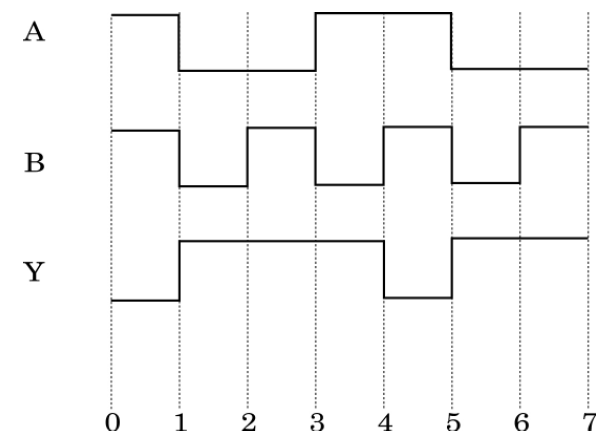
- The following figure shows the input waveforms (A, B) and the output waveform (Y) of a gate. Identify the gate, write its truth table and draw its logic symbol.
- 7View SolutionA series LCR circuit with R = 20Ω, L = 1.5H and C = 35μF is connected to a variable-frequency 200V ac supply. When the frequency of the supply equals the natural frequency of the circuit, what is the average power transferred to the circuit in one complete cycle?
- 8View Solution
- Draw a schematic ray diagram of a compound microscope when image is formed at distance of distinct vision.
- Write the expression for resolving power of a compound microscope. How can the resolving power of a microscope be increased?
- 9The instantaneous current in an ac circuit is $\text{i}=0.5\sin314\text{t},$ what is (i) rms value and (ii) frequency of the current.View Solution
- 10In the given circuit, the value of resistance effect of the coil L is exactly equal to the resistance R. Bulbs $B_1$ and $B_2$ are exactly identical. Answer the following questions based on above information:View Solution
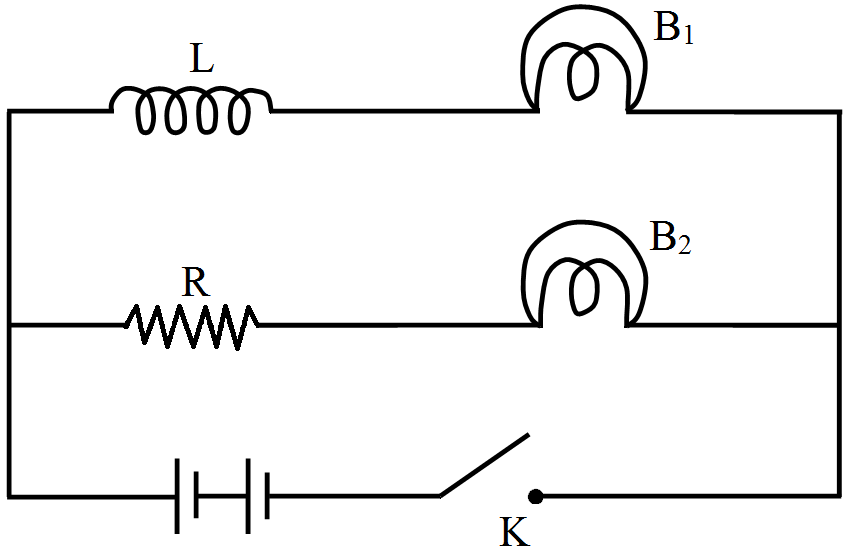
- Which one of the two bulbs lights up earlier, when key K is closed and why?
- What will be the comparative brightness of the two bulbs after sometime if the key K is kept closed and why?