Of the following the one which emits sound of higher pitch is
Easy
Download our app for free and get started
(a)Pitch of mosquito is higher among all given options.

Download our appand get started for free
Experience the future of education. Simply download our apps or reach out to us for more information. Let's shape the future of learning together!No signup needed.*
Similar Questions
- 1View SolutionSound waves in air are
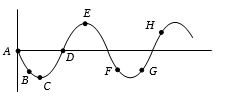
- 2View SolutionThe diagram below shows the propagation of a wave. Which points are in same phase
- 3The vibration of a string fixed at both ends are described by $Y= 2 \,\,sin(\pi x) \,\,sin\,\,(100\pi t)$ where $Y$ is in $mm$,$x$ is in $cm$,$t$ in $sec$ thenView Solution
- 4A source producing sound of frequency $170 Hz$ is approaching a stationary observer with a velocity $17 \,ms^{-1}$. The apparent change in the wavelength of sound heard by the observer is (speed of sound in air $= 340 \,ms^{-1}$) ..... $m$View Solution
- 5Three sound waves of equal amplitudes have frequencies $(n - 1 ), n, (n + 1 ).$ They superimpose to give beats. The number of beats produced per second will beView Solution
- 6In an organ pipe whose one end is at $x = 0$, the pressure is expressed by $p = {p_0}\cos \frac{{3\pi x}}{2} \,\,sin\,\, 300\pi t$ where $x$ is in meter and $t$ in $sec$. The organ pipe can beView Solution
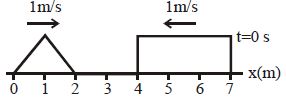
- 7Two pulses on a string approach each other at speeds of $1 m/s$. What is the shape of the string at $t = 3s$ :-View Solution
- 8When a sound wave of frequency $300 Hz$ passes through a medium the maximum displacement of a particle of the medium is $0.1 cm$. The maximum velocity of the particle is equal toView Solution
- 9Following statements are given for a stationary waveView Solution
$(a)$ Every particle has a fixed amplitude which is different from the amplitude of its nearest particle.
$(b)$ All the particles cross their mean position at the same time.
$(c)$ All the particles are oscillating with same amplitude.
$(d)$ There is no net transfer of energy across any plane.
$(e)$ There are some particles which are always at rest.
Which of the following is correct
- 10View SolutionWhen a wave travelling in medium is reflected from the boundary of a denser medium, which of the following will not change?