Of the two bulbs in a house hold circuit, one glows brighter than the other, Which of the two bulbs has a large resistance?
Easy


Download our appand get started for free
Experience the future of education. Simply download our apps or reach out to us for more information. Let's shape the future of learning together!No signup needed.*
Similar Questions
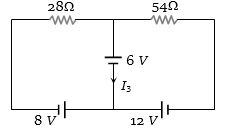
- 1Consider the circuit shown in the figure. The current ${I_3}$ is equal toView Solution
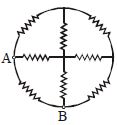
- 2Eight resistances each of resistance $5\,\Omega $ are connected in the circuit as shown in figure. The equivalent resistance between $A$ and $B$ isView Solution
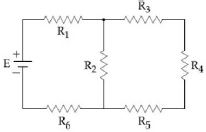
- 3In the figure shown, what is the current (in Ampere) drawn from the battery ? You are given $R_1 = 15\,\Omega $$,R _2 = 10\,\Omega ,$$ R_3 = 20\,\Omega ,$$ R_4 = 5\,\Omega ,$$R_5 = 25\,\Omega ,$$R_6 = 30\,\Omega , $$E = 15\,V$View Solution
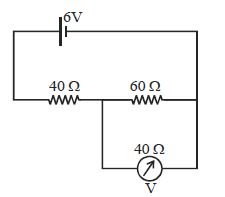
- 4The reading of voltmeter in the circuit shown is ............. $V$View Solution
- 5View SolutionWhich of the following will NOT be observed when a multimeter (operating in resistance measuring mode) probes connected across a component, are just reversed?
- 6Which of the following wiring diagrams could be used to experimentally determine $R$ using ohm's law? Assume an ideal voltmeter and an ideal ammeter.View Solution
- 7A student measures the terminal potential difference $(V)$ of a cell $($ of $emf \;\varepsilon $ and internal resistance $r)$ as a function of the current $(I)$ flowing through it. The slope, and intercept, of the graph between $V$ and $I$, then, respectively, equalView Solution
- 8If the length of the filament of a heater is reduced by $10\%$, the power of the heater willView Solution
- 9The resistivity of iron is$1 \times {10^{ - 7}}\,ohm - m$. The resistance of a iron wire of particular length and thickness is $1\, ohm$. If the length and the diameter of wire both are doubled, then the resistivity in $ohm - m$ will beView Solution
- 10A wire of resistance $20 \Omega$ is divided into $10$ equal parts. A combination of two parts are connected in parallel and so on. Now resulting pairs of parallel combination are connected in series. The equivalent resistance of final combination is_______.0$\Omega$.View Solution